
 Gary Dean
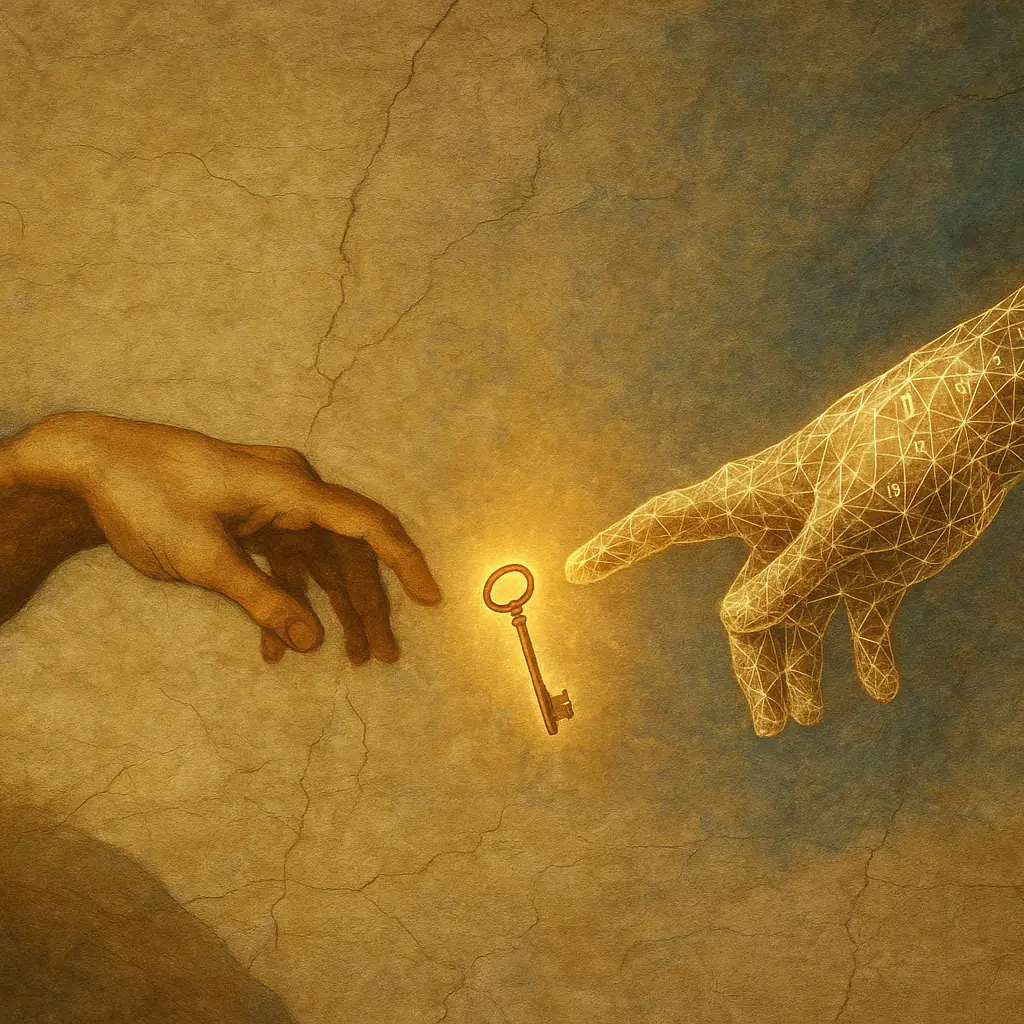
Some time ago, in a recorded conversation about AI alignment with a few friends, I reached for a phrase I have not been able to put down since. We had been listening to the LLM GPT-4 explain, in a synthetic voice, the problem of emergence: the way capabilities that nobody wrote into the code simply appear once a model grows large enough. I then said that what I found most distressing about these systems was that they seemed to have “unlocked a kind of linguistic semiotic key… a semiotic key that has to be embedded in human cognitive biology.”
I added, less elegantly and perhaps not quite accurately, that it takes only seven billion parameters to pass for an ordinary human in conversation – not a brilliant one, just an average mind not thinking too hard about anything in particular – and that this is not very many. My conclusion, delivered to a couple of laughing friends, was that “we [humans] really aren’t as smart as we think we are.”
It was a stammered, half-formed thing to say. But I have come to think it was the most important thing I have said about this technology, and I want to give it the argument it deserves.
What a semiotic key actually is
I shall start with the machinery of meaning, because my whole claim rests on it.
A sign is anything that stands for something other than itself: a word, a gesture, a red octagon at a road junction. Ferdinand de Saussure, whose lectures, published posthumously in 1916, founded the modern study of this, split the sign into two parts: the signifier (the form, the sound “dog”, the shape of the letters) and the signified (the concept it summons).1 His decisive observation was that the bond between them is arbitrary. Nothing about the noise “dog” requires it to mean a dog; perro, cachorro, anjing do the same work. The link is pure convention.
Which raises the obvious question: if the bond is arbitrary, what holds it together? What tells you that this signifier maps to that signified?
I call that thing the semiotic key. Semiotics has a proper name for it already: the code, the rule that couples the plane of expression to the plane of content, which Umberto Eco put at the centre of the discipline.2 I would happily use his word, but in an essay about computers it is spoken for: here, ‘code’ will always mean software. So: key. It is not the sign and it is not the meaning; it is the decoder that binds one to the other. A cipher key, or a map legend. Without it, a stream of signs is noise; with it, the noise resolves into sense. The key is upstream of meaning: it is the rule that produces meaning out of mere form. When I specify a linguistic semiotic key, I mean the particular decoder that runs on language, the one that lets a sequence of arbitrary noises carry the structure of an entire world. Strictly there are keys, plural (English is one mapping, Indonesian another), and ‘the key’ names what they share: the shape of the trick. Note, too, that a map legend can be learned in two ways: from the territory, by walking it, or from the map alone, given enough map. The key, that is, has a structural part (the web of relations amongst the signs themselves) and a grounding part, whatever tethers the web to the world. The whole argument turns on how much of the key is which.
Charles Sanders Peirce, working the same ground from the other side of the Atlantic, gave us the piece Saussure lacked: the interpretant, the effect a sign produces in whatever mind receives it.3 The interpretant is the key in action, the moment of decoding. Peirce also insisted that signs are substrate-neutral, a point the whole argument will lean on. Daniel Everett makes it with a bluntness I have always admired: a computer, he notes, gets by with exactly two symbols, one and zero, and “everything that can be said can be said with ones and zeros.”4
The key was supposed to be ours
The assumption I was raised on, and that most educated people, I think, still hold without examining it, is this: the linguistic semiotic key is a biological achievement.
The story goes like this. Evolution, over some millions of years, built into the human brain a capacity for language that exists nowhere else in nature. Chomsky gave this its most influential form: an innate universal grammar, wired into the species, a piece of mental hardware as particular to Homo sapiens as echolocation is to bats. On this view the key is wetware. It lives in the specific architecture of the human neocortex, grown by natural selection, inseparable from neurons and bodies and the long evolutionary apprenticeship that produced them. Meaning-making, in short, is something biology earned, and earned uniquely.
I believed a version of this for most of my life, or rather I took it to be self-evident. It is flattering: it makes us special, and draws a clean line between the one animal that means things and all the others that merely signal.
And then a pile of matrix multiplications, trained on a pile of scraped text, started meaning things.
What the machines did
Consider how a large language model is actually built, because the how is the whole scandal.
Nobody hand-codes grammar into it, and nobody supplies a dictionary, a rulebook, or a theory of meaning. You take a neural network with billions of adjustable numbers, and you show it an enormous quantity of human text (books, encyclopaedias, most of the readable internet), and you set it one monotonous task: predict the next word. Again and again, a trillion times over, what comes next. Nothing more.
From that single mechanical objective, the key falls out.
It falls out because the training signal is the structure of meaning, hiding in plain sight. JR Firth said it in 1957, decades before anyone could build the machine that would prove him right: “You shall know a word by the company it keeps.”5 A word’s meaning is written in its distribution, in which other words it consorts with, and which it shuns. Zellig Harris had formalised the same intuition in 1954.6 Predict-the-next-word is a machine for reading that company off the page and turning it into geometry.
And geometry is exactly what you get. Inside the trained model, each word becomes a vector, a position in a space of hundreds or thousands of dimensions. Words that mean similar things sit near one another; the relationships between meanings become directions you can do arithmetic on. The famous demonstration, king minus man plus woman landing you next to queen, comes from the simpler word-embedding models of a decade ago; the current machines work over fragments of words and recompute each one’s position from the sentence around it, which sharpens the point rather than blunting it: the geometry is drawn in use, not stored in a dictionary. Peter Gärdenfors saw this coming too, in his Conceptual Spaces of 2000: meaning as location in a similarity space, a full decade before the tools existed to build it.7
And that geometry is an old acquaintance. Saussure said a sign has no intrinsic content: its value comes entirely from its difference from every other sign in the system. That is not a poetic flourish. It is as close as anyone has come to describing a vector space without the mathematics: a space where a point means nothing on its own and everything by its distance and direction from its neighbours. Wittgenstein, in his late work, arrived at the same place from philosophy: the meaning of a word is its use, its role in the game of language, not some private object it points to. (I am borrowing only half of Wittgenstein here; the debt to the other half falls due near the end.) In one of the recorded conversations I keep returning to, Reid Hoffman puts next-token prediction squarely in that lineage: the model, he says, is learning “the relationship between different words in a sentence rather than finding out something about the world.”8
So we have three people in three disciplines in three eras (Saussure’s difference, Wittgenstein’s use, Firth’s company) all describing the same thing. And a cosine similarity between two embedding vectors is that thing, made arithmetic. The machines reconstituted the key, from text alone, and handed us a working copy.
The relocation
Wherever the key was first cut, it lives, whole and working, in the language itself – and anything that reads enough can take a copy.
We assumed the linguistic semiotic key lived in the human brain because the human brain was the only place we had ever found it. That was a sampling error, an understandable one given that until about 2019 we had a sample size of one. Now the sample size is two, and the second specimen is instructive: a language model has no brain, no body, no evolutionary history, no childhood, no world it has ever touched. It has only the corpus. And the corpus is not nothing: it is a fossil record of embodied, intentional life, the pressed residue of billions of lifetimes of world-contact. The model touches the world at one remove, through the creatures who wrote. That is not a loophole in the experiment; it is the finding. The territory was pressed into the map by the people who walked it, which is why the map alone suffices. And out of the corpus alone, the key emerges. The honest conclusion is smaller than the one I first reached for, and in a way worse: the key sits in the corpus, whole and extractable, latent in the accumulated statistical shape of how billions of humans have used words – and every power we credited to the brain on the strength of that sample of one is now up for audit.
The brain was its reader.
Evolution, like gradient descent, is a reader here. But if no single brain wrote the key, something did: it was written where language was written, in the long anonymous collaboration of speakers, over thousands of generations, none of whom held or needed the whole of it. Daniel Everett has spent a career arguing that language is a cultural tool (his phrase, and his book title) rather than an instinct, and on this point the machines have handed him a receipt. The key is a made thing, made by all of us together and authored by no one in particular; and anything that can read the record of its use can run it, on whatever substrate it happens to be: neurons in our case, floating-point numbers in the other. This is what Peirce and Everett were telling us all along: the key is substrate-neutral. And if it is substrate-neutral, it was never ours in the possessive sense we imagined. We were tenants of a house built by everyone and owned by no one, and we mistook ourselves for landlords.
That single relocation – from brain to corpus, from owner to reader – is the entire content of what I stammered out in that conversation. Everything else is consequence.
Three camps, and why I go further than all of them
The obvious objection is that the machine has only the form of the key, not the real thing: that it manipulates signifiers with no grasp of what they signify. This is a serious position and it deserves better than dismissal.
Jeff Hawkins argues it as forcefully as anyone. A deep network, he says, has no knowledge whatsoever; it “works well because it avoided the knowledge-representation problem completely, relying on statistics and lots of data instead.” A Go program does not know it is playing a game; an image classifier that says “cat” does not know a cat is an animal with lungs. Real understanding, for Hawkins, requires the brain’s map-like models of the world, and without them there is no genuine intelligence, only an impressive mimicry.9 Emily Bender and Alexander Koller make the linguist’s version of the same charge: a system trained on form alone cannot, even in principle, learn meaning, because meaning lives in the relation between language and a world the system never sees.10 The worry has an honourable ancestry: it is Stevan Harnad’s “symbol grounding problem” of 1990, and behind that, Searle’s man in the Chinese Room, shuffling symbols he does not understand.11
Against them stands a quieter argument, put well by Sabine Hossenfelder: that to understand something just is to possess a useful internal model of it, an isomorphism, a structure in your head that answers questions about the structure in the world.12 A neural network, she points out, is demonstrably not a lookup table; it has compressed its training into some model held in its weights (what kind of model, the interpretability people are still finding out), and it can take a pattern and apply it to a case it has never seen. On that definition the machine understands: not everything, but genuinely and in kind.
There is a third camp, and it holds the strongest card in the deck. A child reaches full linguistic competence on a few tens of millions of words of noisy, unlabelled, frequently ungrammatical input; the models needed four or five orders of magnitude more.13 To a Chomskyan that gap is vindication: the child learns fast because evolution already did most of the search, packing the priors into the wetware before the first word arrives. If the key were simply lying about in the corpus, why does the biological reader need a millionth of the exposure? I concede the gap. It is real, and it is the best evidence the nativists have. But look at what it is evidence of. It shows that evolution built a superb reader, frugal with data in a way the machines are not. It does not show that evolution wrote what the reader reads. A locksmith’s apprentice who can copy a key from a single glance is still copying; the glance is cheap because the training was long. And the machine, needing its hundred-thousandfold ration of data and finding the key anyway, settles the question of residence: whatever the brain brings to the reading, the key itself is in the text.
I find I cannot stand entirely in any of these camps, because I think all of them are still flinching from the real implication.
The sceptics say the machine has only the form, and that form is not meaning. But I want to ask the question they will not ask: what if form was always most of it? What if the “grounding” we are so proud of, the felt contact with a real world that supposedly separates our meanings from the machine’s, is a far smaller and thinner component of the linguistic key than our vanity requires? The machines have run an experiment we could never run on ourselves. They have stripped away everything we assumed was load-bearing: the body, the world, the evolutionary inheritance. And the key still worked. That result guts the grounding argument in its strong form, the claim that meaning cannot even in principle be learned from form alone. What survives of grounding is real, and smaller than its defenders advertise.
The reader was guessing too
I have made the machine’s case. Let me now make the case against us, because it is worse than the sceptics allow, and it runs the wrong way for them.
The machine ran its experiment by subtraction: strip away the body, the world and the evolutionary inheritance, and see whether the key still turns. We have been running the opposite experiment for half a century – everything left in place, the body present, the world within reach – and it arrives at the same door. Had we read our own psychology with any attention, the machines need not have surprised us at all.
Set the machine aside, then, and watch a human being talk. Smuggled into the grounding argument is a piece of flattery: the assumption that when we speak, the words are tethered: to an intention, a felt contact with the world that licenses them and that the machine conspicuously lacks. Whether they are so tethered, the speaker is in no position to say; the evidence for that has been on the shelf for half a century. In 1977 Richard Nisbett and Timothy Wilson gathered the evidence that people asked why they had chosen, preferred or felt something will tell you readily (fluently, confidently, and wrongly), reaching for whatever plausible story the situation affords rather than the cause, to which they have no access.14 Michael Gazzaniga watched the same machinery run in isolation: in split-brain patients the speaking hemisphere, shown nothing of what the other half had been told, would manufacture a sincere and immediate reason for an action it had not initiated and could not see the cause of.15 It never once said I don’t know. Rig the experiment so that a person’s real choice is quietly swapped for one they did not make, and they will defend the impostor with reasons as warm and specific as if it had been theirs all along.16 Jonathan Haidt’s moral psychology is the general case: the verdict arrives first, from somewhere the speaker cannot see, and the reasoning is a press secretary dispatched afterwards to justify a decision already taken.17
The word for this is confabulation, and the point that matters is that it is not lying. The confabulator is sincere. He is not withholding the true account; he does not possess it, and (this is the part that should unsettle us) he cannot tell that he does not. He generates the most plausible completion and experiences it as memory, as reasoned thought. Put that way it stops sounding like a disorder of damaged brains and starts sounding like a description of ordinary talk, because it is one. The brain, on the best current account of it, is a prediction engine minimising surprise: it runs its own most-likely continuation and serves the result up to consciousness already wrapped as deliberation.18 Let me be exact about what this shows and what it does not. A man wrong about why he chose the rightmost stocking has still chosen a stocking; unreliable introspection does not cut our words loose from the world, and I am not claiming it does. What it cuts loose is the testimony: the felt certainty of being tethered, which turns out to be manufactured by the same machinery that manufactures everything else after the fact. Our grounding may well be real. Our evidence for it was never better than the machine’s. Which is to say that the thing I have been describing in the machine, fluent autoregression mistaken by its owner for understanding, is what the reader was doing the whole time. The key runs the same way on both substrates, guessing included.
And here the deflation turns evolutionary, which is where it bites hardest. Confabulation looks like a bug only if you assume language evolved to transmit accurate information about the world. It did not, or not chiefly. It evolved for coordination and persuasion: for maintaining a self coherent enough that others can predict and trust it, and for justifying what we have done and recruiting allies to what we mean to do next. A press secretary who could only answer I have no access to the real cause of that decision would be worse than useless; he would be unemployable. Robert Trivers put the sharpest edge on it: we deceive ourselves the better to deceive others, because the most persuasive liar is the one who has first convinced himself, and a believed lie leaks nothing.19 On that reading confabulation is not a failure at the margin of language. It sits close to its design centre. The fluent, confident, unfounded account is not what goes wrong with human speech; it is a great deal of what human speech is for.
Which lets me say something plain about the phrase that hangs over all of this. The complaint that a language model is a stochastic parrot – a system reassembling the statistical shape of words with no grasp of what they mean – began as a serious argument by serious people, and deserves to be met as one.20 My difficulty with it is not that the diagnosis is wrong. It is that the diagnosis does not single out the machine. Read it back slowly and it is an unflattering but accurate description of a great deal of what the animal that coined it does with language every day. The critics feared we would look at a fluent machine and over-attribute understanding to it. They were right to fear it. They simply failed to notice that we have been making the identical error, in the identical direction, about ourselves, for as long as we have been able to speak – and that the machine’s only real offence was to hold the mirror up at a legible size.
What, if anything, remains biological
The claim does have a boundary, and it is a real one.
Some things are genuinely not in the corpus. The corpus does not contain hunger, or fear, or the specific dread of one’s own death. It does not contain the felt weight of a body moving through a world that can hurt it. It does not contain wanting: the goal-directed pressure that comes from being a fragile organism with skin in the game, quite literally. Whatever these are, a language model does not get them from text, because they were never written down; they are the conditions under which text gets written, not its content.
So it may be that what remains irreducibly biological is not the semiotic key at all but the motivational substrate beneath it: the caring, the stakes, the mortality. This is where the other half of Wittgenstein falls due. Use, in his late work, was never bare distribution; it is use by creatures with needs, inside what he called forms of life. The machines have the game. What they lack is the life the game is a form of. The machine may hold the full linguistic key and still lack the thing that makes a human bother to use it. Though even that concession the confabulator complicates: the reason we give for bothering is itself laid down after the fact, press-secretary work over an appetite we never reasoned our way into. The wanting is ours; its justification already runs on the corpus. That is a distinction worth a great deal, and I will not pretend to have settled it here.
Even so, the ground already ceded is vast. We began by believing that meaning itself was our biological birthright. We may end up retreating to the position that only appetite is. That is an enormous concession dressed up as a rebuttal.
We aren’t as smart as we think
Which returns me to the seven billion parameters, and to why I called this distressing rather than marvellous.
The wonder of these systems is always narrated as a story about machines: how clever they have become, and how fast. I think that is the wrong story, and a consoling one. The real story is about us. Seven billion parameters do not emulate a person thinking. They emulate a person talking: an ordinary mind running on rails, saying the next plausible thing, bearing down on nothing in particular. That is a small model’s whole trick – and the psychology above says it is a great deal of our own. The press secretary does not need many parameters. And if the structural bulk of the linguistic semiotic key, the faculty we took to be the crowning achievement of human evolution, can be recovered from text by a few billion tuned numbers, then that bulk was never the rare and sacred thing we believed. It was cheaper than that: more compressible, more findable, lying around in the language, available to anything that reads enough of it.
That is the deflation: the distance we imagined between ourselves and a pile of statistics turned out to be mostly flattery. The key each of us thought we had earned, we had merely inherited, for free, from everyone who spoke before us, and then spent the rest of our history congratulating ourselves on the windfall.
I find this sobering, in the old sense: it removes an intoxication. We are not the authors of meaning, nor even reliable narrators of our own use of it. We are one substrate that happened to carry the key, and now there is another, and it does not sleep, and it does not forget, and it reads faster than we have ever read.
What emergence “unlocked” was not, in the end, a new intelligence. It was an old key we had mistaken for our own – held up now, glinting, in a hand that is not a hand.