
 Gary Dean
At about half past nine on the morning of Thursday 14 January 2016 I bought a coffee at the Starbucks on the ground floor of my building. I did this every working morning. Religiously, I used to say. An hour later a man walked into that Starbucks and blew himself up.
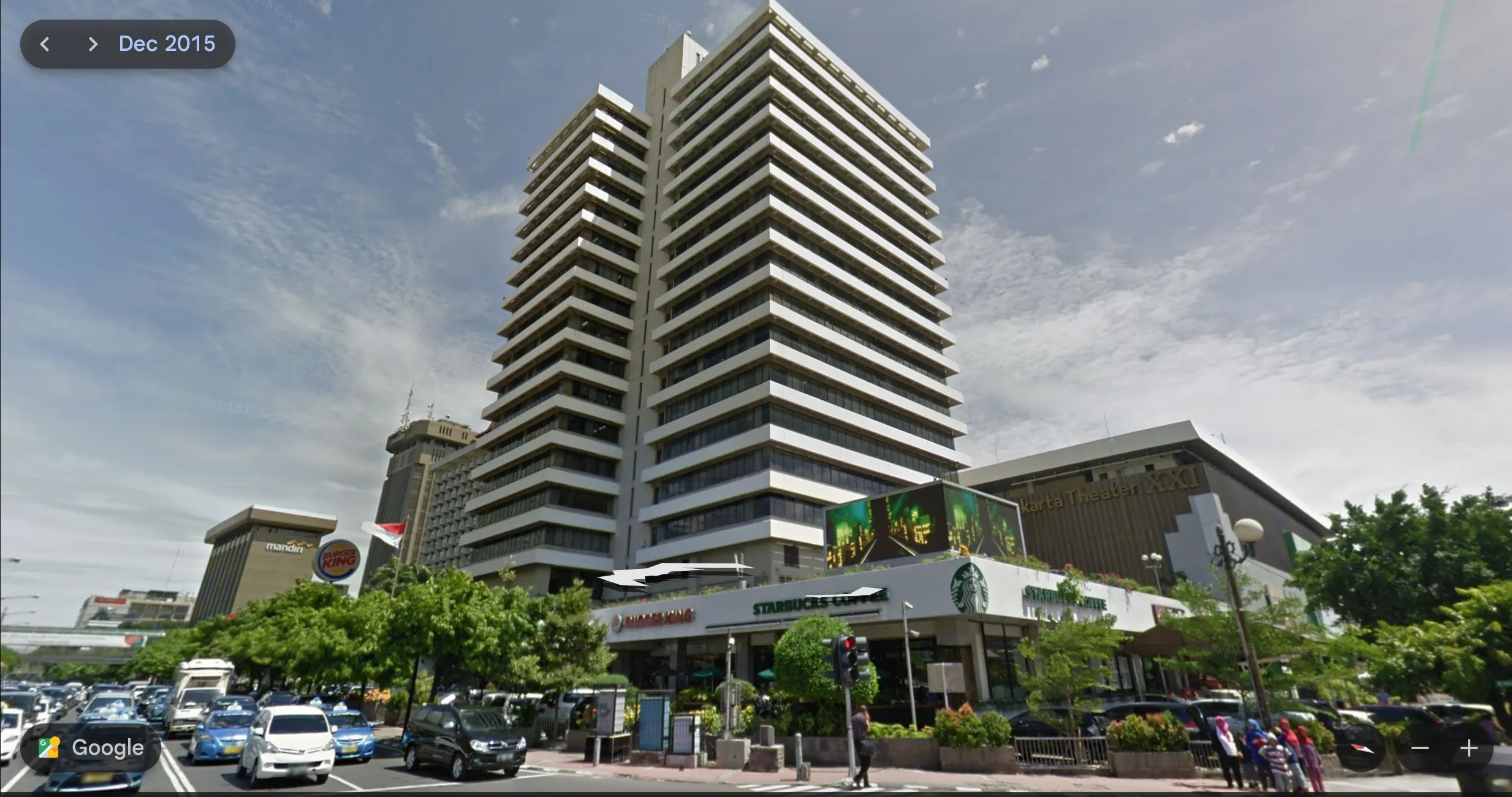
Sarinah is the old state-owned department store, the first modern one in the country, and the intersection in front of it is one of the busiest in Jakarta. Our building, Menara Cakrawala, the Skyline Building, Jalan MH Thamrin No. 9, stands directly on it. Starbucks and Burger King occupied the ground floor. Okusi occupies units 1204 and 1205, twelve storeys up, which put my office windows almost vertically above the traffic police post in the middle of the junction.
Almost everything I can now say about that day comes from records made within hours of it: photographs with their clocks running, messages to my daughter, messages to my accountant, closed-circuit video, and a stack of office email that reads, in retrospect, like a seismograph. I have spent years in the habit of not throwing anything away. Which is why I can now retell this story in minute-to-minute detail.
The morning the record preserves is entirely ordinary. Kristin, my accountant, sat at her desk from 08:43 sending out the annual personal tax reports. CENTENIAL, COMSOL, CRAMMS, CUTECH, DDC, DFASS, DULUB, DRAGON, ERA, ERKODENT, FILTER, … one client after another, more or less alphabetically, the way she did it every January. The last of them left her outbox at 10:35 and twelve seconds. In my own inbox, another batch of job applications had landed at 08:59; we were establishing a new company that month, Okusi Biotech, and I had spent a fortnight working through candidates for a product development assistant. At half past ten I was in the meeting room interviewing one of them.
Five minutes after Kristin’s last report went out, the bombs went off downstairs.
The window
I was not at the window when the first device detonated. I was at the meeting-room table, and I stayed there. The office camera caught us: the caption reads Kantor Jakarta 1, Ruang Meeting, the timestamp reads 2016-01-14 10:42:04: a job interview still in progress a minute or two after explosions in the building. About ninety seconds after that timestamp I finally got up and went to the window with my phone.
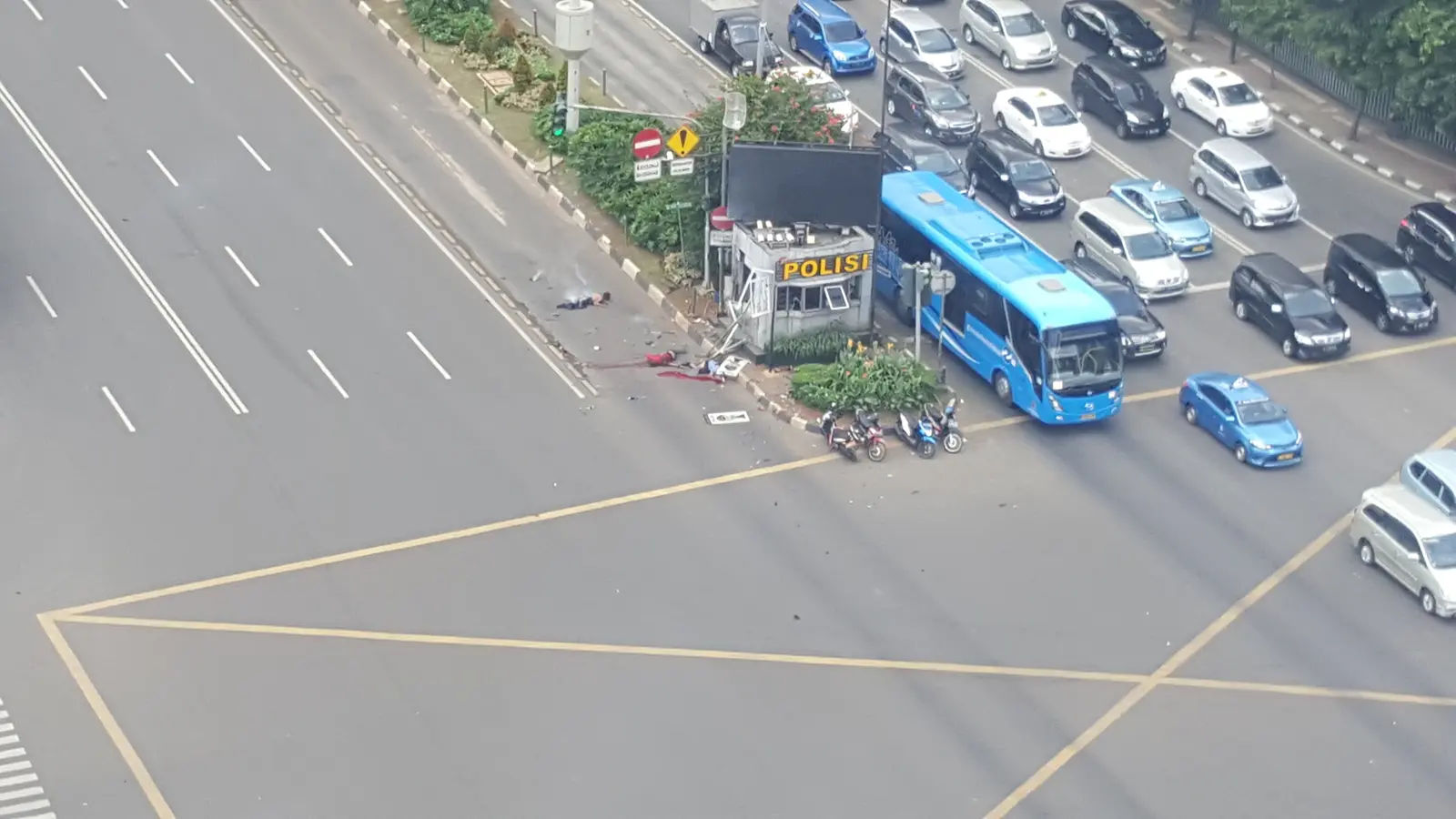
My first photograph is timestamped 10:43:35. It shows the pos polisi with its windows blown out, debris across the roadway, bodies on the ground beside it, and, the detail that still surprises me a little, traffic moving normally in the far lanes and a TransJakarta bus pulled up at the kerb. Three minutes after the explosion nobody had cordoned anything.
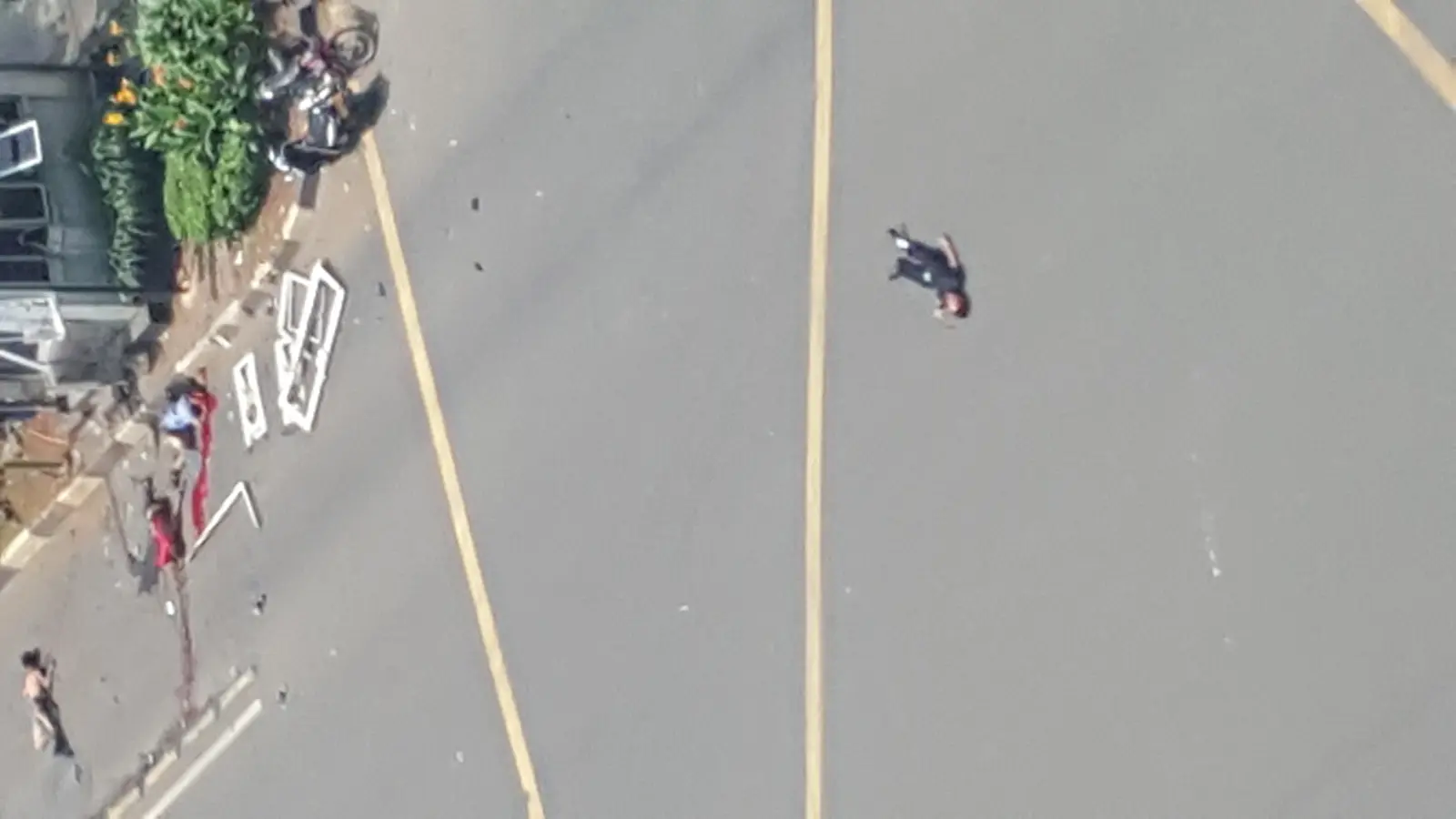
By 10:51 the intersection was empty except for the dead. There is a man lying alone in the middle of it in one of my frames. At 11:11 and 11:14 the police had massed in the junction in body armour and helmets, perhaps thirty of them, and at 11:15 I photographed straight down into the service road below my window, where two officers were taking cover behind a parked white MPV with a rifle drawn.
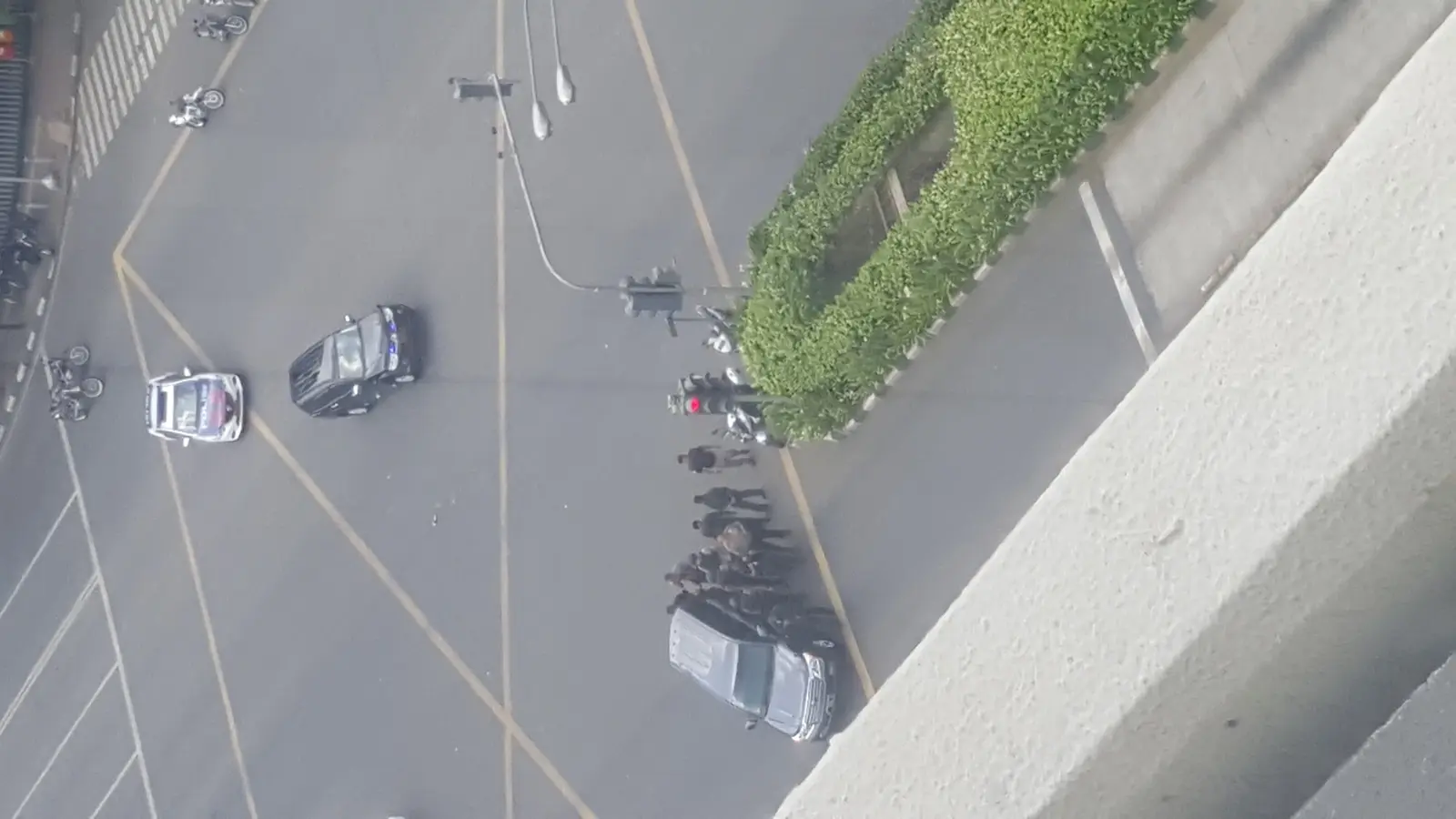
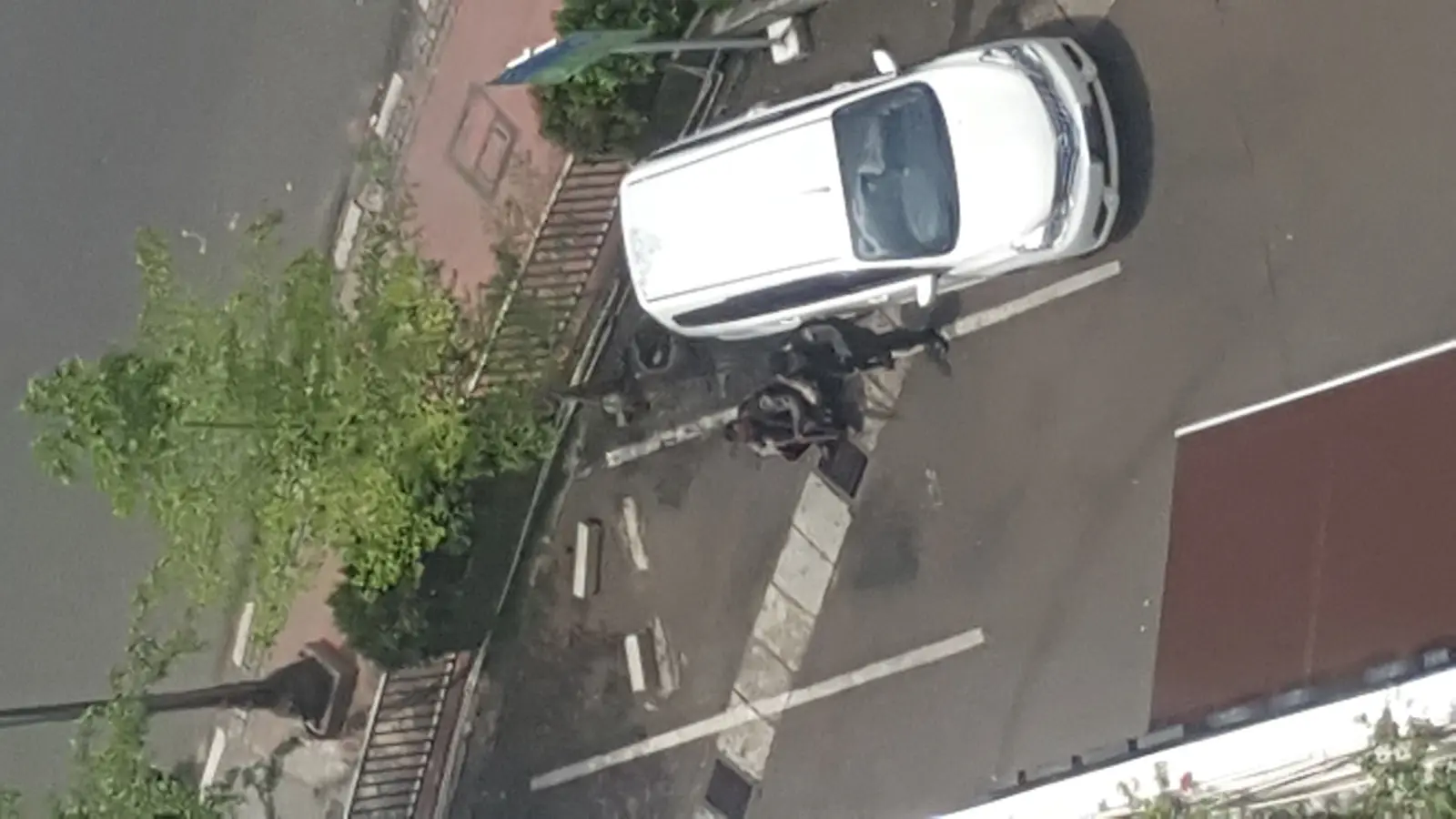
At 11:37 I sent seven of those photographs to a contact of mine at the Menteng police station. I had forgotten that entirely until I went back through the messages ten years later.
The shooting went on for well over an hour. I have read since that the whole operation ran until about half past three, which is probably right, though from the twelfth floor it was impossible to tell what was an assault and what was a nervous man firing at shadows.
I saw three men blown up. I saw one shot dead by the police. In front of the Starbucks I counted five bodies. I record my count as a count and not as a finding; the official reckoning is four attackers and four civilians dead, and I have no way of knowing which of the five I could see from that height belonged to which column. The dead do not sort themselves for the convenience of a witness on the twelfth floor.
The civilians have names, and I will use them. Taher Amer-Ouali, seventy, an Algerian-Canadian hearing-care specialist, killed in the car park area of my own building. Sugito, forty-three, a courier. Rais Karna, thirty-seven, an office boy at Bangkok Bank, who died of his wounds two days later. And Rico Hermawan, who was twenty, and who was standing at the police post that morning because he had been summoned there over a traffic ticket.
The empty floor
What I have never put in any account of that day is what I was doing while the building emptied.
I carried on with the interview.
Forty-five or so people worked in that office. Every one of them left. Somewhere in the first half hour a security guard came up and asked me to evacuate, and I declined. Somebody came and asked again, and I declined again. Three decades here breed a certain professional scepticism about panic; there was a young man sitting opposite me who had prepared for this interview; and I was, frankly, irritated. A company was being set up. I had a fortnight of applications to get through. This was interrupting my concentration.
I am aware of how that reads. The footage is above, and it is not a flattering document: two men at a large wooden table, one of them me, neither of them with his mind on the task.
It took me an hour or so to register that the two of us were the only people left on the twelfth floor (and as I was later to learn, the entire building). The candidate, I now understand, would have very much preferred to be somewhere else for the whole of it, and was too well brought up to say so. I have thought about that lad on and off ever since. I called him back for a second interview a couple of weeks later. But I gave the job to somebody else.
Perhaps an hour into the shooting a second guard came up, and this time he insisted. He was not asking. I reluctantly agreed.
Twelve floors down
The lifts had been shut down, so it was twelve floors of fire stairs, and at the bottom of them a door onto the ground floor that would not open, which meant one more flight down to the basement car park. I pushed that door open and found two young police officers aiming assault rifles at my head and demanding to know who I was.
Both of them about twenty, I would guess. Both frightened. I have thought since about what they had been told that morning: that gunmen were inside the building, and that anyone coming out of a fire door at that particular moment was unlikely to be a tenant.
I made some sort of explanation. I no longer remember a word of it.
I was taken outside, put on the back of a police motorcycle, driven at high speed to the Menteng station, questioned, and held there for two or three hours. They let me go when several of my own IT staff turned up and confirmed I was who I said I was. An hour before all this I had sent seven photographs from my office window to a contact of mine at that same station, which did nothing for me whatsoever.
The bombs went off before I looked up. The gunfight I watched from a hundred and twenty feet above it. The only moments of that day in which I was in any real danger were the two boys with rifles at the fire door, and the ride to Menteng. The latter more scary than the former.
The afternoon
Somewhere in the shuffle between the fire door and the police station, at 12:14, I asked Kristin where she was. She had made it as far as Tugu Tani, and three minutes later she typed out the list of who was walking with her — Ahmad, Wiwit, Nana, Lita and Luci — in that flat administrative way Indonesian staff have of reassuring the boss, itemising the safe.
I wrote back that I hoped none of our people had been sitting in the Starbucks, and that I had seen five bodies there.
She replied: “Mobil saya parkir depan starbuck persis.” My car is parked directly in front of the Starbucks.
The office inbox, meanwhile, was doing what office inboxes do in a disaster. The first inquiry had arrived at 11:36, while I was still upstairs and the operation was still live, from Ari Jannah of a Japanese research client: “Kami mendengar ada ledakan Bom di Sarinah yang begitu dekat dengan kantor Okusi… semoga tidak sampai ke Menara Cakrawala” — we hear there has been a bomb at Sarinah so close to the Okusi office… we hope it has not reached Menara Cakrawala. It had reached the ground floor of it. At 12:39 John Wilson wrote from Singapore: “I saw on the news that some of the gunmen after the bombing went to Skyline building. Are you guys safe in there? Did you see any of them?” Over the following days the same arrived from clients in Japan, Singapore and Australia, one hope-and-pray message after another.
At two o’clock Kristin asked where I was and I answered in two words: polisi menteng. She told me to stay put: “beberapa teroris masih kabur”, several of the terrorists are still loose — which was what the police were telling everyone that afternoon, and which turned out not to be true, though nobody could have known it then. At twenty to four she wrote that she had been watching television and it looked safe enough to go home. I took a taxi and was in the apartment by four.
Volin
My daughter Volin had arrived in Jakarta that morning, though in the noise of the day I barely registered it. Her message came at 11:21 — “Aku udah di jakarta” — forty minutes after the first bomb, from Graha Okusi, our building in Kebon Sirih, a few streets from everything I had just photographed. Walking distance.
I did not go and see her. At six o’clock in the evening I wrote to explain why:
“maaf papa tidak bisa ke graha saat ini. polisi bilang masih berbahaya untuk org bule. masih ada 1 org teroris blm ditangkap.”
Sorry, papa can’t come to Graha [Okusi] right now. The police say it’s still dangerous for white people. There’s one terrorist still not caught.
She was twelve. She sent back a crying face. I told her Rama was waiting for her too, and that he was hemmed in over at Kebon Kacang, the kampung directly behind Sarinah, which is the sort of thing you say to fill a silence.
“Terorisnya ngeseliiin”, she wrote. The terrorists are so annoying.
And then, because she is my daughter and because I have never worked out how to talk to children about anything except by telling them the truth:
“emang. papa lihat sendiri 3 orang diledakkan, juga lihat 1 orang ditempak mati oleh polisi.”
Indeed. Papa saw with his own eyes three people blown up, and saw one man shot dead by the police.
“semua ini atas nama agama ….”
All of this in the name of religion.
Sereem, she replied. Scary.
There is a reason that sentence came out of me the way it did, and it is not one I put in writing at the time except to the police. Volin had arrived in Jakarta that morning from a radical pesantren (Islamic boarding school) in Gunung Kidul, Yogyakarta, where she had been enrolled the previous year, without my agreement, and while I was occupied with my wife’s cancer. She had been away from me for months. I spent that Thursday watching men murder strangers in the street in the name of God, and in the evening I found myself explaining it by message to a twelve-year-old who had spent the year being taught by people who thought rather well of them.
I have looked at that exchange a number of times in the years since and I cannot decide whether I handled it well or badly. It is four lines long. It contains the worst thing I have ever seen, an apology for missing a visit, and a verdict on organised religion, in that order, delivered to a schoolgirl. Whatever else it is, it is honest, and it was written before I had time to arrange the day into a story.
The car
A little after half past six I asked Kristin whether she had been able to see her car yet, and said I thought there was a chance it had been hit by the bomb and the bullets.
Six minutes later she sent three photographs.
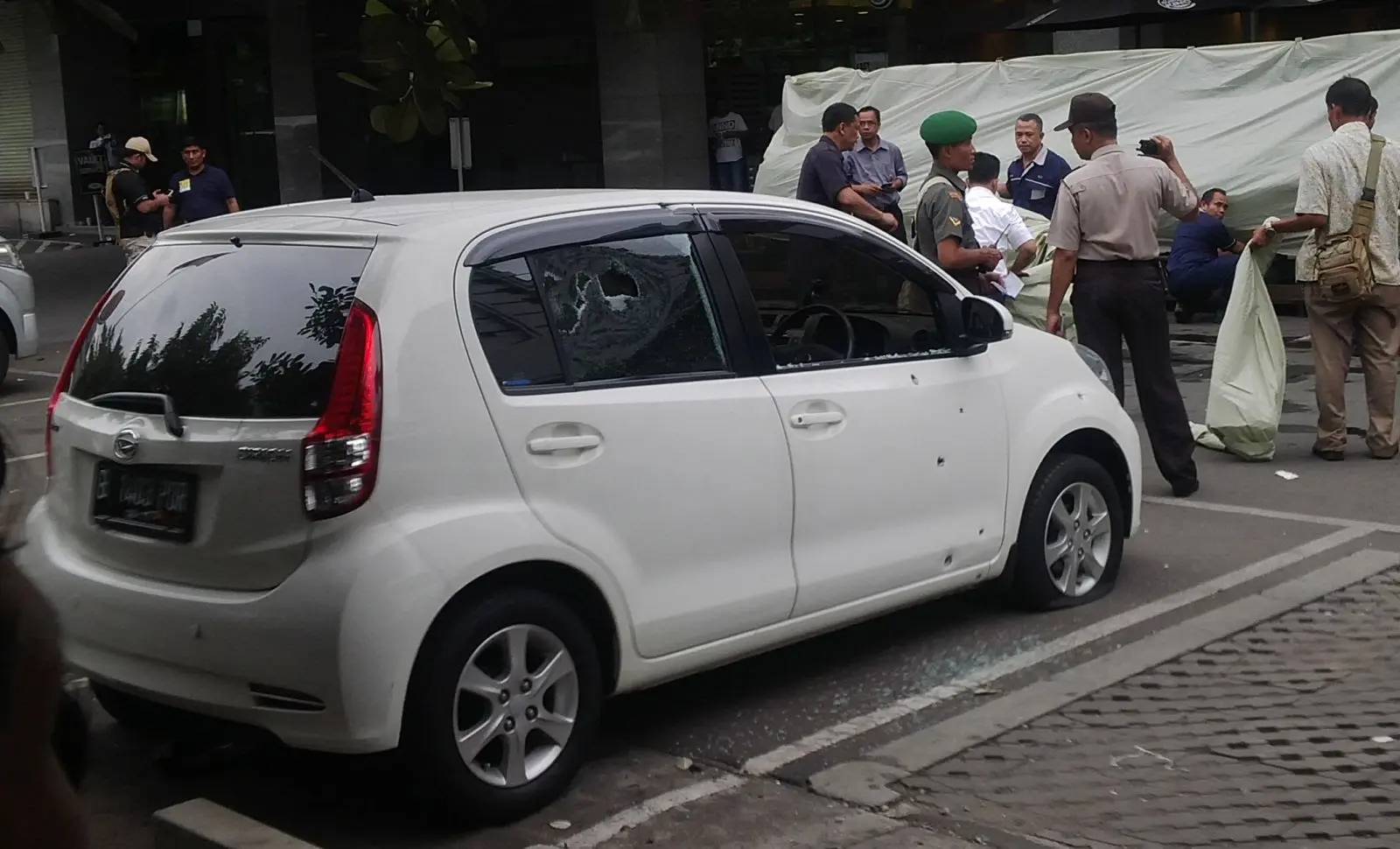
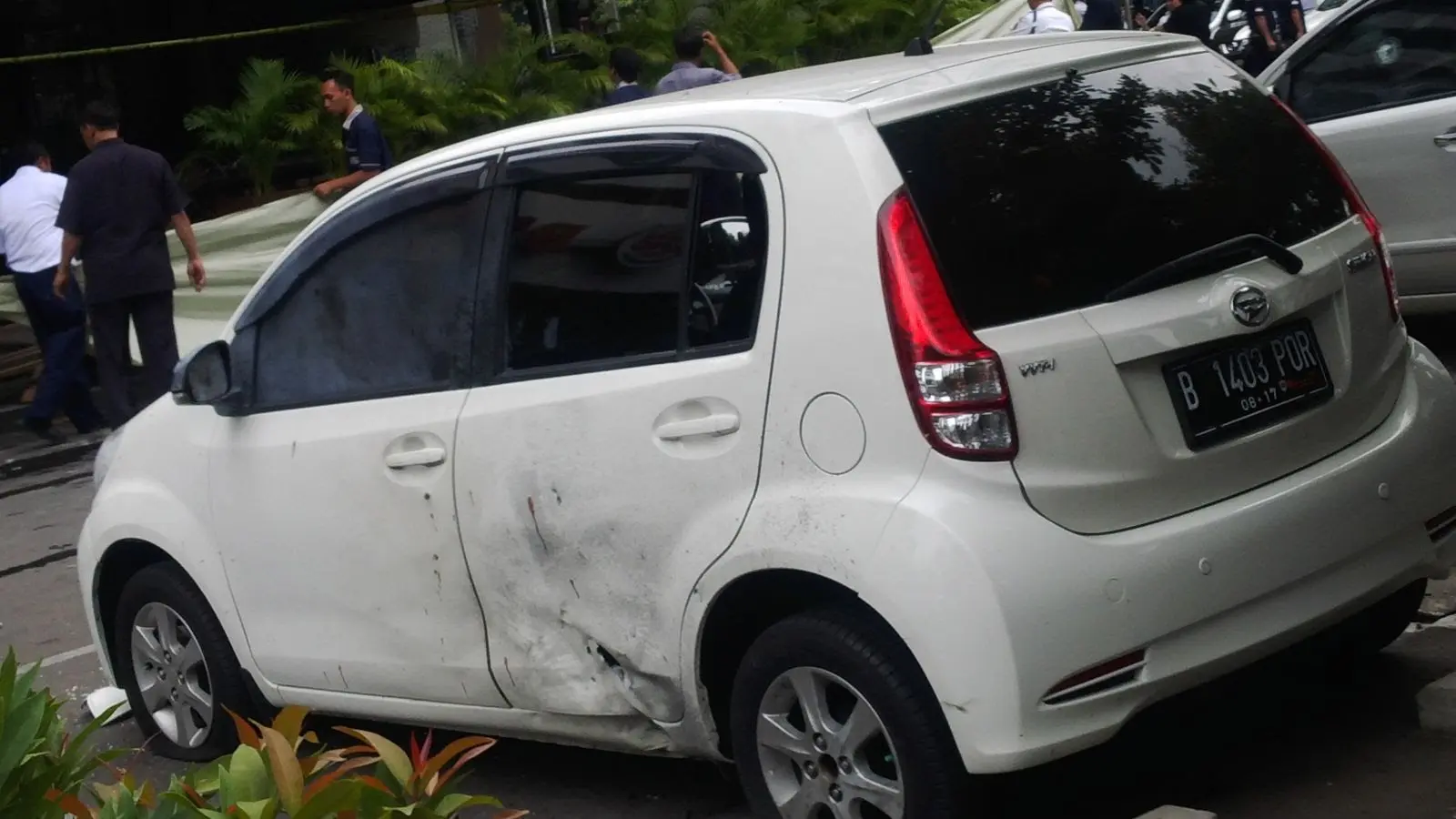
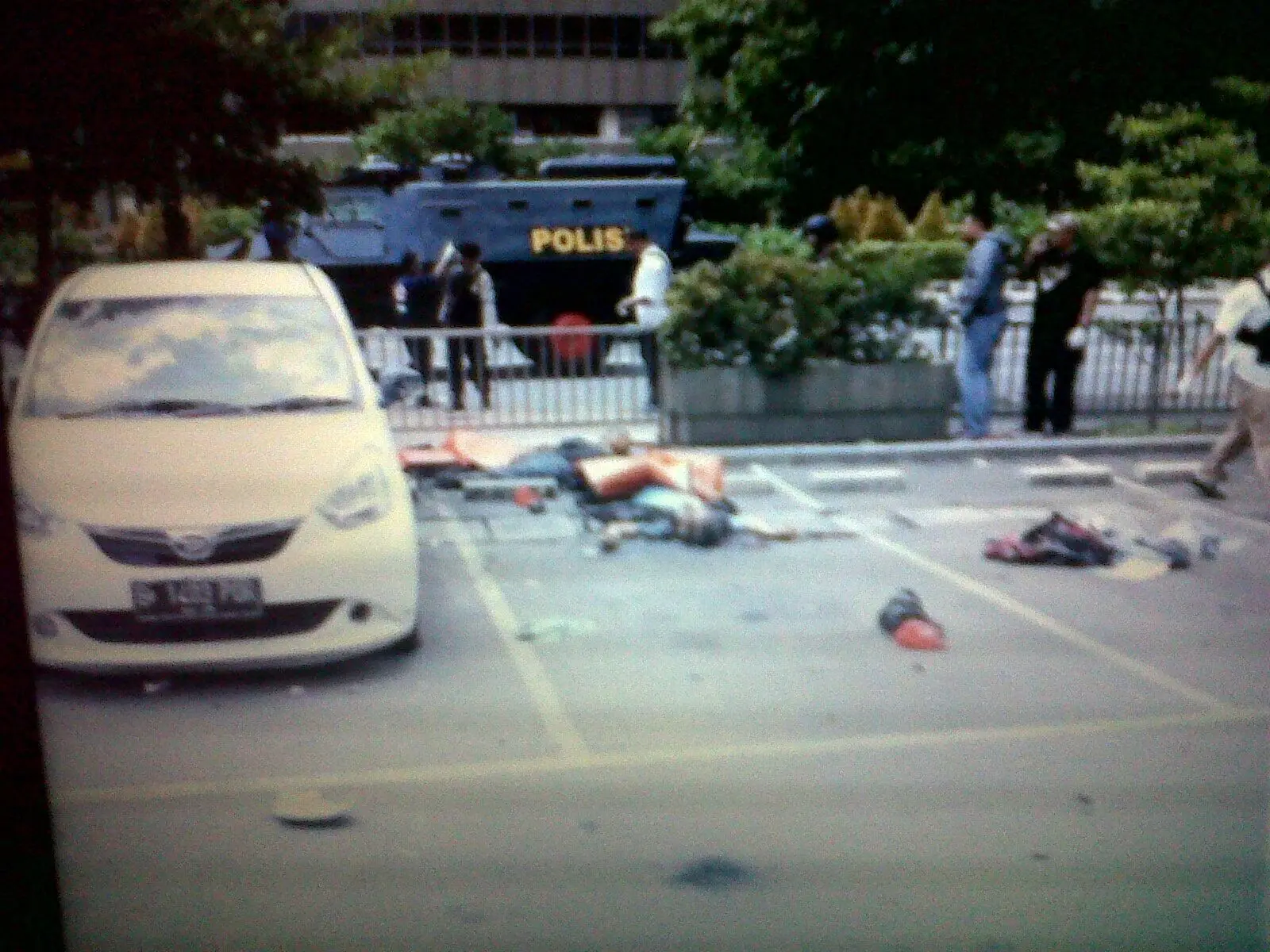
A white Daihatsu Sirion, plate B 1403 POR, still sitting in its member’s bay in front of the Starbucks, investigators standing about. In the third photograph you can see the parking bays beside the car where the last two attackers had blown themselves up, huddled together, at the end of it all.
Then she described it herself, and her sentence is better than anything I could write about it:
“Kaca pecah, ban kempes, spion pecah 1, body bolong2 bekas tembakan & sobek bekas bom bunuh diri, ada bercak darah juga.”
Glass shattered, tyres flat, one wing mirror broken, bodywork riddled with bullet holes and torn open by the suicide bomb, and there are bloodstains too.
Ada bercak darah juga. And there are bloodstains too, tacked on at the end, after the mirror, in the same tone as the broken mirror.
Thirteen minutes after reading that I asked her whether she could come in to the office the next day. I said I thought it would be good if everyone got back to normal as quickly as possible.
I would like to say that I paused before sending it. I did not. She replied that the building was closed until Monday.
The men who did it
They were four, we learned later: two who blew themselves up and two who fought it out with pistols and grenades in the open. The organisation behind them was the outfit that became Jamaah Ansharut Daulah, and the instruction, according to the police case that eventually convicted him, came from Aman Abdurrahman, who was in prison at the time and had been in and out of custody for a decade. The money apparently came from Bahrun Naim, an Indonesian who had gone to Raqqa. It was the first attack in Indonesia claimed by Islamic State, and everybody has since agreed it was amateurish – four gunmen, an entire morning, four murdered civilians, half of them at a traffic post. That is one way of putting it. Rico Hermawan’s family may put it differently.
The paperwork
Here is where it becomes an Indonesian story rather than a terrorism story.
On the Friday morning the police passed on an instruction from the President: conditions and activity were to be restored to normal immediately. The building management had the site cleaned overnight, and by that afternoon the car park was operating again. The ground floor stayed shut, with a police team stationed on it for an undetermined period, which is the phrase the circular used and which I have always liked.
On the Tuesday, Kristin wrote to the building management. The subject line reads “Permohonan Solusi atas Service Mobil Sirion B 1403 POR (Korban Bom)” — request for a solution regarding the Sirion, and then, in brackets, Bomb Victim. She marked it High importance. She set out that she was the registered owner, that she was a tenant of units 1204 and 1205 on the twelfth floor, that the car held a parking membership, and that in view of the shattered window glass and the bullet holes in the door she requested the building owner and the car park operator to arrive at the best solution regarding the damage sustained on the morning of Thursday 14 January 2016. She attached two photographs, left side and right side.
The tenant relations officer replied three days later offering a meeting on Tuesday 26 January at half past three.
Compensation from the government: none. She told a client so on the Monday, in four words and a sideways-crying emoticon. The car was repaired on her own insurance.
I am not sure people outside Indonesia will understand quite how ordinary all of this is. The state restored the traffic flow in a little over twenty-four hours.
I had been through this once before, from the other side of the desk. In July 2009 the Marriott and the Ritz-Carlton were bombed at the CEO breakfast in Mega Kuningan, and one of the men killed was a client of mine, Nathan Verity, who had first written to me in December 2007 to set up his recruitment company and whose last email to me, a month before he died, is a routine note about renewing his re-entry permit. Two days after he was killed his widow flew into Jakarta, sat down with me, and signed a letter instructing me to appoint her as director and her father-in-law as commissioner, and to raise a power of attorney so that somebody could sign the tax returns. The letter does not mention the bombing. Neither of us mentioned it in writing at any point.
Grief, in my experience of this country, arrives as paperwork. Not because the feeling is absent — I have never met anyone less sentimental or more attached than an Indonesian family in trouble — but because the paperwork is the part you can do something about. The Directorate General of Taxation does not observe a period of mourning. The building management wants to know about the parking membership. Somebody has to sign.
Meet me at the Starbucks that was bombed
The city, meanwhile, was making its own arrangements.
The day after the attack, street vendors were selling satay outside the shattered Starbucks to crowds of onlookers taking selfies. By Friday morning we were back on PMA applications, exchange rates and a client’s incorporation documents; Faria wanted the closed-circuit video from the legal and immigration section, which I had put up the night before, and I had to tell her it was too big to send over WhatsApp — a hundred megabytes. On Monday the eighteenth Kristin answered a week’s worth of anxious client mail from Japan, Singapore and Australia with a single sentence, repeated to each: Everything has been back to normal again today. On the twenty-fifth she checked in at the McDonald’s in Sarinah. Volin went to Grand Indonesia, as arranged, with her aunt.
In September I was sitting in the Starbucks, the same one, reopened, having a coffee, and I took a photograph out of the window of the rebuilt police post. I posted it that evening with a caption complaining that Jakartans seemed oblivious and not to be giving a damn, and noting that I was taking the picture from the seat where several people had been killed.
Then, on my way out, I passed a woman on her phone, arranging to meet a friend. What she said was:
“Iya, bertemu aku di Starbucks yang dibom lho.”
Yes, meet me at the Starbucks that was bombed.
She meant it literally. There are a great many Starbucks in Jakarta and only one of them has that particular distinguishing feature, so that is how you identify it when you are making arrangements for coffee. I went back and added it to my own post as a correction, because it demolished the point I had just finished making.
I had called it obliviousness. It was nothing of the kind. Within eight months an act of mass murder committed in the name of God had been filed, by the city it was committed against, under landmarks, useful, for the arranging of meetings. The hashtag that week had been #KamiTidakTakut, we are not afraid, and I remember thinking at the time that it was a bit pat, the sort of thing that trends for three days. I was wrong about that too. The refusal was actually real, and it did not take the form of defiance, but rather the form of an appointment.
Coda
Ten years on I have the whole of that Thursday in a folder: seven photographs from the twelfth floor, three of a shot-up Daihatsu, two closed-circuit videos, four days of office email, and a handful of messages to a twelve-year-old and to an accountant.
Kristin’s last tax report went out at 10:35 and twelve seconds. She sent the next one on Monday.
Just another day in paradise.