
 Gary Dean
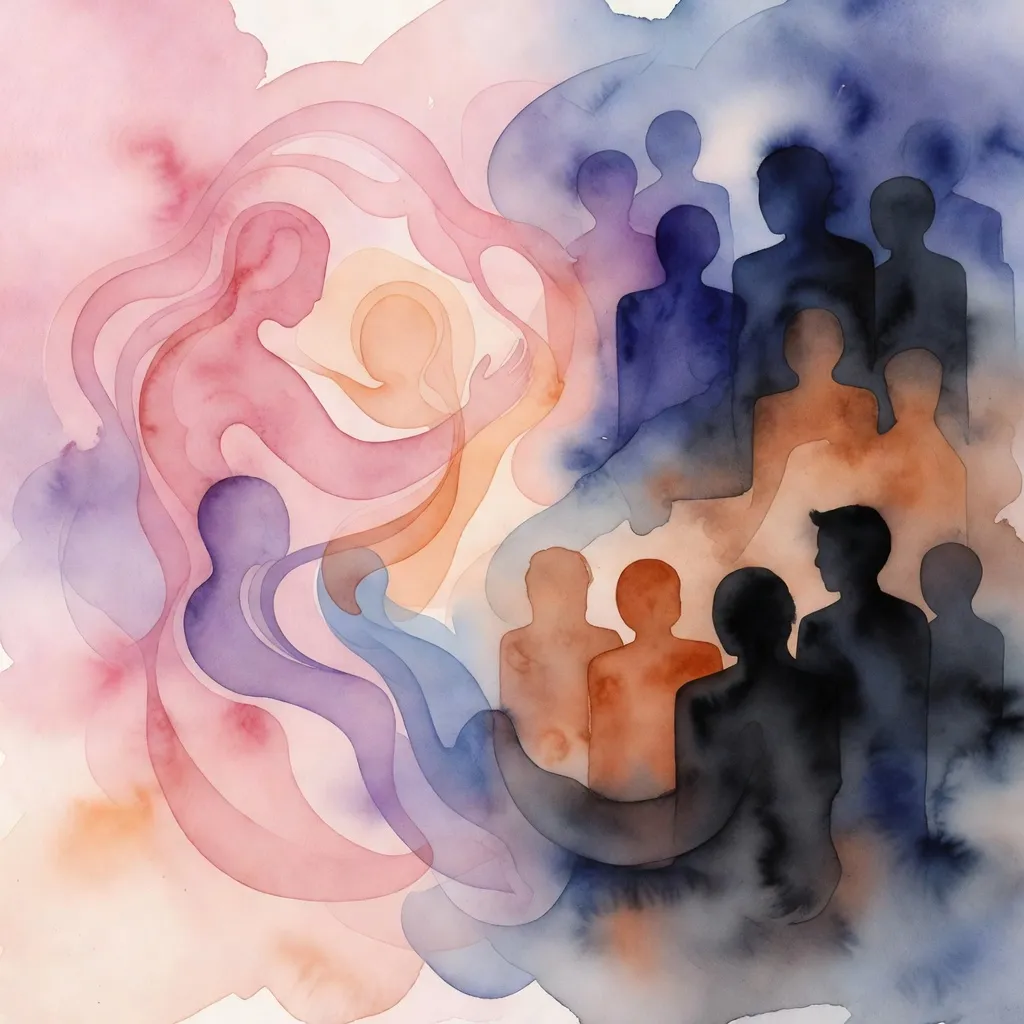
Oxytocin is sold to the public as the ‘love hormone’. That label is marketing, not mechanism, and it has done more to obstruct the study of human group behaviour than any rival error of the past two decades. A more defensible description is that oxytocin regulates social salience, attachment, and the sense of safety inside relationships that already matter to the animal carrying it. It can deepen care. It can also sharpen the line between ‘us’ and ‘them’. Which of those it does, on any given occasion, depends far less on the molecule than on context, identity, and the culture in which the animal is embedded.
What the evidence can and cannot carry
Any serious account has to begin with the limits, because in this literature the limits are the finding.
Most of the human behavioural work rests on intranasal administration: a peptide sprayed up the nose, on the assumption that it travels directly to the brain in quantities sufficient to change behaviour. Whether it does so remains unresolved. Martins and colleagues compared nasal spray, nebuliser, and intravenous delivery, and found that oxytocin’s effect on amygdala perfusion was explained entirely by the rise in the systemic circulation, with nothing left over for a direct nose-to-brain route.1 Daniel Quintana has pressed the sharper objection, and it deserves recruiting rather than answering: the assumption that intranasal delivery raises central oxytocin is so weakly evidenced that any failed replication can be blamed on the assumption rather than on the hypothesis, which conveniently protects the theory from ever being wrong.2 Peripheral measures (saliva, urine, blood) carry the mirror-image problem, since nobody has established what they index centrally either. Samples are small, effects are context-sensitive, and several headline results have not survived scrutiny.
None of this makes oxytocin irrelevant. It means claims must be ranked by the method behind them, and that the popular story has been ranked by its narrative appeal instead. A peptide that may never reach the brain, administered at doses no body has ever produced, generating international headlines about the biology of racism: the finding travelled a great deal further than the molecule did.
What survives is the broad function. Oxytocin is involved in parturition, lactation, mother–infant bonding, and, in some species, pair bonding and selective social approach. It makes particular relationships feel urgent, safe, and worth defending.
What does not survive as settled human fact is the stronger claim: that oxytocin straightforwardly produces ethnocentrism, out-group spite, or dehumanisation. Those results rest almost entirely on the narrow set of intranasal experiments run by Carsten De Dreu and his collaborators, including the much-repeated study in which Dutch subjects proved readier to push a man named Helmut or Ahmed under a tram than a man named Dirk.3 Strip out the contested method and the human evidence for parochial hostility is close to empty. Robert Sapolsky, who popularised the finding more effectively than anyone, knows this perfectly well and says so in the journals, where his treatment is careful and explicitly cautionary;4 it is on the lecture circuit that the caveats fall away and oxytocin becomes the hormone that “exaggerates the us-and-them divide”.
In-group care is better attested than out-group hate
The durable pattern is asymmetrical, and the asymmetry is the whole argument.
Oxytocin is far better supported as an amplifier of attachment and in-group concern than as a dedicated engine of hostility toward outsiders. People may become more attentive, more trusting, more generous, more protective toward mates, children, allies, and fellow members. That alone is enough to produce tribal consequences. A system that intensifies care for ‘us’ will, under competition or threat, look very much like tribalism without containing any separate module for hating ‘them’.
This is the careful meaning of parochial altruism: heightened willingness to cooperate and sacrifice for one’s own coalition, sometimes accompanied by indifference or defensive aggression toward rivals. The first half of that package has considerably better footing than the second. Differential allocation of care is not dehumanisation, and the literature slides from one to the other with a readiness that ought to embarrass it.
The largest study using naturally occurring rather than administered oxytocin makes the contingency plain. Terris and colleagues took blood samples from 399 participants, measured the change in endogenous oxytocin after a group-salience task, then watched monetary allocations to in-group and out-group targets. Participants whose oxytocin rose showed no out-group bias at all. Bias reappeared only among those whose group identification had already reached 87 per cent of its maximum.5 The hormone did not draw the boundary. It met a boundary that identity had drawn already.
Fieldwork points the same way whilst complicating it usefully. Among the Tsimané of lowland Bolivia, urinary oxytocin was measured in football players before and after matches against intra-community, inter-community, and interethnic opponents. Oxytocin rose after competition in men and not in women, and it rose most sharply for intra-community and interethnic matches alike — a pattern the authors read as sensitivity to familiar rivalries as much as to outsiders.6 Whatever that is, it is not a clean gradient running from kin outwards to strangers.
The comparative record, read carefully
Comparative evidence earns its place here precisely because it constrains the grand claims rather than supplying them.
In chimpanzees, oxytocin appears reactive around border patrols and tense encounters between communities, in a species whose ecology includes coordinated territorial defence.7 The behavioural half of that picture is solid and independently replicated: at Taï, intergroup competition makes communities measurably more cohesive and suppresses aggression amongst males within the group;8 participation in intergroup encounters tracks maternal kinship and bond strength;9 and playbacks of unfamiliar pant-hoots raise in-group tolerance in captive groups.10
Bonobos were, until recently, the tidy contrast. Cheng and colleagues found no rise in oxytocin activity with out-group presence in wild bonobos, in either sex, alongside coalitions that included out-group partners.11 The temptation is to explain this by the familiar dichotomy (the peaceful ape, the matriarchal ape), and the temptation should be resisted, because the dichotomy is collapsing. Mouginot and colleagues found male bonobos more frequently aggressive than male chimpanzees;12 Bryon and colleagues, working across twenty-two groups with Bayesian network analysis, found no species difference in overall or contact aggression once group size and sex ratio were controlled, only a difference in who targets whom, and substantial variation between groups within each species.13 Brooks and colleagues, meanwhile, found that bonobos do show moderate in-group cohesion in response to out-group cues, weaker than in chimpanzees but present.14
The sharper reading is therefore not that bonobos are gentler. It is that bonobos lack cooperative range defence — the specific behavioural system that oxytocin’s supposed ‘tend-and-defend’ function is meant to serve. Samuni and Surbeck identify precisely that absence as the trait bonobos share with Indo-Pacific bottlenose dolphins, two lineages with almost nothing else in common, both of which manage costly cooperation across group boundaries.15 Read that way, the bonobo null stops being an awkward exception and becomes a confirming result for a much narrower hypothesis.
One further result deserves more attention than it has received. Fischer and colleagues measured oxytocin directly in the paraventricular nucleus of communally breeding house mice, dispensing with delivery assumptions and peripheral proxies alike. Central oxytocin predicted egalitarian cooperation and reproductive success. It did not vary with social cues of out-group competition.16 When the measurement problem is finally removed, the in-group half of parochial altruism survives and the out-group half does not.
Evolutionary sense without evolutionary melodrama
The framing fits the likely evolutionary history without overclaiming on its behalf.
Intense bonds amongst mates, kin, and allies improved childcare, food sharing, mutual defence, and survival. The same machinery that made ‘our people’ emotionally real would also make an animal readier to defend a coalition when outsiders pressed on it. Human tribalism, on this account, is partly the shadow cast by our capacity for deep cooperation — which is a more uncomfortable proposition than the alternative, since it means the trait cannot be excised without taking the cooperation with it.
Evolution is not a moral alibi, however, and oxytocin is not destiny. Biology may supply a gain control for social belonging. It does not write the membership list.
Culture decides what the gain is applied to
Human categories of ‘us’ are extraordinarily plastic. Kin, band, faith, language, village, province, nation, profession, party, regiment, alumni, diaspora, a football club, or a shared emergency lasting six hours can each reorganise who feels like an ally. Once a classification is socially live, attachment systems make it expensive to ignore.
The practical question is therefore not how to abolish bonding, which is neither possible nor desirable. It is how to shape what belonging rewards.
Here the parallel with testosterone is instructive, and rather better evidenced than anything in the oxytocin literature. Eisenegger, Haushofer and Fehr argued that testosterone in humans is best understood as serving the pursuit and maintenance of social status rather than aggression as such;17 the supporting work has held up unusually well. In a Japanese university rugby team ordered by a rigid seniority norm, higher salivary testosterone predicted dominant play amongst senior members and strategic submission amongst junior ones, and the relationship reshaped itself as individuals rose through the hierarchy over two years.18 The hormone supplies the drive toward standing. The culture decides what standing consists of.
Apply the same logic and the conclusion follows without strain. If a group awards prestige for dominance, purity, and the humiliation of outsiders, bonding chemistry will amplify factional aggression with perfect efficiency. If a group awards prestige for hospitality, fair dealing, courage expressed as restraint, and the protection of strangers, the identical machinery will amplify a wider ethic. Call that a dharma if the word is useful: an ethical orientation in which the marks of high standing inside the group include care that does not stop at the group’s edge.
This is also why the standard policy slogans need handling with care. ‘Equal-status contact’ can reduce prejudice under favourable conditions, but contact is an intervention with a failure mode, not a lever that yields on being pulled. Negative contact generalises too, and generalises further than the encounter that produced it: Meleady and Forder found that a bad experience with one out-group reduced willingness to engage with unrelated others.19
The defensible conclusion
Strip away the hype and the overconfident experimental narration, and a sturdier claim remains. Oxytocin intensifies social attachment and the salience of relationships already valued. It is far more convincingly linked to in-group care than to any reliable circuit for out-group hatred. Tribal effects emerge where bonding systems meet identity, threat, and social structure — which is to say, where biology meets culture, on culture’s terms.
The ethical task is not to suppress the human need for an ‘us’. It is to build an ‘us’ in which status attaches to fairness, hospitality, and restraint, so that the chemistry of belonging is recruited to enlargement rather than to siege. The love hormone was never going to save us. It was never going to damn us either.