
 Gary Dean
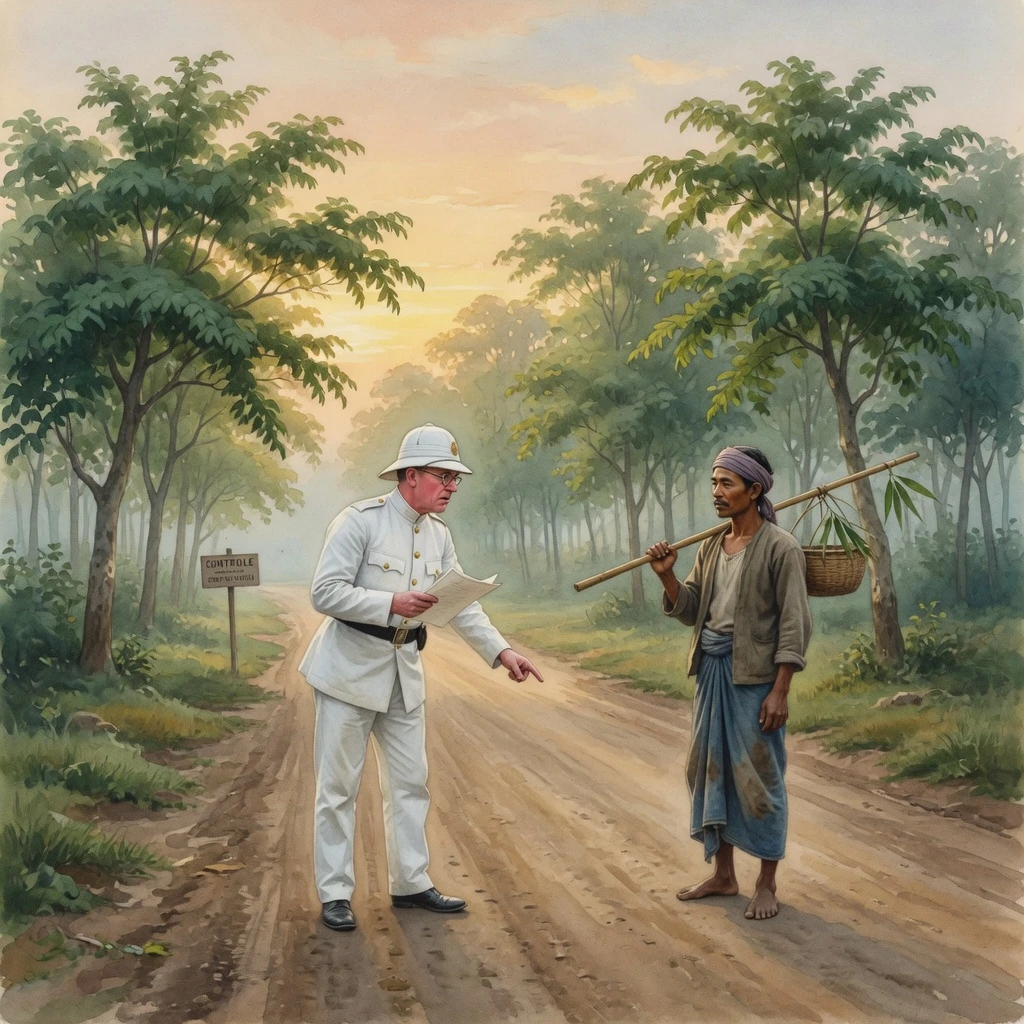
An illiterate farmer, a fenced-off forest, and a way of living so complete it outlasted its maker by a hundred years. What a Javanese peasant movement can show us that the great religions no longer easily can.
Sometime in the first years of the twentieth century, on a dirt road in the teak country of central Java, a Dutch colonial official stops a barefoot farmer and asks him a routine question. Where are you from? The farmer answers: from the forest. Where are you going? To the forest. Every word is true; every word is useless. The official has learned nothing he can write in a report, and nothing he can punish, because the man has not refused to answer; he has answered perfectly, and said nothing at all. The scene comes down to us as Javanese memory rather than colonial paperwork – no archive holds this exchange – but it is how the tradition itself tells the story, and, as we will see, it is exactly how the archive shows these people talking.
If you were that official, you would know you were being mocked. You would also know you could not prove it. And if you were patient enough to keep asking (and the Dutch, by every account, asked and asked) you would slowly realise this was not one stubborn man having a bad morning. It was a method. A whole community, thousands of people across a cluster of villages, had quietly agreed to meet the colonial state with this same deadpan, literal politeness. They paid no tax they could avoid, registered no marriages, and answered the census with riddles. And they did it all without ever raising a hand.
A hundred years later, in 2017, nine women farmers travelled from those same hills to the gates of the Presidential Palace in Jakarta, sat down on the pavement, and poured wet cement around their feet. They stayed there for hours, locked to the ground they had come to argue about, while the traffic of the capital flowed past. One of them, a woman named Patmi, forty-eight years old, died not long after the protest. They were the heirs of the man on the forest road: some by blood, all by their manner of refusal.
So I went looking for what connected them, and what I found was a dharma.
A dharma you can hold in your hand
The story so far has been very large and very abstract: civilisations, millennia, the Axial Age. I wanted the opposite. I wanted a dharma I could almost touch: small enough to see all the way around, recent enough that we know the names of the people who built it, and humble enough that no one had spent two thousand years polishing it into something grand and untouchable.
Not a world religion with a billion followers, in other words. Something hand-made.
The Samin of Java are exactly that. Their dharma was assembled, more or less in front of the historical record, by a single farmer and his neighbours, beginning around 1890. We know roughly when it started, what set it off, what it asked of people, and how it spread. We can watch it being made. And because we can watch it being made, it tells us something the ancient traditions cannot, not because it is wiser than they are, but because the machinery has not yet been hidden behind a curtain of scripture and the fog of time.
So this part is a close-up. One dharma, in a few hundred square kilometres of teak forest, held up to the light.
An illiterate farmer in the teak forests
The man on the road has a name, or rather several. He was born Raden Kohar, probably in 1859, in the Blora region of central Java: a flat, hot country famous for its teak. As a grown man he took the name Samin Surosentiko, and it is as ‘Samin’ that he entered history, mostly through the alarmed reports of the people trying to govern him.
There is a story about his father, and even if it is only half true, it tells you something about where the movement’s spirit came from. By tradition, his father, remembered as Samin Sepuh (‘Samin the Elder’), was a nobleman from Ponorogo who renounced his aristocratic rank to live as a commoner, in deliberate opposition to Dutch rule. Whether or not the bloodline is exact, the gesture is the seed of the whole movement: a turning away from status, a choice to go down rather than up.
From about 1890, Samin began teaching in his home village and the surrounding villages. What he taught was not, at first, a revolt. It was a way of living. But it landed in a world that was being squeezed hard, and that is what turned a quiet ethic into a movement.
In 1897 the Dutch colonial forestry service drew a line around the teak forests that the villagers had always used – for firewood, for building, for grazing, for the thousand small needs of a subsistence life – and declared them restricted: state forest, off limits. At the same time, the colonial taxes pressed down: a land rent, a poll tax, a tax on what little the farmers produced. To a family living at the edge of enough, the fencing of the forest and the demand for cash were hunger, made by a distant authority that gave nothing back.
This is the soil in which the Samin dharma grew, and the pattern already has a name that fits, from the anthropologist James C Scott: the moral economy of the peasant. Scott argued that peasant communities carry a deep value-system ‘irrevocably linked to subsistence requirements’, a shared sense of what people owe each other, and what a community is owed, organised entirely around the basic right to survive. When an outside power, a market or a colonial state, tears up those customary rights of access in the name of profit or order, it takes more than resources. It violates a moral world. The Samin response was the defence of that moral world, raised into a creed.
And that creed spread. From Blora it travelled across an arc of districts (Rembang, Pati, Kudus, Grobogan, Bojonegoro), reaching, by one estimate, somewhere between three and five thousand followers by 1907. That was the year it became too visible to ignore. The Dutch arrested Samin and exiled him to Sawahlunto, in West Sumatra, far across the sea, where he died in 1914. His followers did not accept that he had simply died. They held that he had attained moksha (release, liberation) and passed into the spiritual realm, a detail that will matter later.
The code
So what did the Samin actually believe? What follows is a reconstruction through other people’s windows – I will make a fuller accounting of those windows shortly – but its shape is consistent across them, and for a movement the Dutch treated as a dangerous sect, the content is strikingly down-to-earth. There is barely any theology in it at all; it is a code for conduct, not a map of heaven.
The recurring principles, as best we can reconstruct them, are these. Be honest, jujur, and speak plainly. Do no violence, and be self-sufficient: live by the work of your own hands, your own farm. Keep life simple; do not chase material excess. Do not disturb or harm other people, and avoid envy, greed, and quarrelling. And do not take ill-gotten gain, especially in trade and commerce: the Samin were deeply suspicious of the merchant’s habit of getting something for nothing.
Underneath these everyday rules sits one conviction with real teeth, the one that made the movement dangerous: that land, water, and forest are common property, to be used for the common good. Not the king’s, not the colonial state’s, not a company’s. Everyone’s. That single idea is the doctrinal root of both the tax-and-forest resistance of Samin’s own day and, as we will see, the environmental struggle his descendants are still fighting now.
They called their faith Agama Adam, ‘the religion of Adam’. The name is a claim: that this was humanity’s original religion, the simple thing we all had before the priests and the empires got to us. Its practice was correspondingly bare: prayer at dawn and dusk, no professional clergy, and almost none of the elaborate ceremonial apparatus that surrounded Javanese village life. A plain ethic for plain people.
The whole thing was carried by mouth. Samin was illiterate, and so were his followers; there was no scripture, no holy book to copy, guard, and argue over. The ethic travelled by recitation, by example, and by embodied practice, including a discipline called laku jejek, days of walking to reach a community gathering. A dharma with no text, held in nothing but memory and the soles of people’s feet.
That picture needs one qualification, and the exception is revealing. A handful of texts are, in fact, attributed to the tradition (most often a manuscript called the Serat Jamus Kalimosodo), and some Samin families keep a kris, the wavy ceremonial blade of Java, as an heirloom that carries the teaching down the generations. So the Samin were not quite textless; they distrusted the written word as the instrument of the mullah, the clerk, and the tax-collector, and inclined to trust instead the things a person keeps in the body.
Javanese spiritual life has a word for this: laku, meaning something close to ‘conduct’, or ‘the path you walk’, a discipline you practise rather than a doctrine you read. Seen that way, the laku jejek, those days of walking to a gathering, was not a quaint custom bolted onto the ethic; it was the ethic, rehearsed in the legs. The deadpan literalism on the forest road belonged to the same family: honesty drilled into a reflex, plain speech worn so smooth it could answer an empire without stopping to think. How a dharma installs itself, through what its people repeatedly do at least as much as through what they believe, is a story for a later part; the Samin, with no scripture to argue over, had almost nothing but the doing. It made them very hard to convert and even harder to stamp out. You cannot burn a book that was never written; you can only try to outlast the people who walk it, and on that score the Samin have proved stubbornly patient, generation after generation.
One more thing, before we go on, about names. The followers themselves came to dislike the word ‘Samin’ because, in mainstream Indonesian society, it picked up a sneer: a synonym for backward, foolish, primitive. They prefer to call themselves Sedulur Sikep, or wong sikep: roughly, ‘honest, responsible kin’; a wong sikep, in the older idiom, is ‘a man who embraces’, one who embraces his wife and his land. It is a better name, and from here I will use both: theirs by preference, and ‘Samin’ where the history insists.
But is it a dharma?
Now, a sceptic could stop me right here. Plenty of villages have customs, the sceptic says. Lots of communities are truthful, simple, and suspicious of outsiders. You have described a set of folkways with a local accent. Why dignify it with a word like ‘dharma’? Aren’t you just doing the thing this project warned against, slapping an exotic label on ordinary peasant life?
It is a fair challenge, and the Samin are where our definition gets tested against a real case. Back in Part 1, we worked out what separates a dharma from mere custom or law or etiquette. Not its content (there is no single belief that makes something a dharma) but a combination of features. I will run the Sedulur Sikep against that test, in plain language.
First: is it comprehensive? Does it govern a whole life, or just one corner of behaviour? The Sikep code clearly does the former. It tells you how to work, how to speak, what you may own, how to treat your neighbours, how to deal with authority, even how to understand death. It is an architecture for living, not a rule about one thing.
The wong sikep do not say that a person dies. They say salin sandhangan, changing clothes: what wears out is the garment, the body, and the life inside it goes on – back, on the tellings the ethnographers have collected, into a person again, into one’s own descendants, or simply ‘gathered with the living’. The rite is as bare as the belief. The village religious official is given no part. The body is washed, or deliberately not washed if the dead person is thought to have held firm to the teaching; it is wrapped in white cloth or a plain jarit, laid level and face up, not turned toward Mecca, and buried without the Islamic prayers and without the words spoken into the grave. There is one shared meal, on the day of the burial, and then nothing: none of the Javanese cycle of feasts at seven, forty and a hundred days, no headstone, no visiting of the grave, no anniversary. Contributions come in rice, sugar and cigarettes; money is handed back. On the Kudus telling, the good conduct of the dead attaches to the next generation, which is why the grave needs no tending. The same refusals run through it as through the rest of the code: no cleric, no cycle of feasts, no tended grave, no profit, no display; and the hope reaches forward through the lineage rather than upward to another world. In the Blora villages the rite has drifted toward the mosque, and the elder of Klopoduwur who died in 2025 was prayed over at the village mosque before burial; Kudus keeps the older form. Benda and Castles, quoting the provincial surveys of the 1950s, put the difference in a sentence: the Saminists’ births and circumcisions looked like their neighbours’, their marriages and burials did not.
Second: is it identity-constituting, does it tell people who they are? Unmistakably. To be Sedulur Sikep is to be one of ‘the honest people’. It is a self; you can hear it in the very name they chose.
Third: is it oriented toward the good, rather than toward mere advantage? Yes. The wong sikep were after a particular kind of life, not the most profitable one – autonomous, truthful, harmonious, rooted in the land – and they paid for it in taxes refused and forests lost.
And the fourth feature is the decisive one: is it reflective and self-aware? Here is where this dharma and mere custom part company for good. Ordinary village tradition is usually inherited and seldom held up for examination. You do it because it is done, because your parents did it, because that is simply how things are. What the Sedulur Sikep did is far rarer, and they did it out loud. They consciously chose a set of values, lifted them out of the surrounding culture, gave them a name, and defended them deliberately, against the dominant order of their day. They knew they were being different, and they meant to be.
That lifting is what turned the Sedulur Sikep’s folkways into a dharma, and they would tell you so, in blunt language, to your face.
Which brings us to the language.
Speaking ngoko to the king
To feel how radical the wong sikep really were, you have to see what they were rebelling against, and it was not only the Dutch. It was the entire intricate hierarchy of Javanese culture itself.
The classic map of that culture comes from anthropologist Clifford Geertz, who in 1960 divided Javanese society into three streams: the abangan, the syncretic peasant majority who blended Islam with older mystical and animist traditions; the santri, the devout, orthodox Muslims; and the priyayi, the refined aristocratic-bureaucratic class tied to the courts. Scholars have argued about this scheme ever since (it is an ideal-type, not a perfect description), but it gives us the lay of the land.
And running through all of it was an exquisitely graded etiquette, encoded in the Javanese language itself. Javanese has levels. There is ngoko, blunt and low, the speech you use with intimates and inferiors; there is krama, high and refined, the speech you use to show respect to your superiors; and there is a middle register between them. In ordinary life, you perform your place in the social order every time you open your mouth. You address the person above you in deferential krama, and you receive ngoko in return, and the whole hierarchy is rehearsed, sentence by sentence, all day long.
The Sedulur Sikep refused the entire arrangement. They spoke plain, low ngoko to everyone: to each other, to officials, to anyone. To address a colonial administrator or a Javanese aristocrat in the same blunt register you would use with a child or a friend was a linguistic refusal of the whole hierarchy of deference. With grammar alone, they declined to admit that anyone stood above them.
They went further. Mainstream Javanese culture prized the ideal of halus (the refined, indirect, emotionally controlled, and impeccably polite person) and looked down on kasar (the coarse, blunt, and direct). The wong sikep took that prestige ranking and turned it on its head. They made plain, literal, sometimes maddening truth-telling into a virtue. The deadpan answers on the forest road were not stupidity. They were halus turned inside out: a refusal to play the game of refined indirection, weaponised into politeness so literal it became a wall.
They minimised the ceremonial life, the elaborate ritual meals and observances, that gave mainstream Javanese religion its texture. And, following old Samin Sepuh’s example, they refused the whole aristocratic-bureaucratic order: no tax, no forced labour, no marriage registration, no census.
But this creed was Java’s own. The Sedulur Sikep were agrarian, mystical, and rooted in the very same peasant world they were reforming; their suspicion of orthodox Islam was itself steeped in heterodox Javanese mysticism. They took Java’s own materials and used them against Java’s own hierarchy. The best name for that is not rebellion from without but heresy from within: an internal reform that knows the tradition intimately, because it is made of it.
A dharma, in other words, can be grown at home, out of the same soil, in deliberate argument with the culture that surrounds it.
‘From the forest, to the forest’
Return, for a moment, to the deadpan on the road. It would be easy to file it under eccentricity. It was the Sikep dharma in action.
James C Scott, the same scholar who gave us the moral economy, spent much of his career studying how powerless people resist powerful ones without open battle, which they cannot win. He called the result the weapons of the weak: foot-dragging, feigned ignorance, false compliance, deliberate misunderstanding, the slow quiet sabotage of people who cannot say no out loud and so say it in a thousand other ways. He called the hidden world of grumbling and mockery, the one the powerful never get to see, the hidden transcript, and the whole domain of this everyday, below-the-radar resistance infra-politics. (Scott never studied the Samin himself, but his frame describes them exactly.)
Read through Scott, the wong sikep’s tactics snap into focus. Answering an official with perfect, useless literalism is feigned ignorance raised to an art. Refusing to register a marriage, declining the census, paying only what cannot be avoided: these are the weapons of the weak, deployed with discipline. What makes the Sedulur Sikep extraordinary is that they took this scattered, instinctive repertoire of peasant resistance and moralised it, turning it into a named, principled, identity-bearing way of life. Most peasants drag their feet and keep the reasons in the hidden transcript. The wong sikep dragged their feet on principle, and were proud. Ethics and tactics had fused into one thing.
And beneath the tactics, it turns out, lay something like a philosophy of language. In the recorded testimony of one follower arrested in 1928, to which we will come shortly, the words that truly mattered were the few about work, marriage, and upright conduct; nearly every other word could be hollowed out or repurposed, often by punning, so that ‘religion’ could shade into the word for a weapon and ‘tax’ could, in the right mouth, mean nothing at all. A word, in this thinking, means what its utterer means by it, and an empire’s word, spoken by an empire, could be handed back empty. The deadpan on the forest road was not merely feigned ignorance raised to an art. It was doctrine: a quiet claim of sovereignty over meaning itself.
There is an older current here too, one we have already met. Christopher Boehm’s reverse dominance hierarchy, from Part 2, was his account of how human morality may have begun: as a device against domination, the many using ridicule, shaming, and ostracism to cut down anyone who tried to lord it over the group. If he is even partly right, then a dharma like the Samin’s, defined almost entirely by its refusal of a domineering state, is morality doing one of the oldest jobs it ever had. The man on the forest road, answering the empire with riddles, was standing in a very long line.
A pause
I have been building a case, and before I finish it, three warnings are in order, because a dharma is exactly the kind of thing it is easy to romanticise, and I have been as charmed by this one as anyone.
The first is about the evidence. Almost everything we ‘know’ about Samin doctrine comes to us second-hand, and often third-hand, from outsiders: Dutch colonial officials and, later, ethnographers. The reason is the very thing that makes the movement so striking: the Samin themselves wrote almost nothing down. The historians Harry Benda and Lance Castles, in their foundational scholarly study, make this their central caution and note that the accounts we do have were frequently written by hostile or baffled observers. We are watching this dharma through a series of other people’s windows, some of them grimy. This chapter adds a window of its own, and the reader should know what kind: a reading of the archive and of the scholars who did the fieldwork, not a report of conversations of my own.
There is one window that is less grimy than the rest, and what can be seen through it should adjust the whole picture. The historian Takashi Shiraishi dug out of the colonial archive the minutes of the interrogation of Dangir, a twenty-five-year-old follower arrested in 1928, who answered a native official’s questions about his faith at length and in his own idiom: how he was initiated with five aphorisms about walking; why the ritual meal that sealed it could be paid for only with money from his own farm labour, never from trade, ‘because traders usually get profit by cheating’; what an honest man may and may not do. It is the nearest thing we have to a Samin speaking, and even it reaches us, as Shiraishi says, doubly alienated, filtered through the official who wrote it down. But a voice it is, and it says something startling: Dangir denied being a ‘Samin’ at all. The word meant nothing to him; it was the government’s label. He called himself wong sikep, a man who embraces, living the religion of Adam he had learned from a neighbouring teacher he could name.
Shiraishi’s larger, uncomfortable lesson is that some of what the record calls ‘the Samin movement’ is an artefact of the record itself: colonial clerks joining scattered circles of quiet people into one remembered conspiracy, and some of the wilder material in the files, the prophecies of coming kings that fed the millenarian reading, arriving by way of paid informers telling their masters what subversion ought to sound like. Even the scholars disagree about what they are looking at: some read the Samin as an ethical-religious resistance movement, some as a millenarian one waiting for salvation and the return of their founder, some as hard-headed peasants rationally defending their livelihoods; and after Shiraishi, the second reading stands on visibly shakier ground than the others. When I tell you what the Samin ‘believed’, please hear the quotation marks. A dharma this good deserves a plain accounting of how little we can be sure of.
The second is sharper, and we have to face it squarely. The wong sikep were not secular. I have spent so long discussing them because they look, at first, like a do-it-yourself ethic with no god in it, a practical code about fair dealing, forests, and taxes. But that is not the whole truth. They had Agama Adam, the religion of Adam; they believed in an eternal soul, and that their founder did not die but attained moksha. There is metaphysics here, and a cosmology, and a hope that reaches past this life.
So why are they here at all when, in the end, the question is whether we can build ethical worlds without the supernatural?
Because they are a boundary case, and boundary cases are worth more than tidy examples. The Sedulur Sikep are not a world religion, with scripture, clergy, and empire. But they are not a secular philosophy either, like Stoicism stripped of its gods. They sit in between: a non-scriptural, non-institutional, this-worldly, ethics-first folk dharma, with just enough cosmology to give it a backbone and not an ounce more. There is a whole middle country of ways of living that are neither, and the Sedulur Sikep are its first sure landmark. For an argument that dharmas come in every form, an example that refuses our neat boxes is the best evidence we have.
The third warning I can only post here and honour later, because it needs a standard this book has not yet built. A dharma this admirable still had hard edges, and they pressed on its own people: for most of a century the wong sikep kept their children from school, and with it from letters, rather than hand them to the state’s classroom; and the same tradition that will shortly give us nine heroic women at a palace gate also prescribed – and in the one village fieldworkers have studied closely still prescribes – a wife’s place in a plainly patriarchal household. Whether a way of life can hold this well without crushing anyone inside it is a real question, not a rhetorical one, and Part 8 will put this very dharma through that test, without flinching, as its hardest case.
Feet in cement
The strongest proof that the wong sikep built a real dharma, and not a one-generation protest, is that it did not die with Samin. It is still being lived, and it has crossed a hundred years and an entire change of subject without losing its spine.
The century in between was not quiet, and it shows what the refusal was really aimed at. When the Dutch left, the refusal stayed, since the thing being refused had never really been the Dutch; it was the state’s claim to name and number people. Anthropologist Amrih Widodo, who has followed the community for decades, records what that meant under Suharto’s New Order: pressure to fill in the religion column on the identity card, since the religion of Adam was not on the official list; mass wedding ceremonies arranged to pull unregistered Sikep marriages into the books of the religious bureaucracy; and, for those who declined, the threat of transmigration off Java altogether. The flags had changed and the census came anyway, and the Sedulur Sikep answered the independent republic much as they had answered the empire.
Travel to the Kendeng mountains today, and you will find the Sedulur Sikep still there, still honest, still stubborn, and now fighting a new enemy. The Kendeng is karst country: soft, porous limestone that soaks up rain and feeds the springs and rivers the farmers below depend on. Since the 2000s, they have been at the forefront of non-violent resistance across the districts of Rembang, Pati, and Grobogan against limestone quarrying and a large cement plant operated by the company PT Semen Indonesia. Their argument is the very same one their great-grandparents made to the Dutch foresters: that land, water, and forest are common property, and that protecting the karst, the rock that holds the region’s water, is a sacred duty, not a thing to be blasted away for profit.
And in 2016, and again in 2017, they made that argument in the most physical way imaginable: nine women at the gates of the Presidential Palace, with wet cement poured around their feet. They are remembered as the Kartini Kendeng. The image is almost unbearably apt: the wong cilik, the ‘little people’, literally encased in the very substance the industry wanted to make from their mountains, immobilised in the capital to dramatise the immobilising of their land. They held there in the heat and the noise. Patmi did not long survive the second of those protests: the night after the cement came off her feet, her heart gave out.
Why was it women who made that journey, and women whose names the protest still carries? They named themselves after Raden Ajeng Kartini, the Javanese noblewoman whose letters, written in Samin’s own lifetime, became the founding text of Indonesian women’s emancipation. And they came not in spite of being mothers and farmers but because of it, framing the defence of the water and the soil as one continuous piece with the daily work of keeping a family fed: the mountains were the kitchen, the springs were the tap, and a cement company was proposing to demolish both. A farmer named Sukinah made that argument her own. The tactic was shrewd: by standing on the most traditional ground available to them (motherhood, the household, the duty to feed) these women advanced a genuinely radical claim about who owns a landscape, and dared the state to be seen hauling mothers in cement away from the palace gate. It is the old Samin move, intact.
The law, for once, sided with the farmers: Indonesia’s Supreme Court ruled in their favour in October 2016. And then the provincial governor issued a fresh permit within days, and the plant went ahead anyway: a bleak little lesson in the difference between winning a ruling and winning a fight.
But look at what has happened to the Sikep dharma. The colonial-era creed – common property, non-violence, refusal of an extractive authority – has been recoded for an age its founder could never have imagined. And the recoding was work, done in company: the Sedulur Sikep stand today inside a wider network of Kendeng farmers, joined by lawyers, environmental groups and city sympathisers; they borrow the nation’s own icons (Kartini was no Samin); and they argue in courtrooms their great-grandparents would have refused to enter. Continuity of spine is not sameness of body. The enemy is no longer a Dutch forester with a tax ledger; it is a cement company with a court-proof permit. The forest has become the watershed. And the deadpan refusal on the road has become a woman with her feet in concrete, refusing to move. Same spine, new century. That is what a living dharma looks like: a way of living flexible enough to meet a threat its makers never foresaw, and rigid enough, at the core, to still be recognisably itself.
What the wong sikep know
So what was waiting, all along, in the teak country of Blora?
A dharma with the lid off. No prophet on a mountain, no book handed down from the sky, no two-thousand-year pedigree to make it untouchable. Just an illiterate farmer and his neighbours, in a squeezed and unjust corner of a colonised island, deciding (deliberately, against the grain of their own culture and the full weight of an empire) how they were going to live. And then living it so completely, and teaching it so well, with nothing but their voices and their feet, that the way outlasted the man by a century and walked itself from a colonial tax revolt into an environmental protest, changing its body but never its spine.
That is the thing the great traditions can no longer easily show us, and the wong sikep can. We are used to thinking of a dharma as something ancient and given, something you are born into or convert to, something you find. The Sedulur Sikep let us watch the opposite happen. A dharma is something a community makes, and then keeps, by choosing it, naming it, and saying, over and over, with their feet in the cement if it comes to that: this is who we are.
If even one small, poor, unlettered community in the forests of Java could build a whole ethical world without scripture, clergy, or institutional machinery, and defend it for a hundred years, then dharmas are not relics we inherit. They are things people make. Which means that, eventually, they are things we could make, too.
But the wong sikep are only one. Having seen a dharma assembled this clearly, in this much close-up, you start to notice them everywhere, and they are not all alike: a single South African word that contains an entire theory of the self; a Roman emperor’s private notebook; a song that maps a thousand kilometres of desert; a promise made in another desert, half a world away, that founded three religions. The teak forest was one country. Next, we cross into the others.
« 2: The genesis of dharmas | 4: A world of dharmas »
Sources & further reading
This part is built from the project’s research notes, which carry the full inline citations. Listed here are the notes it draws on and the key works behind them.
Research notes
Research notes used in this book are published on GitHub.
- 4.1 Samin of Java – origins, the Sikep ethical code and Agama Adam, the dharma-fit argument, the break from mainstream Javanese culture, and the Kendeng turn. The spine of this part.
- 1.3 Boundary & Definition – the four-feature test (comprehensiveness, internalisation/identity, ethical orientation, reflective self-awareness) used to answer ‘but is it really a dharma?’
- 7.3 Dharma & Power – Boehm’s ‘reverse dominance hierarchy’ and morality as an anti-domination device; the dharma defined by its refusal of the state.
- 8.1 Planetary Dharma – the frame for reading the Kendeng turn as a contemporary, place-based ecological dharma, developed further in Part 8.
Key works
- Harry J Benda & Lance Castles, ‘The Samin Movement’, Bijdragen tot de Taal-, Land- en Volkenkunde 125(2) (1969): 207–240 – the canonical scholarly study; the central caution that all accounts derive from outsiders because the Samin were illiterate.
- Takashi Shiraishi, ‘Dangir’s Testimony: Saminism Reconsidered’, Indonesia 50 (1990): 95–120 – the 1928 interrogation minutes, the nearest thing to a Samin first-person source; ‘Samin’ as the state’s label for the self-named wong sikep; the movement as partly an artefact of the colonial file, the millenarian evidence as partly spy-mediated, and the Samin doctrine of language.
- APE Korver, ‘The Samin Movement and Millenarism’ (1976) – the contested millenarian reading (salvation expectation; the return-of-Samin / moksha motif), now weakened at its evidentiary root by Shiraishi’s archival work.
- Anis Sholeh Ba’asin & Muhammad Anis Ba’asin, Samin: Mistisisme Petani di Tengah Pergolakan (Semarang) – the Indonesian account behind two scenes in this part, and the route to a primary record: it quotes the Dutch East Indies newspaper Het Nieuws van den Dag of 5 March 1907 on the interrogation of the arrested Samin Surosentiko (‘My body is my home’), and reports at p. 63 the patih’s interrogation of a follower who answers that he owes the state nothing, is slapped for it, and declines to be angry because the officer has his duty and the Sikep has his. ▲ A note on the opening scene: the forest-road exchange with which this part begins is widely reported in Indonesian sources but appears in none of the three canonical English-language studies above. It is offered here as what it is – a well-attested Indonesian tradition about how these people spoke to power, not a line from the colonial archive.
- Amrih Widodo, ‘Samin in the New Order: The Politics of Encounter and Isolation’, in Jim Schiller & Barbara Martin-Schiller (eds.), Imagining Indonesia: Cultural Politics and Political Culture (Ohio University Center for International Studies, 1997), 261–287 – the community under Suharto: the religion column, mass marriage registration, and transmigration threats.
- Nancy Lee Peluso, Rich Forests, Poor People: Resource Control and Resistance in Java (University of California Press, 1992) – the three-century political economy of state forestry and criminalised customary access behind the 1897 enclosure.
- Clifford Geertz, The Religion of Java (1960) – the abangan / santri / priyayi map and the ngoko / krama speech-level hierarchy that the Samin refused.
- James C Scott, The Moral Economy of the Peasant (1976), Weapons of the Weak (1985), and Domination and the Arts of Resistance: Hidden Transcripts (1990) – the peasant moral economy, the ‘weapons of the weak’, and the ‘hidden transcript’ / ‘infra-politics’ of below-the-radar refusal; the comparative frame for the Samin’s tactics.
- Christopher Boehm, Hierarchy in the Forest (1999) – egalitarian foragers and the ‘reverse dominance hierarchy’; morality’s deep origin as a check on domination.
- On salin sandhangan and the Sikep funeral: Siti Munawaroh, Christriyati Ariani & Suwarno, Etnografi Masyarakat Samin di Bojonegoro (Balai Pelestarian Nilai Budaya Yogyakarta, 2015); Moh Rosyid, ‘Studi Komparatif Konsep Ketuhanan Islam dan Agama Adam’, Ulumuna (2012), and ‘Komunitas Samin: Agama Adam dan Ajarannya’, Hanifiya (2023), for the Kudus rite and its drift; and detikJateng’s reporting of Mbah Wargono’s burial (February 2022) and of the Blora elders’ funerals (2025–2026). The 1950s contrast is Benda & Castles quoting the provincial volumes.
- Reporting on the Kendeng resistance – the Kartini Kendeng, the 2016 and 2017 feet-in-cement protests at the Presidential Palace, and Patmi’s death (Mongabay, 2020; Indonesia at Melbourne, University of Melbourne).
- The living Indonesian scholarship – S Setiadi, A Saraswati & N Rosyid, ‘Geger Sikep: Environmental (Re)Interpretation among the Contemporary Anti-Cement Movement in Kendeng, Central Java’, Komunitas 9(1) (2017): 13–28; Moh Rosyid, ‘Memotret Agama Adam: Studi Kasus pada Komunitas Samin’, Orientasi Baru 23(2) (2014) – the community as an object of active Indonesian research, not only of colonial and Western memory.