
 Gary Dean
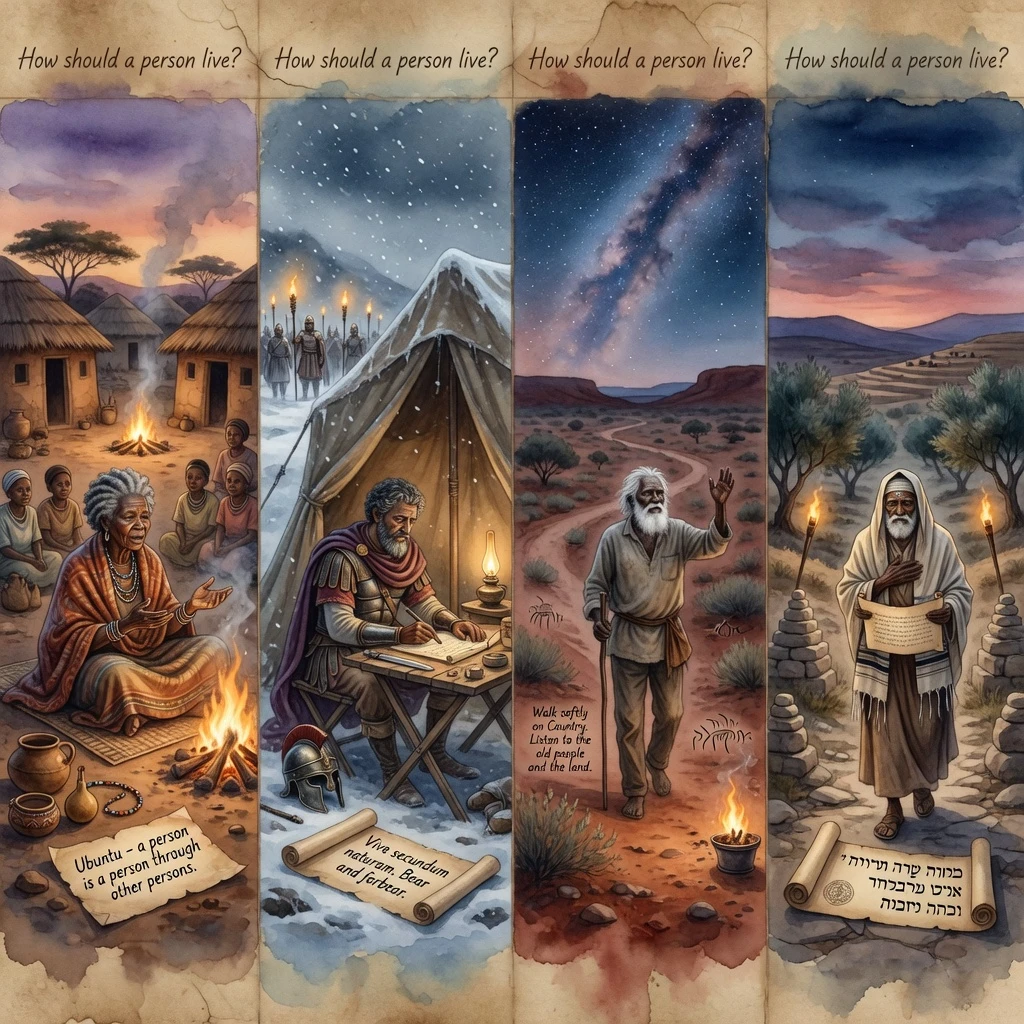
A relational web, a rational fortress, a sung land, an open hand, a commanding covenant: five ways of living that disagree about almost everything, and rhyme underneath. Including, if you have the nerve to look, your own.
Picture five people, in five worlds, each answering the same question: how should a person live?
An elder in a southern African village is asked what makes a good person, and she does not start with the person at all. She starts with everyone else. A human being, she says, becomes human only through other human beings; you are a person because, and only because, you belong to a people.
A Roman emperor sits in a campaign tent on a freezing frontier, writing to himself by lamplight, reminding himself that the empire he commands, the body he inhabits, and the very next breath he takes are not finally his to keep, and that the only thing that is truly his, the only thing worth guarding, is the quality of his own choices.
An old man in the Australian desert walks a path his ancestors walked, singing as he goes, because the song is the map and the law and the history all at once, and the land beneath his feet is not scenery but scripture, sung into being and sung into order.
In a court city on Java, a bank clerk sits at home in the evening with his eyes closed, doing what looks like nothing at all: practising the hardest discipline he knows, the letting go of discipline itself, releasing opinion, effort, and will so that, as he would put it, God may act through him.
And somewhere in the ancient Near East, a person sets out, quite deliberately, to walk a way: to live every hour, the meals and the washing and the buying and the burying, according to a path laid down in a covenant between a people and their God.
Five answers. They look nothing alike. The first dissolves the self into the community; the second builds a fortress around it. The third writes the law into the ground; the fourth hands the self over to its God; the fifth receives the law from the sky. And yet they rhyme. What follows is a tour of that strangeness, the irreducible variety of human dharmas, and the stubborn family likeness that runs underneath them all.
How far can they get?
The wong sikep of Part 3 were one dharma, watched up close. Now pull back and take in the range, because the plurality is a real and sometimes dizzying fact about the human world. So we are going to visit five dharmas that grew up far apart, look at each on its own terms, and only then ask what, if anything, holds across them. One thread runs through every stop: where each dharma draws its circle of care, who it gathers in and who it leaves outside.
I am going to end the tour with the one many of you were raised inside, the family of Jewish, Christian, and Muslim ethics, and I should say why. The whole wager here is that we can look at dharmas without privileging any of them, including our own. That is easy to say about somebody else’s tradition and hard to do about the water you were swimming in before you could see it. So the Abrahamic covenant comes last, as the real test of whether the non-privileging eye can be turned around to look at itself.
And one tradition needs different handling, so let me do it here at the door, before the tour proper. Buddhism, the tradition through which the word dharma reached most of us, is this project’s home water: the one I look with more than at, the source of half my instruments, and, as the Preface disclosed, the name on this book’s cover. I cannot cross-examine it with the detachment I am asking of you, and for most of this project’s life I used that as a reason to excuse it from the stand. That was a mistake, or at least a fingerprint pretending to be a courtesy. Partiality disclosed is not exemption earned. So let it take the witness chair like everyone else, briefly, with my hands where you can watch them.
As a dharma it is the textbook case; Part 1 already scored its four features full marks, and no one contests them. The real questions are the ones this book is building toward: does it hold without crushing, and who may revise it? On holding, twenty-five centuries at every scale from forest hermitage to imperial church speak for themselves. On crushing, the record is there like every other great tradition’s. The Vinaya’s own account has the founder admitting women to ordination while attaching eight ‘heavy rules’ that subordinate every nun, however senior, to any monk, however junior; the women’s ordination lineage was then allowed to die out across the Theravada world for most of a millennium, and its modern restoration is still being fought over by hierarchies that hold the keys; and when the holding turned ethno-national, it produced the preaching monk Part 6 will meet.
On revision, the founding archive contains one of the most instructive scenes in any tradition: on his deathbed the Buddha explicitly permitted the sangha to abolish the lesser and minor rules after him, a revision hatch built in by the founder himself. At the First Council, months later, the elders, unsure which rules counted as lesser, resolved the doubt by abolishing none of them. The hatch was welded almost before the body was cold, and the great revisions since have mostly come from the margins or the exits: the half-million who will walk out with Ambedkar in Part 6, the modernist remaking Part 8 returns to, Batchelor’s secular reconstruction out at the far edge.
So examined, Buddhism stands where the others on this tour will stand: a magnificent holding-system with its pauses on the record, at the women and at the welded hatch. And one fingerprint, stated plainly: the secular dharma this book works in descends from the revisable margin of this tradition, which is surely part of why I prize revisability. A lens ground at the margin will find the margin admirable. Now you know that too, and can discount accordingly.
Ubuntu: the self is a ‘we’
Start in southern Africa, with a single sentence in the Nguni languages: umuntu ngumuntu ngabantu. ‘A person is a person through other persons’. In its travelling English form it became ‘I am because we are’, and behind that gentle slogan sits one of the most radical claims any dharma makes, a claim that reaches past how you should behave to what you fundamentally are.
In the world most of my readers grew up in, the individual comes first. You are a self, complete and bounded, and then you enter into relationships, take on duties, join groups. Descartes gave that world its motto: I think, therefore I am. The lone mind is the bedrock. Ubuntu turns this inside out. The proverb is Nguni; the argument it carries runs the length of the continent. On the account given by the Nigerian philosopher Ifeanyi Menkiti, personhood is not something you are issued at birth; it is something you achieve, and you achieve it only by taking your place in a community and discharging what you owe it. You can be a living, breathing member of the species and still not yet be, in the full sense, a person, because personhood is a moral accomplishment, grown in the soil of relationship. The self grows out of the ‘we’.
It is tempting to hear in this the simple erasure of the individual, the single person swallowed whole by the group, and Ubuntu’s own thinkers are alert to the misreading. One of them, the Ghanaian philosopher Kwame Gyekye, pushed back against the most radical version, the one that would make the community the entire substance of the person. A fully realised human being, he insisted, is also a chooser and a reasoner, a bearer of conscience who can and sometimes must stand against the group when the group has gone wrong. Ubuntu at its best does not abolish the individual; it denies that the individual comes first. There is a real difference between saying you are nothing but your relationships and saying you become yourself through them, and the more careful readings of Ubuntu mean the second.
In the hands of Thaddeus Metz, a philosopher working in South Africa, Ubuntu hardens into a precise moral theory: an action is right insofar as it honours relationships in which people recognise themselves in one another and act in solidarity. And it has done real public work. When apartheid ended and South Africa had to decide what to do with the torturers and killers of the old regime, it did not reach mainly for the courtroom and the prison. Under Desmond Tutu, it established a Truth and Reconciliation Commission, an attempt to heal a fractured community by bringing the truth to light and reintegrating even perpetrators into the moral world, rather than simply exacting retribution. And when the new Constitutional Court struck down the death penalty, it did so partly in the name of Ubuntu, holding that a state which kills its own betrays the recognition of shared humanity on which a decent society rests. A proverb became a principle of constitutional law.
That sentence needs one qualification, because the timing is stranger than it looks. The proverb is old. Its use as the definition of Ubuntu appears to be recent: the historian of ideas Christian Gade, tracing when people actually wrote the two together, puts it between 1993 and 1995, the very years of the interim constitution and the founding of the Truth and Reconciliation Commission. He offers that as a hypothesis about the written record rather than a claim about what villages said, and it does not make Ubuntu an invention. But it does mean the warm ancestral picture and the constitutional moment arrived more or less hand in hand, each lending the other authority. A dharma being consolidated exactly when a country needed one is not a scandal. It is my whole argument about how dharmas get made: as a response to external pressure.
I have to add the shadow, because every dharma on this tour has one, and Ubuntu’s is instructive. The warm picture of timeless African togetherness is, in part, a story told later, and it can be put to ugly uses: a demand for ‘harmony’ can be a demand for silence, a way of shaming the dissenter and protecting the powerful. And there is a bitter irony on the record. The same post-apartheid South Africa that wrote Ubuntu into its highest law has seen waves of murderous violence against migrants from other African countries, the supposed brothers and sisters of the human family attacked as unwanted strangers. The web that includes can also exclude. We have met this before, the hard edge around the warm circle, and we will meet it again.
The Stoics: the fortress inside
Now travel back, to the Greek and Roman world, for a dharma that will feel oddly modern, because it is one of the most nearly secular the ancient world produced.
Two of its greatest teachers could hardly have been further apart in station. Epictetus was born a slave, and taught, after he was freed, that no master could touch the one thing that mattered. Marcus Aurelius was the most powerful man in the Roman world, its emperor, and spent his private nights reminding himself of exactly the same thing. That a slave and an emperor could practise one and the same discipline, and arrive at one and the same freedom, tells you most of what Stoicism is.
Its core is a single, bracing distinction that Epictetus put at the very front of his handbook: some things are up to us, and some things are not. Our opinions, our intentions, our own choices and responses are ours. Almost everything else – our bodies, our reputations, our wealth, the behaviour of other people, the turn of events – is not finally in our control. The whole of wisdom, the Stoics taught, is to draw that line clearly and then to invest your hopes and your sense of yourself only on the inner side of it. Want what is up to you, accept what is not, and no tyrant, no accident, no loss can reach the citadel of your character. Virtue, the excellence of your own choosing self, is the only true good; everything else is, at most, raw material to be used well or badly.
Underneath the ethics sat a picture of the cosmos as fundamentally rational, ordered by what the Greeks called the logos, a reason running through all things, which a human being could align with by living ‘according to nature’. But that metaphysics sits lightly on the practice. You do not have to believe in a particular god to draw Epictetus’s line between the controllable and the uncontrollable and to reorder your life around it. Which is why Stoicism has come roaring back in our own anxious, secular century, repackaged in a thousand books and apps for people who would never set foot in a temple. It is a dharma that travels with remarkably little metaphysical luggage, a portable fortress for the self.
I should say that the Stoics themselves would dispute that, and so do many of their best modern readers. For Epictetus the cosmos is providentially ordered, and ‘living according to nature’ means aligning with a rational plan that is actually there; scholars like AA Long argue that the theology is not decoration but load-bearing, the thing that makes the resignation reasonable rather than merely stoical in the small-letter sense. Accept the universe when it is governed by reason and you are trusting; accept it when it is governed by nothing and you are just bracing. So the better description is not that Stoicism came without luggage. It is that the luggage can be, and is being, left behind, and that the practice keeps working well enough for millions of people to carry on. We are about to meet a Javanese fellowship doing the very same operation on its own idea of God, and it will raise the question this whole book is walking toward: how much of a dharma’s metaphysics can you unscrew before the thing stops holding?
And the fortress points outward, in a way you might not expect from a philosophy of the inner citadel. If reason runs through all things, then it runs through all people, and every human being, slave or emperor, shares in the same logos and the same fundamental worth. The Stoics drew the obvious conclusion and called themselves citizens of the world, members of a single community of rational beings that takes no account of city, tribe, or birth. Marcus, ruling an empire built on conquest, reminded himself nonetheless that he owed the foreigner the same basic regard he owed his own kin. Set beside the others on this tour, the contrast is sharp: where Ubuntu binds you tightly to a particular people and the Dreaming, our next stop, to a particular country, the Stoic stretches the circle to its widest possible edge, the whole of humanity at once. The same impulse to draw a circle of care, and wildly different ideas about where to draw it.
It has its own failure mode, of course. Push the acceptance of ‘what is not up to us’ too far and the fortress becomes a retreat: a counsel of passivity that can shade into indifference toward injustice you might actually be able to change. And one question presses on any philosophy that says externals do not matter: it is a good deal easier to believe that wealth and status are indifferent when, like Marcus, you already have all of both. A dharma can be true and still be more comfortable for some to hold than others.
The Dreaming: the law in the land
Now go to Australia, and to dharmas so old and so unlike the others that they stretch the very category: the hundreds of distinct Aboriginal traditions the English language clumsily gathers under a single word, the Dreaming.
Begin by throwing away three things you might think a serious ethical tradition needs. There is no scripture, because there is no writing. There is no founder, no Buddha, Christ, or Confucius at the origin. And there is no separate ‘code’, no list of commandments you could copy onto a page. Instead, there is the Tjukurrpa, to give it its Western Desert name, for each language has its own: a word that means the ancestral past, the present reality, the moral law, and the structure of the world, all at once. The anthropologist WEH Stanner, seeking a way to translate it, coined the word ‘everywhen’: a time that is not back then but always, in which the acts of the ancestral beings who shaped the land remain a living present, still holding the law in place.
And where is this law written, if not in a book? It is written in the land itself, and in the songs that cross it. The famous songlines are paths through the country, and to sing the song in order is to recite the features of the landscape in order, and woven into the same performance are the law, the genealogy, the ethics, and the map. The land is the scripture, and you read it by walking and singing. It is dharma as total order, carried entirely in voice, movement, and place.
You might think something so unwritten must be vague or quick to drift, but the evidence says otherwise. Researchers gathered Aboriginal stories from twenty-one places around the Australian coast, all describing a time when the sea stood lower, and the shore lay further out. They are not myths in the dismissive sense. On the reading of the geographer Patrick Nunn and the linguist Nicholas Reid, who did the matching, they appear to be memories of the coastlines that drowned when the last ice age ended, carried by mouth, faithfully enough to still fit the geology, for something between seven and thirteen thousand years. Oral does not mean fragile. High fidelity across hundreds of generations turns out to be an achievement of careful cultural machinery.
Two features recur across indigenous traditions well beyond Australia, each belonging to its own people rather than to a single indigenous creed. The first is what some call kincentricity: the moral circle extends beyond human beings to encompass the living world, so that the river, the animal, and the plant are not resources but relatives, owed the same reciprocity you owe your kin. The botanist Robin Wall Kimmerer, writing from the Potawatomi tradition, calls humans ‘the younger brothers of Creation’, the ones with the most to learn. The second is the long time horizon: the Haudenosaunee of North America, who maintained an entire constitution orally for centuries, are famous for the principle that every serious decision must be weighed for its effects on the generations to come. (The ‘seven generations’ wording everyone quotes is a later crystallisation; the Great Law as the chiefs dictated it in 1900 says ‘future generations’, which is demanding enough.) Place, kin, and the unborn are all inside the circle of care.
The scholar Vine Deloria Jr drew a distinction that is better used as a lens than as a filing system: religions of time and religions of space. The Abrahamic traditions, the reflective traditions of the first millennium BCE, and arguably the secular outlook as well, are religions of time. They tell a universal story that runs from a beginning toward an end, and because the story does not depend on any particular patch of ground, it can be packed up and carried anywhere, preached on any continent. The Dreaming is a religion of space. It is this land, these rocks, that waterhole, and the law is written into the country itself. That portability we take for granted in the great missionary faiths is not a universal feature of dharmas at all. Some of them are bolted to the earth, and mean nothing the moment you remove them from it.
It is dangerously easy for outsiders, especially guilty modern ones, to turn indigenous peoples into a fantasy of the noble ecological saint, the human who lived in perfect harmony with nature, as a stick to beat our own civilisation with. The anthropologist Shepard Krech showed how much that image is a projection, and how indigenous peoples, like all peoples, in fact shaped and sometimes depleted their environments. The real lesson is more useful than the fantasy: these traditions encode genuinely powerful wisdom about living within limits, and they do so without their holders having to be angels. We can learn from a dharma, as one of its own custodians warned, without going around in borrowed feathers, pretending to own or to become it.
Sumarah: the open hand
Now come back to Java. The island that gave us the Samin has more than one dharma to teach, and the second could hardly be less like the first. The Samin met the world with refusal: flat speech, stubborn plainness, a wall of polite no. In the court city of Yogyakarta, some forty-five years after Samin Surosentiko began teaching in the teak country, a quieter movement grew from the opposite gesture, and its whole teaching is already in its name. Sumarah is Javanese for total surrender.
It began in 1935, when a palace retainer and bank clerk named Sukinohartono took the experiences that came to him in practice to be revelation. A circle of friends formed around what he had received, grew through the Japanese occupation and the revolutionary war, and organised itself around 1950 as Paguyuban Sumarah, the fellowship of those who surrender. What the fellowship does is called sujud. People sit together, usually weekly and for hours at a stretch, in a guided, settling silence; body, feeling, and finally thinking are allowed to relax, attention comes to rest in rasa, the felt sense that Javanese tradition treats as an organ of knowing, and the practitioner surrenders every aspect of personal being, in the movement’s own formula, ‘so the self functions as a vehicle for God’s will’.
Put this next to the Stoic and you have the tour’s sharpest contrast. The Stoic drew a line around the one thing that was truly his, the quality of his own choices, and built a fortress on it. Sumarah gives exactly that away. Every other dharma we have visited tells you what to do with your will: bind it to the community, command it with reason, walk it along the songline. This one asks you to open your hand and let the will itself go. It is a fourth answer to what a person most deeply is: not a node in a web, not a citadel of choice, not a singer of country, but an instrument.
And it does this with almost none of the equipment a religion is supposed to need. There is no scripture; a guide named Pak Wondo put it flatly: ‘In Sumarah we have no sacred book. Our sacred book is Life’. There are no temples, no clergy, and no creed to recite. Above all there is no guru. The only teacher who finally counts is the guru sejati, the true teacher within; the person who guides a session, the pamong, is understood not as a master but as a function, someone speaking spontaneously out of attunement to the people in the room, with an authority that lasts exactly as long as the attunement does. Even revelation must pass inspection. At the fellowship’s 1950 congress its first chairman, Dr Surono, insisted that guidance claiming the highest source still had to be proven before the gathering: ‘Even Sukino asks us for our agreement’, he said, and then drew the boundary that earns Sumarah its place on this tour: ‘We differ from religions, within which people accept God on faith and without knowledge’.
Nor, finally, is there anywhere to retreat to. The tradition’s phrase for its own style is tapa rame, asceticism in the crowd: the practice carried on inside ordinary working and family life, the surrender renewed at the desk and the market stall as much as in the meditation hall.
So where does this dharma draw its circle of care? At the doctrinal edge, more softly than any other stop on the tour. Most members are Muslims, but Buddhists and Christians sit in the same silence without ceasing to be Buddhists and Christians; one independent Indonesian study of the fellowship describes people of different religions joined in a single shared ritual, each remaining inside their own faith. Almost anyone, it seems, may sit, and nobody is asked to convert, because there is nothing to convert to: no profession of belief is required of anyone who takes a place in the silence, and the fellowship has never proselytised. The hard edge is practical instead.
A practice with no book, no technique, and no franchise can travel only by contact, person to person and session to session, and for most of its history it travelled in Javanese, sometimes in the difficult high Javanese of the founder’s own guidance. Its near-twin Subud, born of the same Yogyakarta mystical circle in the same decade, wrapped a portable spiritual exercise in a uniform format and carried it around the world; Sumarah stayed a Javanese fellowship of a few thousand, its numbers peaking near ten thousand in the mid-1970s and drifting down ever since. Smallness, here, is not a failure of marketing. It is the price of refusing every reproducible form.
And the shadow. The openness has a floor, and the floor is God. When practitioners in Solo developed a religiously neutral ‘relaxed meditation’ for officials and foreigners, the leadership ruled from inside the practice that meditation without God ‘led to void and not God’, and the national chairman told the Western practitioners bluntly, ‘I stress that you are not members’.
That floor has a history, and the history could not be spoken of while it was being made. After the coup of 1965, in the massacres that followed, somewhere between half a million and a million Indonesians suspected of communism were killed, and atheism itself, though no statute ever named it, was treated as communism’s twin: a citizen who professed no God was marked as subversive, and the mystical movements were told, in effect, that they could remain open exactly insofar as they put surrender to God at the front of what they were. Sumarah’s God was not invented then; he is there in the founding vows of 1940, a generation before the terror.
And a further caution comes from the language itself: Javanese and Indonesian public speech is densely formulaic, and a talk that opens by acknowledging the One Almighty God is observing etiquette, not necessarily making theology. But from 1965 no one inside the movement could safely question that God, and no scholar who cared for the movement could ask the question in print, so how much of the policed theism was devotion, how much etiquette, and how much armour is something the record can no longer tell us. It could not be said then. At this distance, it can.
A fellowship that tests truth by collective feeling has a characteristic failure mode as well, and its own historian records it: where everyone believes there ought to be unanimity, criticism is quietly repressed. And that historian is himself the final caution. Nearly everything the English-speaking world knows about Sumarah passes through one man, Paul Stange, a scholar who has also been a practitioner since 1971, and the teacher who, as the Preface records, first put this book’s question in my path. I am not a neutral witness here, and neither are my sources. Whether a practice like this could give up its God and still be itself is a question held over, at full length, for Part 7.
The Covenant: looking at your own
For most readers in the Western world, the tradition you absorbed before you could choose, whether or not you still believe a word of it, is one of the three faiths that trace themselves to Abraham. And the reflex bred into the modern mind is to file these under a different and opposite heading from ‘dharma’: under religion, the thing of belief and faith and the supernatural, as against ethics or philosophy or a way of life. That reflex is mistaken, and I should own that the bookshelf behind this project shares its tilt: heavy on evolution and secular philosophy, light on the faiths of Abraham. Judaism, Christianity, and Islam are, by every test we have used, dharmas like any other.
The clinching evidence is sitting in their own vocabulary. Halakha, the word for the whole body of Jewish practice, comes from a root meaning ‘to walk’, and it is best translated not as ‘law’ but as ‘the way to walk’. Sharia, in Islam, literally means ‘the path to water’. And the very first Christians, before anyone called them Christians, called themselves followers of ‘the Way’. The same image in all three: a path one walks. That is the image the Indian traditions attach to dharma as well, and the plain meaning of its companion word mārga, the Sanskrit for a road or path. These traditions describe themselves, in their own oldest language, just as a dharma does.
And the path-image goes deeper than etymology. The modern assumption that religion is essentially belief, a set of propositions you hold in your head, is a peculiar and recent one, shaped largely by Protestant Christianity. Judaism and Islam do not fit it well at all, because they are overwhelmingly traditions of practice: comprehensive orders covering food, law, marriage, money, the shape of the day and the shape of the year. When an observant Jew keeps kosher, or a Muslim pauses to pray five times between dawn and night, what is mainly happening is not a proposition being affirmed but a day being shaped. And for most of its history Christianity did not fit the belief-picture either: the liturgy and the sacraments, the fasting calendar, confession, the monastic round of hours, made a Christian life a shaped day long before it was a list of affirmations. The belief-first picture is the Protestant exception, mistaken for the family rule. A shaped day is a dharma, by the definition we built. In this sense the great Abrahamic faiths are more dharma-like than the ‘religion equals belief’ picture allows.
What genuinely sets them apart is the kind of ground they stand on. The Indic, Chinese, and indigenous dharmas tend to align you with an impersonal order, the ṛta or the Tao or the law in the land. The Abrahamic dharmas instead rest on a covenant: a binding, personal, historical relationship between a people and a God who commands, promises, and remembers. The order is not a structure to be discerned but a Person to be answered. And where does this dharma draw its circle of care? A covenant binds a particular people, a chosen ‘us’ with a definite edge, even as Christianity and Islam extend the same logic outward, offering the covenant to anyone willing to walk its path. That is a real difference, and it brings real consequences, including the hard question we have already met of whether ethics that rests on God’s command can outlive belief in that God.
Two common stereotypes deserve puncturing. Islam carries inside its own law a list of the law’s higher purposes, the maqasid, which the medieval thinker al-Ghazali summed up as the protection of religion, life, intellect, lineage, and property. That is a floor of protected human goods, built into the tradition centuries ago, and it looks remarkably like the list of basic human capabilities that Martha Nussbaum has proposed as a universal minimum. And Christianity contains two strands in tension. One, the Pauline strand, makes love the whole of ethics, declaring that ‘love is the fulfilling of the law’, and can seem to dissolve detailed path-walking into a single inner disposition. But alongside it runs another, the natural-law tradition that Thomas Aquinas built by marrying Christian faith to Aristotle, in which the core of morality is available to human reason reflecting on human nature, with no special revelation required. That strand is the direct ancestor of the secular, nature-grounded ethics I lean on. The supposed opposite of secular dharma turns out to contain one of its grandparents.
And these are living traditions, not fossils, which is what the secular eye most easily misses. The very maqasid, the higher purposes of the law, are what reformers reach for when they argue that a cruel or patriarchal reading has lost sight of what the law was for: movements such as Sisters in Islam contest extremist interpretations by reaching further into the tradition rather than walking away from it. Both Islam and Judaism carry centuries of fierce internal argument, and both shelter mystical, inward streams, Sufism and Kabbalah, every bit as contemplative as anything in Buddhism. A dharma is not its most rigid and frightened version. To define other people’s traditions by their fundamentalists while defining our own by their philosophers is a failure of the non-privileging eye.
If the Abrahamic paths are dharmas, then so is whatever I am doing here. The non-privileging stance, taken seriously, privileges me least of all.
What rhymes
So we have our five, and they really are profoundly different. Set them side by side and they disagree about the deepest things there are. They disagree about what a person even is: a node in a living web, a self-contained citadel of choice, or an instrument surrendered to its God. They disagree about time: a line running from creation to judgement, or an ‘everywhen’ in which the ancestral past is permanently present. They disagree about the ground of it all: an impersonal order you align with, a commanding God you answer to, a silent God you yield to, a land you belong to. This diversity does not melt away on inspection; it goes all the way down. The claim that the world’s wisdom traditions are ‘all really saying the same thing’ does not survive a hard look at what they actually say.
And yet, if you stand back far enough, the family resemblance is just as plain as the difference. Every one of these dharmas, each in the form we have met it here, carries some version of the oldest rule we know, the call to treat others as you would be treated, whether it is extended to the village, the cosmopolis, the more-than-human world, or the covenant community. Every one of them binds an ‘us’, turning a crowd of strangers into a people who can trust one another, and every one draws that circle with a hard edge as well as a warm inside. Every one of them forms character through practice and habit rather than through assent alone. And every one of them treats the moral order as continuous with the order of reality itself, so that to live rightly is to come into tune with the way things truly are.
Each of the five also has to do something with a corpse and a mourner, and none of them treats the first as refuse or the second as a private matter. In the Ubuntu world, on John Mbiti’s account, the recently dead are the ‘living-dead’, still persons, still in the web, remembered by name until the last person who knew them is gone. Epictetus tells his student to say of the cup, and then of the child, that it was always the kind of thing that breaks; Marcus reminds himself, entry after entry, that the next breath is on loan. In Aboriginal Australia the dead go home: the spirit is sung back to its country, to the waterhole or the rock it came from, to wait there for another birth, and the name is not spoken until the finishing rites are done and the ban is lifted. Sumarah, unusually, has no funeral of its own; a member is buried by the official of whatever religion stands on their identity card, and the tradition’s one service to the dead is the survivor’s own surrender, offered in place of a prayer. The covenant buries quickly and then sits seven days with the mourner, or washes, shrouds, prays over and buries the body, ideally before the day is out. Every one of them turns the loss of a member into a rite that re-binds the survivors.
That is the shape we keep arriving at. The variety is real, thick, and not to be flattened, and underneath it runs a thin band of shared human concern that no functioning dharma seems to do without. Difference all the way down, and kinship all the way down, at the same time. One admission is owed here: these five were chosen because they rhyme, so this gallery illustrates the family resemblance; it cannot prove it. Later, when we have to ask the dangerous question of whether some dharmas are simply better than others, that thin shared band is going to be the only honest place to stand.
Made of the same need
Taken whole, the world of dharmas shows human beings facing the one problem of how to live well together, and building answers of breathtaking variety. A relational web in southern Africa, a fortress of the will in imperial Rome, a sung and walked law in the Australian desert, an open hand in Java, a covenant in the Near East: five solutions to one need, each fully itself, each unmistakably a member of the same family. A family can share a need and still quarrel about everything else, and this one does.
But I have been describing these dharmas from the outside, as an observer strolling through a gallery, comparing the exhibits. That is not how anyone actually lives inside one. From the inside, your dharma does not feel like one option among five. It does not feel chosen, or built, or cultural at all. It feels like simply the truth, like the plain shape of reality, as obvious and unremarkable as the ground being solid and the sky being up. The elder does not experience ‘a relational ontology of personhood’. She experiences the plain fact that a person needs other people. That is the real power of a working dharma, and it is also its deepest mystery. How does a made thing get so far inside a human being that it stops feeling made? How does a path you were born onto come to feel like the only ground there is?
To answer that, we have to stop looking at what dharmas say and start looking at what they do to the people who hold them, how they get under the skin, into the habits, and down into the nervous system itself. We have to ask not what a dharma teaches, but how it installs.
« 3: The dharmas of the Samin of Java | 5: How a dharma gets under your skin »
Sources & further reading
This part is built from the project’s research notes, which carry the full inline citations. Listed here are the notes it draws on and the key works behind them. The five sketches that open this part are emblematic composites, drawn from each tradition’s own self-descriptions rather than from reportage; the sourced detail sits in each tradition’s section and in the notes.
Research notes
Research notes used in this book are published on GitHub.
- 4.2 Ubuntu – relational/achieved personhood, Metz’s moral theory, the TRC and S v Makwanyane, and the romanticisation/xenophobia critique.
- 4.3 Indigenous Oral Dharmas – the Dreaming/Tjukurrpa, songlines, oral fidelity, kincentricity, the future-generations principle, place-boundedness, and the ‘Ecological Indian’ caution.
- 3.5.1 Sumarah: Origins & History – Sukinohartono’s 1935 revelation, growth through occupation and revolution, the 1950 Paguyuban, the membership arc, and the post-1965 compulsion: atheism outlawed, God-priority the price of remaining open.
- 3.5.2 Sumarah: Practice & Transmission – sujud, the pamong and guru sejati, tapa rame, contact-only transmission, high-Javanese guidance, the ‘you are not members’ ruling, and the Subud contrast.
- 3.5.3 Sumarah: Rasa Epistemology – rasa as organ of knowing; Surono’s ‘we differ from religions’; the unanimity/repression pathology; the Stange insider-scholar caution.
- 3.5.4 Sumarah & the Secular-Dharma Question – the God-floor (‘void and not God’), its duress-contamination after 1965 (devotion inseparable from armour), and the translation question deferred to Part 7.
- 4.5 Subud and Sumarah – the shared 1930s Yogyakarta mystical circle and Subud’s worldwide spread.
- 4.4 Abrahamic Ethics as Dharmic Frameworks – the way/path test (halakha, sharia, ‘the Way’), orthopraxy, covenant, the maqasid, caritas, and Aquinas’s natural law; the non-privileging demands.
- 1.4 Cross-cultural Cognates – the impersonal cosmic orders (ṛta, Tao, the Stoic logos) against which covenant grounding is set.
Key works
- On Buddhism’s turn in the witness chair: the Mahāparinibbāna Sutta (Dīgha Nikāya 16) for the Buddha’s deathbed permission to abolish the lesser and minor rules, with the First Council’s refusal to use it in the Vinaya (Cullavagga XI), and Cullavagga X for the eight garudhamma and the founding of the nuns’ order.
- Thea Mohr & Jampa Tsedroen (eds.), Dignity and Discipline: Reviving Full Ordination for Buddhist Nuns (2010) – the extinction and contested modern restoration of the bhikkhuni lineage; with Bhikkhu Anālayo’s The Foundation History of the Nuns’ Order (2016), which questions the antiquity of the garudhamma account itself.
- Ifeanyi Menkiti, ‘Person and Community in African Traditional Thought’ (1984), with Kwame Gyekye’s moderate-communitarian reply, and Thaddeus Metz, ‘Toward an African Moral Theory’ (2007) – achieved personhood, the place of individual choice, and the formalised Ubuntu principle.
- Christian BN Gade, ‘The historical development of the written discourses on ubuntu’ (2011) – when ubuntu and the proverb umuntu ngumuntu ngabantu were first written together, which he dates as a hypothesis to 1993–95, alongside the interim constitution and the TRC.
- S v Makwanyane (1995) – Ubuntu as a foundational constitutional value; with Bernard Matolino & Wenceslaus Kwindingwi, ‘The End of Ubuntu’ (2013), and Peter Echewija Sule, ‘Xenophobia and the End of Ontological Ubuntu’ (Acta Academica, 2022), for the critique and the reply that keeps an axiological Ubuntu.
- Epictetus, Enchiridion, and Marcus Aurelius, Meditations – the dichotomy of control, virtue as the only good, and living ‘according to nature’.
- AA Long, Epictetus: A Stoic and Socratic Guide to Life (2002), and Pierre Hadot, Philosophy as a Way of Life (1995) – Stoicism as lived practice, and the argument that its providential theology is integral rather than detachable decoration.
- WEH Stanner, ‘The Dreaming’ (1953); Patrick Nunn & Nicholas Reid on 7,000–13,000-year-old coastal memories (2016); the Haudenosaunee Great Law of Peace (Arthur C Parker’s 1916 text, where ‘future generations’ is the wording; ‘seven generations’ is a later gloss); Vine Deloria Jr, God Is Red (1973), on ‘religions of space’ vs ‘religions of time’.
- On what each tradition does with its dead: John S Mbiti, African Religions and Philosophy (1969), on the ‘living-dead’; Epictetus, Enchiridion 3; the Aboriginal material in note 4.3 (Stanner, Spencer, Dussart, Yunupingu); Sumarah’s no-rite position in note 3.5.2 (Stange); and, for the covenant, the ordinary practice of shiva and janazah, stated here from general knowledge rather than from a research note.
- Robin Wall Kimmerer, Braiding Sweetgrass (2013), on kincentricity; with Shepard Krech III, The Ecological Indian (1999), as the corrective.
- Paul Stange, The Evolution of Sumarah (PhD dissertation, University of Wisconsin–Madison, 1980) and Relaxed Meditation: Selected Sumarah Teachings (1977/2001) – the insider-scholar’s history and practice texts; with AMR Maulana, M Muttaqin & AN Fitriyani, ‘Paguyuban Sumarah and Interrituality’, Walisongo 29(1) (2021), for independent confirmation of the multireligious sujud.
- Paul Stange, Politik Perhatian: Rasa dalam Kebudayaan Jawa (LKiS, 1998; his English manuscript, The Politics of Attention, unpublished), on the New Order’s compulsory theism – atheism treated as communism’s twin, movements pressured to put ‘surrender to God’ first as the condition of staying open; with Robert Cribb (ed.), The Indonesian Killings of 1965–1966 (Monash, 1990), on the massacres behind that compulsion.
- On the Abrahamic path-idiom and grounding: the etymologies of halakha and sharia; al-Ghazali’s maqasid al-shariah; Paul on love fulfilling the law (Romans 13:10); and Thomas Aquinas, Summa Theologiae, on natural law and synderesis.