
 Gary Dean
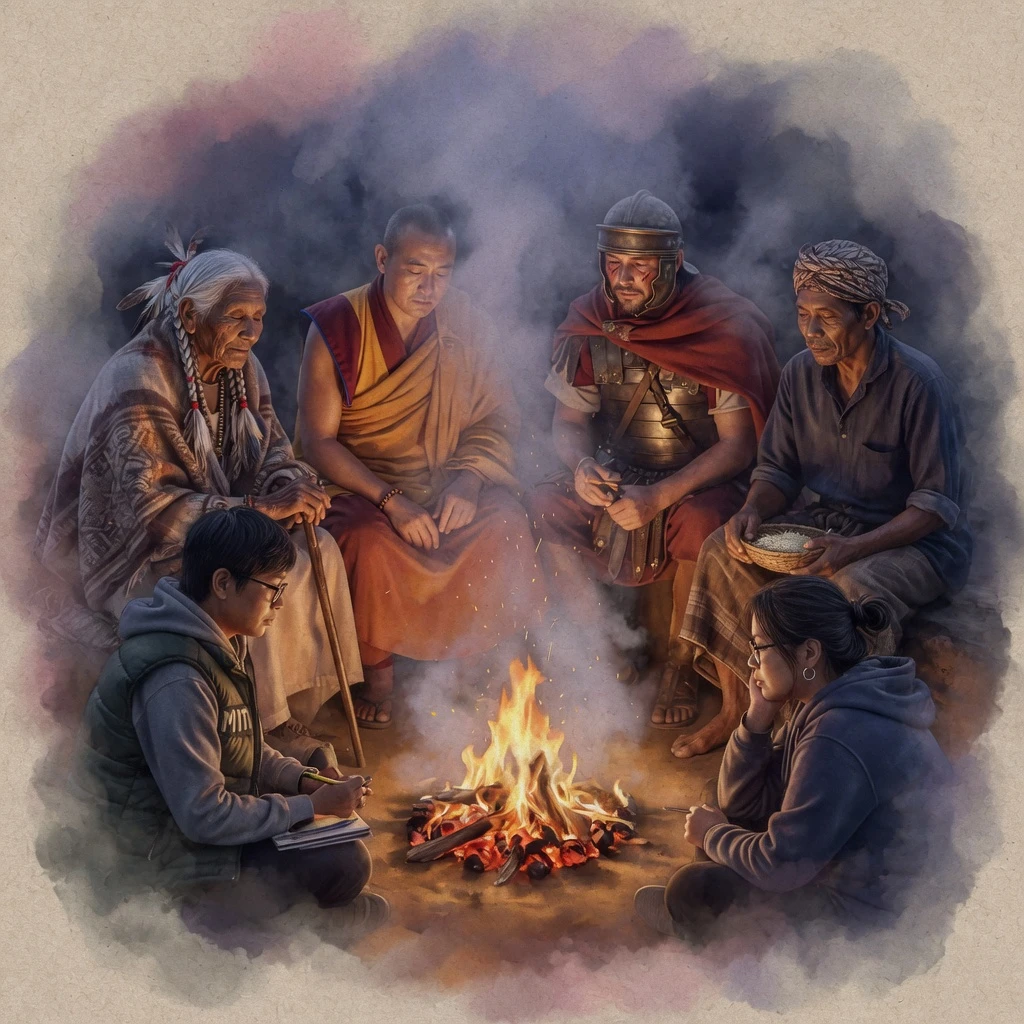
Eight parts of searching have earned one plain definition and two tests. So here they are, stated rather than argued: what a dharma is, and how to tell the better ones.
A dharma is a way of living that tells a person or group how to act, what to value, what to avoid, and what kind of person is worth trying to become.
A dharma is not necessarily a religion. It is a living ethical orientation: a pattern of values, habits, stories, duties, practices and social expectations that helps humans navigate the world. Most dharmas are inherited half-consciously and never feel chosen at all; a few are examined, reformed, or built on purpose. The word describes what a thing does, not how well: gentle and cruel, living and hollowed, all are dharmas. Whether one is any good is a separate question, answered below.
At its deepest level, a dharma is that which holds a life, a community, or a world together.
There is no single ‘the Dharma’
It is better to say a dharma than the Dharma, because human beings create many dharmas.
And the word itself is a placeholder. Every culture builds the thing and names it in its own tongue: Ubuntu, ma’at, and Tao are not translations of dharma but sibling names for sibling instances. The Sanskrit is kept because, of all the candidates, its root says most plainly what the thing does: hold.
A Buddhist dharma, a Hindu dharma, a scientific-rationalist dharma, a warrior dharma, an environmental dharma, a professional dharma, a family dharma, a personal dharma: all of these are candidates. But coherence alone does not make a dharma. What marks one off from mere custom, law, or etiquette is a combination of four features:
Comprehensive – it governs a whole life, or a whole domain of one, not a single slice of behaviour.
Identity-constituting – it binds from the inside, by conviction, and works to remake its carrier.
Oriented toward the good – an answer to how one ought to live, as its carriers conceive it, not a strategy for getting ahead.
Reflectively self-aware – it can be held up and known as a path: named, questioned, reformed.
The features come in degrees; a profession, a subculture, an environmentalism may carry two or three, and sit near the rim.
Religious dharmas do not have automatic privilege over secular ones. All dharmas can be studied as human cultural systems for answering the same practical question:
How should we live?
The question is shared. The answers are not: they differ all the way down, about what a person is, what time is, and what the world rests on.
What a dharma contains
A dharma usually includes:
Values – what matters.
Ethics – what is appropriate or inappropriate.
Practices – what one repeatedly does.
Stories – why life is this way.
Duties – what one owes to self, others, community, or world.
Community – whom one belongs to, and who holds one to the path.
Identity – who ‘we’ are, or who ‘I’ am trying to become.
Discipline – how one trains conduct, attention, speech, desire, and response.
Transmission – how the way is handed on: by story, example, drill, and correction.
A dharma is more than an idea: it becomes real through behaviour. It is embodied in how one speaks, works, eats, raises children, handles conflict, treats strangers, responds to suffering, and uses power.
Why humans need dharmas
Humans are cooperative primates with dangerous capacities: love and cruelty, loyalty and tribal hatred, care and domination, imagination and self-deception.
A dharma helps regulate these forces. It gives structure to conduct, makes people more predictable to one another, and helps groups coordinate, reduce conflict, transmit wisdom, and preserve meaning across generations.
In this sense, a dharma is a kind of ethical software running on human biological hardware.
It does not erase our animal nature. It trains it.
And none of this survives on its own. Every carrier of a dharma dies, so a dharma persists only by reproducing itself in new people: taught by story and example, grooved in by practice and repetition, held in place by a community that notices when it slips. The funeral is where that shows most plainly: the rite that sends one carrier off is the one that reseats the rest. Call it education, in the broadest sense, so long as the word is allowed to include all of that; explicit instruction is the smallest part of it, and most of the teaching happens below argument, which is why a dharma feels inherited rather than chosen. A dharma that cannot reproduce itself dies with the people who hold it, however wise it was.
And no dharma is built from nothing. New dharmas emerge from within the cultures and communities that carry their makers, and they inherit the materials of those cultures, the worse along with the better. The craft lies in choosing what deserves to go on holding.
How a dharma survives translation
A dharma can be carried out of its old cosmology, and the record holds both successes and husks. The translations that keep their transforming power do three things. They keep the whole bundle: practice, ethics and community together, never the soothing technique alone. They put some this-worldly replacement in the place the old metaphysics held: something that still binds, still motivates, still endures. And they remain a way of life one practises, rather than a worldview one merely holds. Do all three and a dharma can survive the loss of its gods. Keep only the soothing technique, and the result is a product.
The two tests
Holding is not by itself goodness, and plural is not the same as equal. A dharma is judged by two tests.
The first is substantive: the better dharmas hold without crushing. They gather a life or a community into shape and meaning without breaking the people inside them or the strangers outside them. A dharma that holds but crushes is a tyranny; one that refuses to crush but cannot hold is a mood.
The second is procedural, and it is the keystone: dharmas are better to the extent they remain revisable by the people bound by them. Not revisable by guardians alone, and not reformed from outside, however enlightened the outsiders: revisable by the bound. Dharmas are made things, and an unrevisable dharma is a made thing pretending to be found. The first test asks what a dharma does. The second asks who holds the pen.
Not everything that holds deserves to keep holding. These two tests are how to tell.
A personal dharma
A personal dharma is the way an individual consciously chooses to live. But it is never made alone: even the most personal dharma is built from inherited language, examples, communities, obligations and refusals, and it needs company, and someone to answer to, if it is to be more than a private mood.
It is not necessarily a mystical destiny or a fixed ‘life purpose’. It is more like a cultivated path: a way of accepting reality, responding to difficulty, reducing unnecessary harm, and leaving the place a little better held than one found it.
A mature personal dharma asks:
What do I care about above all else?
What kind of person do I become through my repeated actions?
What do my habits actually serve?
Does my way of living reduce suffering or increase it?
Does it help only me, or does it help us?
The question that dissolves
For readers who came from the secular-dharma world carrying its standing worry (is what we practise still Buddhism? is it really a dharma?): the eight parts behind this page dissolve the question rather than answer it. Dharmas are made, plural, and revisable. The living questions are the ones above: what are we building, does it hold without crushing, and who holds the pen?
A dharma is a way of living that holds a person or a people together. The better ones hold without crushing, and leave the pen in the hands of those held.
Sources & further reading
This coda states in miniature what Parts 1–8 argue and source in full; it introduces no new claims. The four features and the placeholder rule are Part 1’s; the disagreement among the answers is Part 4’s; the point about reproduction condenses Part 2’s storytelling and Part 5’s installation machinery; the translation rule is Part 7’s; the two tests are stated at the end of Part 8 and defended at full length in the appendix that follows, Dharmas: the better ones, which is also published with the research notes on GitHub.