
 Gary Dean
Taxonomy is the attempt to make a process sit still long enough to be spoken of.1
When Linnaeus set out to name the living world, he assumed that the world was already divided. Species were the created kinds; the naturalist’s task was to discover the joints and hang labels on them. Within a century that assumption had collapsed. Darwin, who spent eight years on barnacles and knew a taxonomic headache when he sat with one, was blunt: the term species is ‘arbitrarily given, for the sake of convenience’, and does not essentially differ from variety.2 The living world, on this view, is a series of forms grading into one another. Classification remains indispensable. It is also, at the point where it matters, a decision.
Among taxonomists that decision has a folk psychology attached to it. ‘Splitters’ multiply names. They treat small, consistent differences as evidence of separate taxa, and they would rather risk a synonymy later than bury a distinct lineage under a broader label. ‘Lumpers’ do the opposite. They treat those same differences as variation within a population, and they would rather risk concealing a real split than litter the literature with names that later have to be swept up. The temperament has been remarked on since at least the middle of the twentieth century; George Gaylord Simpson wrote as if it were already office lore.3 It is still office lore. It is also a poor explanation. Personality may bias a given worker, but the quarrel survives every change of personnel, every new instrument, and every generation of students who arrive convinced that this time the data will settle it. The data accumulate. The quarrel does not close.
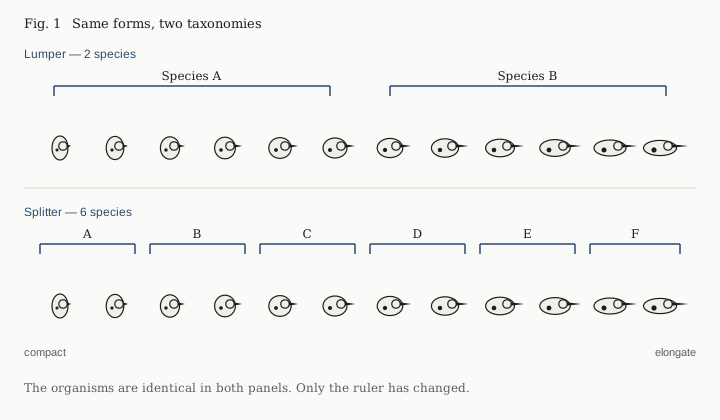
Fig. 1. Same twelve forms, two taxonomies. Schematic morphocline. The organisms are identical in both panels; only the ruler has changed.
It does not close because evolution does not deliver the units that the naming system requires.
A name in the Linnaean hierarchy is discrete. A specimen is this species or it is that one; a fossil is referred to one taxon or another; a conservation statute lists an entity or it does not. Evolution, by contrast, is a process in populations across time. Lineages diverge gradually, or rapidly, or not quite; they hybridise; they go extinct in the middle of becoming something else; they sort their genes incompletely; they form rings, clines, and swarms. The world that has to be named is full of spectrums. The language that names it is full of boxes. Visible light is the case everyone already knows. The spectrum is continuous; the colour terms are not, and they do not fall in the same places from one language to the next.4 Splitters and lumpers are the two available ways of forcing the first into the second.
Ernst Mayr’s biological species concept was the great lumping charter of the modern synthesis. Species, he argued, are groups of actually or potentially interbreeding natural populations, reproductively isolated from other such groups.5 The field naturalist, who sees intergradation and gene flow, was to be preferred to the museum worker who sees the skins in the drawer and names every island. Mayr called the museum habit a residue of typological thinking: the old error of treating species as essences rather than as populations. For sexually reproducing animals in the present tense, and in the temperate zones where Mayr did his watching, the concept works well enough to have survived a century of assault. It works much less well for the rest of biology.
Fossils do not interbreed on request. Plants hybridise with an enthusiasm that makes ‘reproductive isolation’ look like a zoologist’s prejudice. Bacteria exchange genes across distances the biological species concept cannot describe, and are grouped, in practice, by percentage thresholds of ribosomal similarity that everyone admits are operational. Ring species — the Ensatina salamanders of California are the textbook case, and like most textbook cases they have been disputed — present populations that can interbreed with their neighbours all the way around a barrier, until the two ends meet and cannot.6
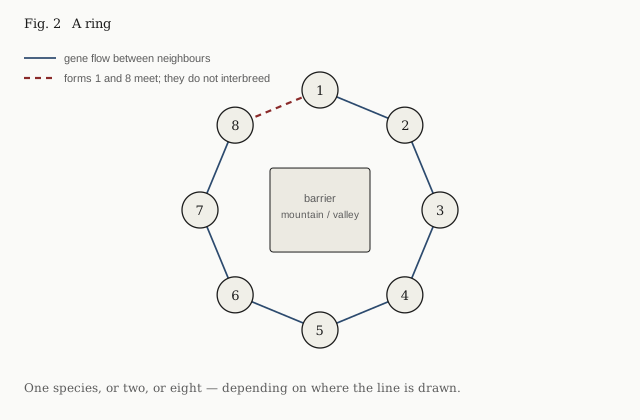
Fig. 2. A ring. Adjacent populations exchange genes around a barrier; the terminal forms meet and do not. Whether this is one species or two is a decision about the line, not a further fact.
Time itself is the deeper problem. A lineage sampled at 2 million years and again at 200,000 years may be continuous and still look, in the slabs, like two things. The biological species concept has almost nothing to say about this, because it was never designed to. It is a concept for the synchronic slice. Evolution is not a slice.
The phylogenetic species concept was the splitters’ reply. Joel Cracraft defined the species as the smallest diagnosable cluster of organisms within which there is a parental pattern of ancestry and descent.7 Diagnose a difference that marks a lineage, and one has a species. The attraction is obvious: it can be applied to fossils, to asexuals, to museum trays, and it claims to recover evolutionary history rather than breeding behaviour. The cost is equally obvious. Diagnosable differences are cheap. Every isolated valley, every island, every morphologically consistent subsample of a fossil assemblage becomes a candidate. Applied without mercy, the concept does not discover how many species there are. It discovers how fine a comb one is willing to use.
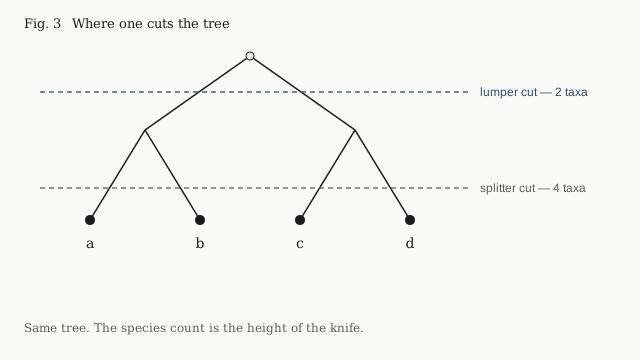
Fig. 3. Where one cuts the tree. The phylogeny is not in dispute. The species count is the depth at which it is sliced.
This is why better data have not ended the fight. Molecular sequencing, morphometrics, and computed tomography have multiplied characters. They have not revealed the joints. What they have revealed is more structure at every grain: more population structure, more incomplete lineage sorting, more old hybridisation, more geographic variation that can be read either as incipient speciation or as the ordinary noise of a widespread organism. The giraffe, for most of the twentieth century one species with subspecies, was proposed in 2016 as four species; subsequent analyses have not so much confirmed or refuted that proposal as demonstrated that the answer tracks the method.8 The Tapanuli orangutan, described in 2017 from the Batang Toru forests of Sumatra, is a split with immediate consequences: a population of perhaps eight hundred animals acquired the legal and moral status of a species on the edge of extinction.9 Neither case is a fraud, and neither is a discovery in the Linnaean sense; each is a decision about grain, made with better instruments than Linnaeus had, and still a decision.
The hominin record is the same argument written in bone, and it is the place where the public meets the quarrel without knowing the names of the factions. Homo erectus, in the lumper’s hands, is a long-lived, widely distributed species stretching from Africa to Java, from something like 1.9 million years ago until late in the Pleistocene. In the splitter’s hands that same material becomes H. ergaster, H. georgicus, H. pekinensis, and a scatter of other names, each tied to a site, a date, a cranial measurement. Homo habilis and H. rudolfensis may be two species, or one, or a grade of australopith that should not be in Homo at all. Neanderthals were a species, or a subspecies of ourselves, until the genomes showed a history of contact that makes the question look badly posed. Denisovans were identified from a finger bone, still lack a formal binomial, and were then found, in fragments, inside living people. The family tree that museums still print is a compromise among these fights, not the resolution of them.
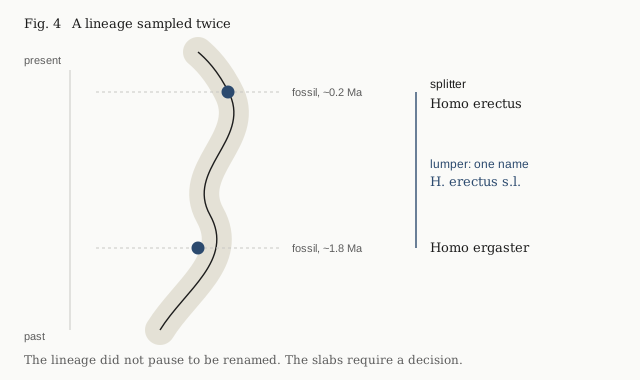
Fig. 4. A lineage sampled twice. Continuous anagenesis, two fossils. The lineage did not pause to be renamed; the slabs require a decision.
Paleoanthropology is not uniquely chaotic. It is merely where the sample is worst and the stakes, for those who think about origins, feel highest. Fragmentary fossils, small type series, characters that change with age and sex and pathology, and a literature in which a new name is also a career event: this is a machine for producing splitters. The lumper’s reply is that a new skull from Dmanisi or Rising Star is being asked to carry more taxonomic weight than any single specimen can bear. Both are right about the incentives, and neither is in a position to point to the joints.
Punctuated equilibrium is sometimes wheeled in as if it rescued discrete species from Darwin’s continuum. It does not. Eldredge and Gould argued that the fossil record, read at the grain of geological time, shows geologically rapid appearances and long subsequent stability, rather than the slow transformation of entire species that a certain textbook Darwinism had led people to expect.10 That is a claim about tempo and mode, and about where to look. It is not a claim that the boundaries are given in nature independently of the observer’s scale. A ‘punctuation’ is still a process with a duration. At the duration that matters to the animals, it may have been a spectrum. The slabs will not say.
If the quarrel were only a matter of museum drawers, it could be left to the specialists and their synonymies. It is not. Species are the currency of conservation law, of wildlife trade regulation, of environmental impact assessment, of the lists that governments and NGOs fund. Split a widespread organism into several narrow ones, and some of the new entities will be rare, and rarity attracts protection, grants, and the attention of the International Union for Conservation of Nature. Lump them, and a distinct population can vanish into a taxon of least concern and be gone before anyone is obliged to notice. Isaac and colleagues called the resulting proliferation ‘taxonomic inflation’ and pointed out, without much delicacy, that it distorts macroecology and conservation triage alike.11 The accusation is sometimes fair. It is also reversible. A lumper who declines to recognise the Tapanuli orangutan has not thereby preserved scientific purity. He has made a decision that may be fatal for a population that cannot wait for the next revision of the genus Pongo.
The honest position is uncomfortable. There is no species count that is simply ‘out there’, waiting to be read off the world in the way a census reads off persons. Asking how many species exist is like asking how long a coastline is. The answer depends on the length of the ruler.12 This is not a licence for cynicism. Some splits recover lineages that have been separate for hundreds of thousands of years, with distinct ecology, and the name does honest work. Some splits are the elevation of subspecies because the molecular clock, or the grant cycle, or the fashion in species concepts, currently favours elevation. Distinguishing the two is the actual labour of taxonomy. It is judgement, not algorithm. The labour is not made easier by pretending that one temperament is science and the other is vanity.
The same structure appears wherever human beings have to impose names on a continuum, which is to say, in most of the things they care about.
A language, Max Weinreich is supposed to have said, is a dialect with an army and a navy.13 Dutch and German intergrade; Indonesian and Malay are one literary history wearing two national costumes; the hundreds of named tongues of the archipelago sit on dialect continua that village-level speech does not respect. The atlas requires colours; the speech does not.
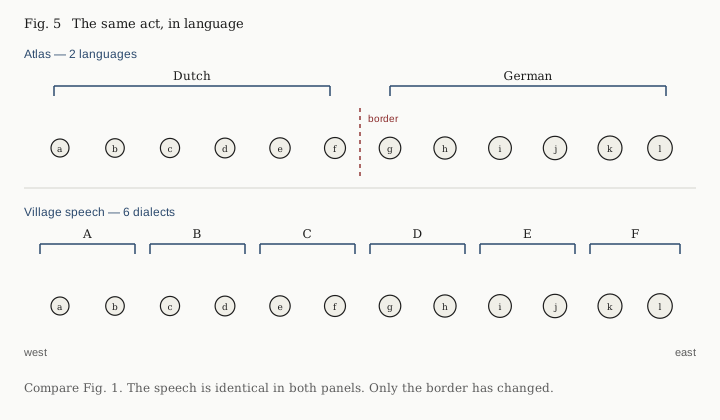
Fig. 5. The same twelve forms as Fig. 1, now as speech. Two named languages; a political border. Compare the species plate: only the ruler has changed.
Psychiatry has spent half a century oscillating between splitting disorders into ever finer codes and lumping them into spectrums: autism is the obvious recent case, with Asperger’s absorbed into a single ‘autism spectrum disorder’ in DSM-5, to the relief of some clinicians and the dismay of people who had organised a life around the narrower name. Folk race science is a splitter’s taxonomy applied to a species whose variation is clinal. The clusters that people are so sure they can see at the airport are real as social facts and untrustworthy as biology; the genetic variation is mostly within groups, and the between-group differences grade across geography rather than stopping at the borders that politics requires. Indonesia’s own catalogue of suku is another such scheme, more honest than race because it does not typically claim to be a discovery about blood, and no more given in nature. Geertz’s santri and abangan split Javanese religious life in a way that was illuminating and, later, contested as too clean.14 The pattern does not change: a continuum presents itself, a name is required, someone draws a line, and someone else says the line is in the wrong place.
Western readers are apt to think that this is a problem for exotic folk classifications, and that science, being ‘objective’, is exempt. It is not exempt. Scientific taxonomy is the most disciplined instance of the same cognitive act: the partitioning of a messy continuum so that people can index specimens, write laws, teach students, and tell each other what they saw. The discipline consists in making the criteria explicit, in publishing the evidence, and in accepting synonymy when the case fails. It does not consist in having escaped the need to decide.
What, then, is to be done with splitters and lumpers?
The useful question is not which temperament is correct. Correctness, here, is the wrong metaphysical demand. The useful question is what the classification is for. A field guide to the birds of a country wants a grain that a competent observer can apply at forty metres. A phylogeny of the same birds may want every diagnosable lineage, including those the observer cannot see. A conservation statute wants units that can bear legal weight without multiplying paperwork into paralysis. A paleontologist wants names that will not dissolve every time a new cranium is lifted from the silt. These purposes do not coincide. A single ‘species concept’ that served all of them would be a bureaucratic fantasy, of the same family as the fantasy that a nation-state’s borders were given by the landscape rather than drawn, with great care and some violence, upon a map.
This is not to say that anything goes. Within a stated purpose, some classifications are better than others. They predict, they travel, they do not have to be rewritten every season, they do not erase lineages that other evidence independently recovers. The error is to treat the preferred grain as a discovery about the furniture of the world. Species are not illusions. They are not, either, the created kinds Linnaeus thought he was filing. They are the least bad discrete names for segments of a process that is not discrete. Biology is messy because the process is messy. The names are the attempt to pretend otherwise, for long enough to get some work done.
Evolution does not read the labels. We do, because we have to talk.