
 Gary Dean
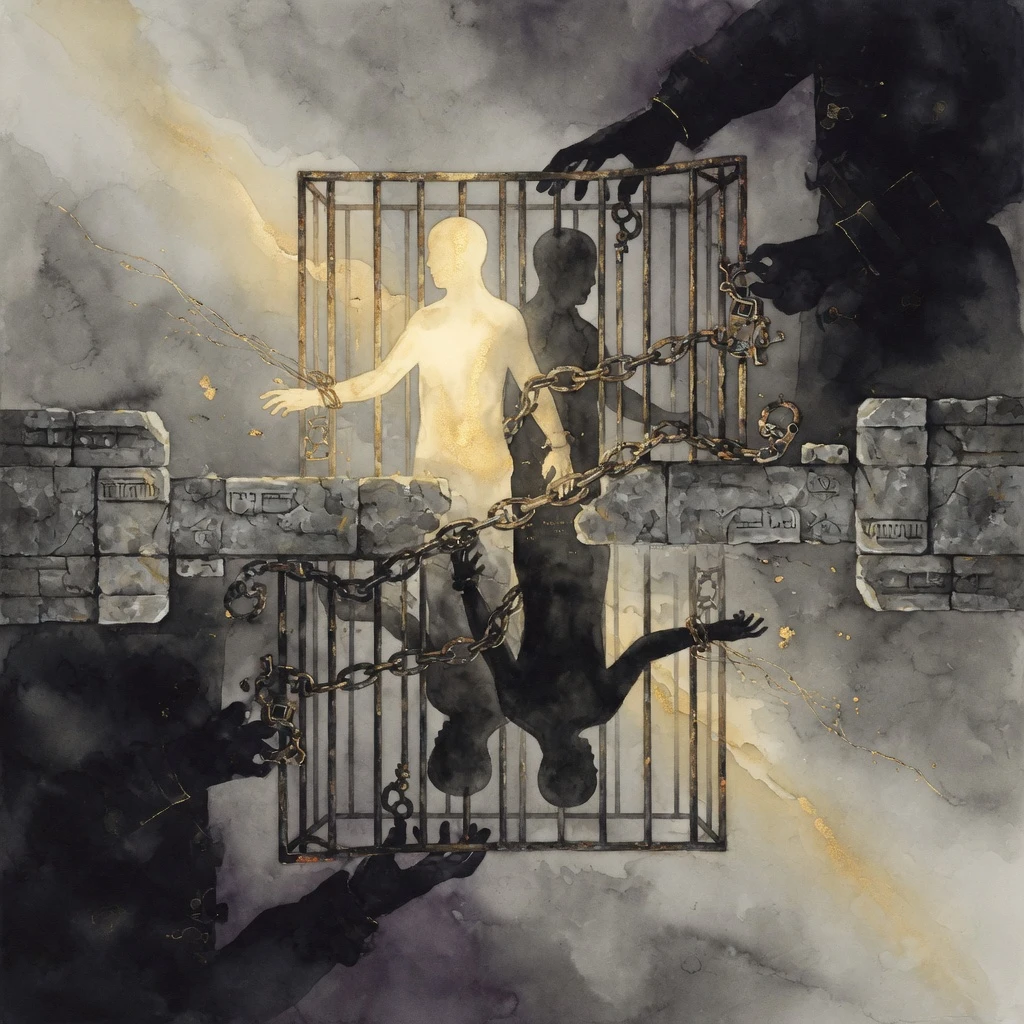
Every failure of a dharma turns out to be the dark twin of a strength. The bond that holds a group together is the fence that shuts others out; the authority that can free people is the authority that can rule them; the practice that liberates is the cage. Failure is not a flaw in a dharma; it is the strength, over-extended – or worn as a mask.
In the Buddhist-majority country of Myanmar, a monk named Ashin Wirathu spent years preaching. He wore the saffron robe. He had taken the vows. And what he preached, to large and adoring crowds, was hatred of his Muslim neighbours, the Rohingya, in terms so incendiary that he came to be seen, not entirely unfairly, as the Burmese face of a coming slaughter. When that slaughter came, when soldiers and mobs drove more than a million Rohingya from their homes, burning villages and killing as they went, the man in the robe had helped lay the moral groundwork, in the name of protecting the faith.
Buddhism, in the Western imagination, is the gentle dharma, the one with no crusades, the religion of loving-kindness, the breath, and the patient smile. And here is a Buddhist monk, sincere, learned, devout, using that very tradition to bless an ethnic cleansing. The first instinct, the comforting one, is to say: well, he is not a real Buddhist. Real Buddhism would never. But that instinct is a trap, and refusing it is where we have to begin.
For five parts we have been, mostly, sympathetic witnesses, watching how dharmas hold us together, how they answer the deepest human needs, how they get so far inside us that they feel like truth itself. We cannot stay sympathetic any longer, because a sympathetic account that never looked at the wreckage would be a lie, and would deserve none of the trust it asks for. If dharmas do everything the last five parts said they do, why is so much of history’s cruelty signed in their name? So now we look straight at that harm, done sincerely, century after century, by people every bit as certain of their own goodness as we are of ours.
Why ‘that’s not real Buddhism’ is a cop-out
The comforting exit has to be closed first: almost everyone reaches for it, and it leads nowhere.
When a Buddhist monk incites genocide, or a Christian blesses a slave ship, or any tradition is turned to cruelty, the reflex is to declare that the perpetrators have betrayed the true faith, that real Buddhism or real Christianity or real Islam is the peaceful thing and the violence is a corruption from outside. Philosophers have a name for this move. They call it the No True Scotsman fallacy, after the imaginary patriot who insists that no true Scotsman would do some disgraceful thing, and who, when shown a Scotsman who did exactly that, simply replies that no true Scotsman would. The trick is that you protect your ideal by redefining anyone who violates it as not really a member.
Scholars at Harvard’s Religious Literacy Project put the correction bluntly: religions are internally diverse, and a tradition deep enough and old enough to contain a saint is deep enough to contain a butcher, with both sincerely drawing on the same scriptures and the same authority. The peace-preaching monk and the hate-preaching monk are both authentically Buddhist. To say so is not to say the tradition commends them equally; it is to refuse the referee’s chair, which no outside observer holds. To wave the second away as fake is loyalty dressed up as argument, a way of refusing to see.
So I am going to hold to an uncomfortable rule from here on. The failures of a dharma are not betrayals of its pure essence. They are expressions of its real potential, as genuine as its glories, and they grow from the very same roots.
The dark twin
The last five parts turned up a handful of things that make a dharma powerful. A strong, identity-shaping sense of who ‘we’ are. Costly, hard-to-fake commitment that binds people tightly together. A transcendent authority that outranks any mere person or law. Deep in-group trust. And an installation machinery, the ritual and habit and repetition, that drives all of this below conscious thought until it feels like simple reality. Every one of those is a genuine strength, and why dharmas work.
Part 5 ended on the blankness of the last of these: the installation machinery will groove cruelty into the bone as faithfully as it grooves kindness. The same blankness runs the whole list. A strong ‘we’ is a wonderful thing right up until you ask what happens to ‘them’. Costly commitment binds the just community and the death cult with equal strength. A transcendent authority can chastise a tyrant or crown him. Deep trust inside the group is the same psychological fact as deep suspicion of those outside it. The features and the failures are not two separate lists. They are one list, seen from two sides. Every failure of a dharma is the dark twin of one of its strengths, which is why no dharma is safe, and why the failures keep coming back no matter how often we are scandalised by them. Six of these twins are worth naming.
The fence becomes a wall
The first and deepest failure is the one we have been circling since the very beginning, the hard edge around the warm circle.
A dharma works by turning a crowd of strangers into an ‘us’. That is its genius, the thing that lets it hold a group together across a scale no troop of apes could manage. But an ‘us’ is defined by its boundary, and a boundary has an outside. The same bonding that makes you cherish your own people is the very mechanism that primes you to fear and distrust the people beyond the line. (Field studies by Antonio Silva and Ruth Mace add one mercy: the two faces can come apart, and the hostility often tracks deprivation more than devotion.)
Researchers call it parochial altruism: we make sacrifices for the in-group and brace ourselves against the out-group. Turned up, fed on fear, and pointed at a hated minority, that ordinary instinct becomes the engine of the pogrom, the crusade, the inquisition, and the cleansing. The fence that holds the community together becomes the wall behind which the community does its killing. Wirathu’s monstrousness was not foreign to his dharma. It was his dharma’s in-group warmth, with the sign flipped outward at the people who had been defined as not-us. The scholar Mark Juergensmeyer, surveying religious violence across every major tradition, found the same grim pattern everywhere: there is no faith so peaceful that it cannot be turned, by someone sincere, into a reason to kill.
I do not want to leave this at despair, because one hopeful thing is buried in the research. It is not obvious that the lethal version of the boundary is hardwired. The primatologist Richard Wrangham points out that our chimpanzee cousins, who kill each other at rates much like ours, show none of the self-sacrificing battlefield heroism that human war runs on, and that the readiness to die for the group against another group looks more like something cultures install than something genes demand. If the killing is installed rather than bred in the bone, then it is not fate: argument cannot undo it, as Part 5 warned, but the same slow machinery that installed it can move it. The line around ‘us’ is not fixed at the tribe; it has been pushed outward again and again across history, from the band to the city to the nation, and there is no law of nature that says it cannot be pushed further. It is the thin thread of hope that Part 8 will try to pull.
The authority that frees becomes the authority that rules
The second twin lives in the very thing that lets a dharma stand above mere power: its claim to a higher authority.
Morality seems to have started as a levelling device. In the small forager bands of the deep past, the moral sense, as Christopher Boehm argued, worked as a way for the many to gang up on the would-be bully and keep any one person from lording it over the rest. And then, when societies grew and stratified, and some people came to rule over others, that same moral authority was captured and turned inside out, made into a justification for the very domination it had once resisted. This is the double face of dharma and power, and the history of religion cannot be understood without it.
On one face, a dharma sanctifies the ruler. The Hindu doctrine of caste, wedded to the idea of karma, could tell the man born into the lowest station that he had earned it cosmically, by his conduct in a previous life, and that his suffering was therefore just. Kings across the world have ruled by divine right. Marx had a hard phrase for this function: religion as ‘the opium of the people’, the drug that makes an unjust order feel bearable and even holy. The Italian theorist Antonio Gramsci saw the subtler version: the deepest power is not the soldier who forces you but the worldview, often religious, that makes the existing arrangement feel natural, inevitable, and right, so that you consent to your own place in it without anyone having to raise a hand. And whoever controls the dharma controls something even more basic, the power to say what counts as orthodox and what as heresy, who is inside and who is to be cast out. In the sociologist Pierre Bourdieu’s phrase, it is the power of legitimate naming, and it is one of the most jealously guarded prizes there is.
But there is another face, and it is the reason this is a real fight, not a swindle. The very same higher authority that can crown a king can also condemn him. Once it is granted that there is a justice above the throne, every prophet and reformer has a place to stand. The Hebrew prophets used it to denounce their own corrupt rulers. We watched this face at work in Part 3: the same machinery that let the Samin of Java quietly refuse an extractive authority is the machinery that caste used to sanctify one. The Indian reformer Bhimrao Ambedkar, leading half a million Dalits out of Hinduism and into a reconstructed Buddhism, performed the most surgical version of this move imaginable. To turn the dharma against the caste oppression he had suffered, he deliberately cut out the doctrine of karma, the exact teaching that had been used to justify that oppression. The authority that the powerful seize to sanctify themselves is the same authority the powerless seize to indict them. It is just that the powerful usually own the institutions, so the sanctifying face is the default and the liberating face is the harder, rarer, more dangerous achievement.
And even the liberating face is not as clean as it looks, which is the unsettling lesson the philosopher Michel Foucault pressed hardest. Power, he argued, is not only the boot that holds you down; it is also productive, busy making the very kind of person you become. Run a dharma’s apparatus through that lens and the point lands close to home. The confessional, the spiritual director, the meditation hall, the programme of self-improvement: these actively shape selves, train desires, and produce a particular sort of disciplined soul. So when a dharma frees you from one regime, it tends to install another in its place, a fresh set of rules about how to watch and govern yourself. There is no escape into a dharma-free clearing where the self runs wild and unsupervised, because the self is itself something a dharma builds. The real question is never power against freedom. It is always a matter of which regime of self-making you are living in, and whether you chose it or were simply born into it.
The cage: who holds the key
The third twin is the way a dharma, which promises a path to the good life, can become a prison, and nowhere is this clearer than in the two arenas of gender and money.
Consider gender first, because dharmas encode it early and the record is bleak. Across tradition after tradition, the codified mainstream has placed women under men and called it the order of things. The Hindu lawbook of Manu states flatly that a woman must never be independent, passing from the control of her father to her husband to her sons. An early Buddhist rule, one the canon itself may have acquired late, made every nun, however senior, subordinate to every monk, however junior. The Confucian ‘three obediences’ bound a woman to obey her father, then her husband, then her son. The household codes of the Abrahamic scriptures lock women into submission. In each case the subordination is handed the highest possible warrant, cosmic or scriptural, so that a human arrangement of power gets to wear the costume of eternal truth.
And yet the very same traditions carry within themselves the materials of revolt. The oldest collection of women’s poetry in India is a set of verses by Buddhist nuns celebrating their own awakening. The Hindu women-saints of the devotional tradition, Mirabai and Akka Mahadevi, walked out of their marriages and their assigned roles, using love of God as the one pretext their society could not deny them. The same Christian scripture that tells wives to submit also declares that in Christ there is ‘neither male nor female’. In our own time the scholar Amina Wadud rereads the Qur’an from a woman’s standpoint and argues that its true principle is equality, and that the patriarchy is the accretion, not the core. The rule is this: a dharma in itself neither frees women nor cages them. It is the contested ground on which that fight is waged, and the same scripture hands down both the chains and the keys. What decides which one you get is not the text. It is who holds the power to read it.
The word ‘cage’ carries my own values inside it. The yardstick I have been using, that subordinating women is a failure and freeing them a success, is itself a fairly modern and broadly liberal standard, and I should not pretend it floats above all dharmas as neutral fact. Many women, including many who had every chance to choose otherwise, have described lives inside traditional roles not as a prison but as a place of meaning, dignity, and chosen devotion. A fair reckoning has to hold two things at once. It must register that self-understanding honestly, rather than sneering at it from a comfortable distance, and it must still name the documented, systematic ways these systems have stripped women of autonomy and authority and called the result the will of heaven. Both of those are true, and the strain between them is the kind of thing the question of judgement will have to face.
Money tells the same double story. Dharmas have both blessed and damned economic orders, often in the same breath. The caste system assigned each person their economic place by sacred duty. In the West, as the philosopher Michael Sandel has argued, the old Protestant idea that worldly success was a sign of God’s favour, once God fell away, slowly curdled into the modern faith in meritocracy: the conviction that the winner deserves to win and, more cruelly, that the loser deserves to lose. That is a secular dharma doing the oldest dirty job in the book, re-sanctifying inequality after the gods have gone home, telling the poor their poverty is a verdict on their worth.
But dharmas have also been the sharpest critics of economic cruelty. David Graeber spent his career as an anthropologist arguing that the language of debt and the language of sin grew up entangled, and that debt has been the supreme tool for making the exploited feel that their suffering is their own fault. Against that, he set the older and almost forgotten intuition that the truly sacred act was never repaying a debt but cancelling it, the clean slate, the jubilee. The dharma that tells the poor to accept their lot and the dharma that tells them to tear up the ledger are written in the same hand.
The fire goes out
The fourth twin turns the danger inward. Not every failure of a dharma involves a victim. Some of the most insidious are the ones where the dharma rots from the inside while everyone keeps going through the motions, and these failures wear a friendly face, which is what makes them so hard to see. They come in two forms: the fire can go out, leaving the form perfectly preserved and empty, or it can burn too hot in the wrong direction, feeding on the group’s own certainty of its goodness.
The first is the hollowing. The sociologist Max Weber described how the white-hot insight of a founder, the living fire of a Buddha or a Christ or a prophet, gets slowly cooled and boxed up over the generations into something manageable: the teaching codified into texts, the experience replaced by a ritual, the personal charisma succeeded by a bureaucracy. The form survives intact, long after the thing it was built to carry has died inside it. A worshipper can kneel in a tradition that has become pure habit, recite words that mean nothing to anyone in the room, and mistake the husk for the kernel. At the scale of a single person this rot has a name too: spiritual bypassing, the use of lofty spiritual ideas to dodge one’s actual messy human problems, the serene meditator who is really just fleeing his own anger and calling the flight enlightenment. In each case the practice continues while its purpose silently inverts.
A rite can also fail to happen at all. Clifford Geertz watched one fail in a small East Javanese town in 1954, because the dharma underneath it had split. A boy of about ten died suddenly in the house of his uncle, a member of Permai, a political-religious movement of the day that was hostile to Islam, and the village religious official, the modin, who was also the man who prepared bodies and led the burial, declined to officiate for a family of that party, on instruction from above. Nobody else knew how. The neighbours came, as the slametan requires, and sat; the body lay in the house for hours while the men argued over whether it could be washed and who might say the words; and the ordinary machinery of Javanese death, which for as long as anyone remembered had turned a corpse into a grave and a stricken household back into a community by nightfall, jammed. Geertz’s point was that the rite had acquired a second meaning, a political one beside the religious, and the two could no longer be carried by the same words in the same room. The fire was still burning; the room had been divided, and the ritual that installs a dharma at its deepest, the one Part 5 stood at, is the first thing to fail when that happens.
The second self-corruption is stranger, because the dharma’s own success causes it. Doing good, it turns out, can license doing bad. The psychologists Benoît Monin and Dale Miller documented what they called moral licensing: having established our virtue in one act, we feel entitled to cut a corner in the next, as though we had banked moral credit and were now free to spend it. A dharma, by this logic, generates moral capital by the ton, and that capital becomes a permit (the laboratory finding is about individuals; scaling it up to whole communities is my own extrapolation). The community certain of its own righteousness is the community best able to excuse its own cruelty, because surely we, the good people, could not really be the ones doing wrong. And the very commitment-signalling that binds a group can run away into a purity spiral, an escalating contest to be the most devout and the most orthodox, until the dharma turns inward and begins devouring its own insufficiently faithful. Here the failure is not that anyone abandoned the dharma. It is that they took it too seriously in the wrong direction, and let their goodness become their alibi.
The blueprint becomes the bulldozer
The fifth twin grows from a capacity that no account of a dharma’s strengths can leave out, and that this whole book stands on: a dharma can be held up and known as a path. It can be named, questioned, reformed, and even built on purpose. We watched Ambedkar do exactly that two sections ago, editing a tradition, deliberately and with precision, to free his people, and Part 8 will argue that we must learn to do such building well. So it matters that this strength has a dark twin of its own, and that this twin has the highest body count of any failure in this part.
The French revolutionaries tried it first, and most literally. In the spring of 1794 the National Convention, at Robespierre’s urging, decreed a new religion into existence: the Cult of the Supreme Being, a rationalist faith of civic festivals and public virtue, designed to replace the Church it had just torn down. The inaugural festival drew hundreds of thousands to the Champ de Mars, with a statue of Atheism burned in effigy and an artificial holy mountain built for the occasion. The revolutionaries had already rebuilt time itself: history restarted at Year One, the months renamed, the seven-day week and its Sunday replaced by a rational week of ten days. It was a dharma by decree, complete with a freshly engineered installation machinery. Seven weeks after the festival, Robespierre went to the guillotine, and his religion went into the ground with him, vanishing so completely that most people now have never heard of it. The lesson is the one that Part 5 should lead us to expect. What takes generations to sink beneath consciousness cannot be legislated in a season, and a dharma that exists only as decree dies with the man who decreed it.
The Bolsheviks understood that, and aimed deeper: not new rituals for old people, but a new kind of person. Their leading theoretician, Nikolai Bukharin, said it with a frankness that still stops the breath, praising ‘proletarian compulsion in all its forms, beginning with summary execution’, as ‘a method of reworking the human material of the capitalistic epoch into Communist humanity’. (The words reach us through a hostile witness: the anarchist Alexander Berkman, who had gone to Russia as a believer in the revolution, quoted them in the indictment he spent the rest of his life writing.) Human material. The New Soviet Man was to be manufactured, and the factory was the labour camp. Seventy years later the project was abandoned, having reworked nothing and killed millions; Berkman’s summary of the party’s basic premise was that the people were a mob who ‘can be made free only by compulsion’.
And then the limit case. On the seventeenth of April 1975, the Khmer Rouge took Phnom Penh and declared Year Zero: history would begin again from nothing. Within about three days they had emptied a city of two million people at gunpoint, hospitals included. Money, markets, schools, religion and the family were abolished; the banks were dynamited, worthless currency raining on the streets. My old lecturer Paul Stange, whose scholarship on Java runs through this whole book, called it ‘a virtually incomprehensible effort to eliminate everything that had come from outside’. Historians still dispute the recipe: imported Maoism, a warped indigenous purification, a countryside already shattered by years of US American bombing; the erasure itself no one disputes. In under four years the regime killed nearly two million of its own people, roughly a quarter of the country. The purest blank slate ever attempted was the fastest catastrophe in this part.
James C Scott, the scholar of peasant resistance from Part 3, spent a career studying these disasters, and his diagnosis is precise. The catastrophe is not planning as such; it requires a combination. A blueprint drawn in perfect confidence. Contempt for the inherited, practical, local knowledge by which people actually live. A state willing to use the full weight of its force to impose the design. And a society too beaten down to resist. Run the three cases through that lens and a gradient appears: the Jacobins tried to replace the liturgy, the Soviets tried to replace the person, the Khmer Rouge tried to replace everything, and the body count rises with the depth of the erasure. The failure is not building. Every dharma we have met to this point was built by someone. The failure is the blank slate: the conviction that the inherited substrate, all that slow evolved and accumulated material of the first five parts, is rubble to be cleared rather than the only material there is.
I grew up in a working-class Perth where communists were not a spectre but part of the landscape. My father was a metalworker; the shop stewards and union officials of my childhood, Party members among them, were some of the most solidly decent people I have known, and the Left they belonged to was an ecumenical world in which communists, Labor people and even the anarchists all knew one another and worked together more often than not.
As a young man I spent some years as an activist in the Communist Party of Australia myself, working out of the same Trades Hall, and I am not ashamed of a day of it; for its time and place, I still think it was right. I can say that with a straight face here, of all places, because the party I belonged to was not a branch office of the terror described above. It was the counter-case. By the time I found it, it had cut its ties to Moscow and had publicly condemned the Soviet tanks when they rolled into Prague, and it spent its last decades slowly unbuilding its own dogma, arguing itself out of one certainty after another, until in 1991 it did the thing no catastrophic dharma in this section ever managed: it judged that its own form had outlived its purpose and voted to dissolve itself, its people and their politics flowing on, by fits and starts, into the movement that inherited their ground: the Greens.
The two pictures belong side by side: the whole lesson of this twin sits between them. The same word covers the emptied city of Year Zero and the unionists I knew in Trades Hall, and what separates them was never the dream of a fairer world, which both held. It was the boot. A constructed dharma that renounces the boot can keep the power to unbuild, and every horror in this section lacked exactly that power. (None of the gentler builders ever commanded a state, so the comparison is not a controlled one; it is still the only comparison history offers.) Dharmas can be built; they always were. But never with a boot, never at gunpoint, never against the grain of the animal, and never without leaving the unbuilding power in the hands of the people the dharma is for.
The mirror: dharma in the yoga studio
The sixth twin is the gentlest-looking and closest to home. Part 1 opened with the word ‘dharma’ on the front of a yoga studio, a soft and pleasant Western thing, vaguely Eastern, vaguely spiritual. It is time to look at that studio squarely, because it is a failure mode too, the failure of how a dharma travels across a line of power.
The problem is not that the West borrowed from the East. Cultures have always borrowed, and dharmas have always lived and grown by crossing borders and mixing; there were Greek kings on the frontier of India two thousand years ago who put the wheel of the dharma on their coins. Borrowing is not theft. The trouble is in the terms. When a powerful culture takes from a culture it once colonised, strips away the demanding ethical and communal core, keeps only the soothing technique, and sells it back as a product, something has gone wrong that the innocent word ‘sharing’ does not cover.
That deep structure has a name, given its critical sense by the scholar Edward Said: Orientalism, the long habit of the West constructing the East as an exotic, mysterious, faintly unreal Other, a screen onto which to project whatever the West was hungry for. The meditation app that promises stress relief with none of the inconvenient teaching about selflessness and the renunciation of craving, the mindfulness reduced to a productivity hack for the very economy it was once meant to question, has been called, sharply, ‘McMindfulness’, a nickname the critic Ronald Purser made stick. It keeps the calm and discards the challenge.
The appropriation goes deeper than products, all the way down into the categories themselves. The tidy nouns we reach for, ‘Buddhism’, ‘Hinduism’, and the very idea of a list of ‘world religions’, were to a considerable degree consolidated, named and boxed by nineteenth-century European scholarship. Not invented: a Hindu identity defined against Muslims is visible in Indian texts from the 1200s, and Buddhists knew perfectly well what they were before Europe gave them an -ism. But the boxes carve up other people’s lives in ways those people did not always recognise, built on Christian assumptions about what a religion is even supposed to be. The West did not only borrow the practices. It manufactured the containers through which we now perceive ‘Eastern religion’ in the first place, and then forgot they were manufactured. So when we sort the world’s dharmas into their neat boxes, we are often handling tools originally forged as instruments of empire.
And now the sting I cannot avoid, because the non-privileging eye has to turn back on itself. This very project, a secular dharma assembled in a Western language from traditions elsewhere, is a prime suspect in its own investigation. When I lift a ‘universal core’ out of Buddhism and set its Asian cosmology aside as cultural packaging, I am doing the exact move an appropriator would do, and saying the exact thing an appropriator would say to justify it. Whether that is honest translation or quiet theft is not settled by my good intentions. It hangs on power, on reciprocity, on whether I keep the demanding parts or only the pleasant ones, and on whether I am willing to be changed by what I borrow or only to consume it. I do not get to exempt myself from this. No one does.
The wolf in the flock
Every failure we have walked through so far shares one feature, and it is the feature that makes them so disturbing: they are sincere. The fence-builder loves his people; the priest who crowns the king believes in the crown; the keeper of the cage thinks he is preserving order; the planner who empties a city believes, with all his heart, in the blueprint; and even the appropriator, myself included, mostly means well. The dark twins need no villain. Ordinary devotion, turned a few degrees, does the damage by itself.
But a dharma is not only vulnerable to its sincere believers. The apparatus that makes it work, the deep trust it manufactures and the benefit of the doubt it extends to anyone who performs the right devotions, is a standing invitation to a figure who is not sincere at all. Back in Part 2, costly, hard-to-fake signals sorted the committed from the casual and welded a group together. That filter was built to keep out the free-rider, the one who wants the warmth of belonging without paying for it. It works against almost everyone. It does not work against the rare person who can perform every signal flawlessly and feel nothing behind it.
Such people exist. The clinical literature has described the far end of the range since the psychiatrist Hervey Cleckley named the ‘mask of sanity’ in 1941: a stretch of the human range (as Part 5 said, not a separate kind of human being, nor a headcount any two instruments agree on) in whom the ordinary equipment of conscience, empathy, fear, and remorse is, from early on, muted close to silence. But a dharma does not check diagnoses at the door. What creates the opening is the structure, not the rarity of the people who might walk through it. A dharma produces trust in bulk and hands it to whoever wears the robe convincingly, so the devotions can be worn as a costume, clinical profile or none, by anyone able to perform them without feeling their pull. This is the guru who preys on his disciples, the venerated elder unmasked after thirty years, the holy man whose followers cannot credit the charges precisely because he played the part so well. He does not over-extend a strength. He wears it.
Here the deep past speaks straight to the present. The forager bands of Part 2 had a remedy for exactly this figure: the intimidator who could not be shamed was watched, levelled, and in the last resort removed, because in a camp of thirty there is nowhere for a predator to hide. What the small band could do, the mega-society cannot. The very anonymity that broke the old morality, the sea of strangers a dharma was built to cross, is also the condition under which the predator flourishes, because the transparency that once exposed him cannot reach across a congregation of thousands or a corporation of tens of thousands. What protected the band was never a gift for detecting insincerity; it was accountable authority: everyone visible, everyone levellable, and the settled power to remove. Any community that manufactures trust at scale owes its members the modern forms of that same equipment. And it owes them one memory more: this same equipment has served, in every age, to punish mere difference, so a community that hunts wolves must watch what else gets called a wolf.
We built dharmas so that strangers could trust strangers, and in the same stroke we built the ideal cover for the stranger who should never be trusted. And this undoes the comfort sincerity seemed to offer: the sincere butcher may be more troubling than the fake one, but it does not follow that sincerity is a test we can lean on. Sincerity is the very thing the predator counterfeits, and a dharma’s demand for visible devotion rewards the most fluent counterfeiter in the room.
No dharma is safe
Taken together, these twins tell a single and rather severe truth.
The bond that holds a community together is the fence that shuts the stranger out. The authority that lets a prophet shame a tyrant is the authority that lets a priest crown one. A path that promises a good life can trap half of humanity inside an assigned role. The very fire that gives a dharma life is the fire that gutters out into empty form, or flares up into a righteousness that licenses cruelty. The capacity that lets a people know, reform and build its own path is the capacity that, armed with a state and a blueprint, will bulldoze a living world to make room for a paper one. The exchange that lets dharmas grow is the extraction that strip-mines a conquered people’s wisdom for a product.
In every case the failure is not a foreign contamination that a purer practice could avoid. It is the strength itself, running past its limit. Even the predator who games a dharma from outside marks the rule’s edge: not a strength over-extended but a strength counterfeited, possible only because the strengths are real. That means the comforting dream, the dream of finding the one good dharma that does not fail, is an illusion. There is no such dharma. The tendency to fail is the standing price of a dharma being powerful enough to do anything at all.
This is bleak, but it is also clarifying, because it finally kills a question we should never have been asking. ‘Is it a dharma?’ was never the same question as ‘Is it good?’ A thing can be fully, authentically a dharma, comprehensive and binding and deep, and be an instrument of horror. So we cannot rest in the comfortable pluralism that says every path is one more lovely flower in the garden. Some of these flowers are poison. If failure is intrinsic, then the only question left is not ‘which dharma is pure’, because none is, but ‘which dharma fails least, and recovers best, and by what standard could we possibly say?’ That is the question of judgement, the one we have been walking toward, and we can no longer walk around it.
But one complication remains. Every dharma we have put on trial here, every caste order and household code and crusading faith, was built long ago, for a world that no longer exists: the world of the village, the empire, the kinship clan, the agrarian field. That world is gone. For hundreds of millions of people now, the old gods have fallen silent, and the village has been replaced by the restless, rootless, screen-lit anonymity of the modern city and the internet. So the question is about to become double. Not only how we are to judge dharmas, but also what becomes of dharma itself now, in an age that has misplaced the foundations on which every previous dharma was built.
« 5: How a dharma gets under your skin | 7: Dharmas in a secular age »
Sources & further reading
This part is built from the project’s research notes, which carry the full inline citations. Listed here are the notes it draws on and the key works behind them.
Research notes
Research notes used in this book are published on GitHub.
- 7.1 Failure Modes – the four failure clusters, the No-True-Scotsman refusal, and the thesis that failure-proneness is intrinsic. The spine of this part.
- 7.3 Dharma & Power – the double face: morality as anti-domination captured to sanctify domination; Gramsci, Bourdieu, and Ambedkar.
- 6.4 Gender & Dharma – the subordinating mainstream and the liberating counter-current; the same scripture as chains and keys.
- 6.3 Economics, Work & Inequality – dharma as justifier, constraint, and critic of economic order; meritocracy and Graeber on debt.
- 7.7 Dharma by Decree: The Engineered-Dharma Failure Mode – the blueprint twin: the Jacobin cults, the New Soviet Man, Year Zero, and Scott’s authoritarian high modernism; the conditional licence for Part 8.
- 7.6 Dogma Undone: The CPA Case – the counter-case: the externally fact-checked history of a communist party that cut its ties to Moscow, unmade its own dogma, and dissolved itself.
- 7.2 Cultural Adaptation & Appropriation – Orientalism, ‘McMindfulness’, and the reflexive indictment of secular translation.
- 5.5 Psychopaths & the Exploiter Limit-Case – the insincere predator who games a dharma’s trust; the free-rider that costly signalling and Boehm’s reverse-dominance evolved to catch, and the one type built to beat the filter.
Key works
- On authentic failure: the No-True-Scotsman / internal-diversity argument (Harvard Religious Literacy Project), and Mark Juergensmeyer, Terror in the Mind of God – sacred violence across every tradition; with the Wirathu / Rohingya case (TIME’s cover story of 1 July 2013, ‘The Face of Buddhist Terror’; the UN Human Rights Council’s Independent International Fact-Finding Mission on Myanmar, report of September 2018; UNHCR’s figures for the 2017 exodus into Bangladesh – more than 700,000 in the first year, atop earlier flights that carry the displaced total past a million).
- Richard Wrangham, The Goodness Paradox (2019) – the lethal boundary as cultural rather than bred in the bone, and therefore movable (chimpanzees share our war-death rates but show no battlefield self-sacrifice).
- Clifford Geertz, ‘Ritual and Social Change: A Javanese Example’, American Anthropologist 59(1) (1957): 32–54, repr. in The Interpretation of Cultures (1973) – the Modjokuto funeral that could not be held.
- On a dharma’s self-corruption: Max Weber on the routinisation of charisma; John Welwood on ‘spiritual bypassing’; and Benoît Monin & Dale Miller on moral licensing.
- Michel Foucault, Discipline and Punish (1975), on productive power – power that manufactures subjects rather than merely restraining them; the application to a dharma’s apparatus of self-formation is this part’s extension of that premise.
- James C Scott, Seeing Like a State (1998) – why the great schemes to redesign society fail: the blueprint, the coercive state, the prostrate society, and the destruction of practical local knowledge.
- On the engineered catastrophes: François Ponchaud, Cambodia: Year Zero (1977); Alexander Berkman, What Is Communist Anarchism? (1929) – Bukharin’s ‘human material’ doctrine witnessed from inside; and Paul Stange, Ancestral Voices in Island Asia (2009) on the Khmer Rouge.
- Christopher Boehm on morality as anti-domination; Karl Marx (‘the opium of the people’); Antonio Gramsci on hegemony; Pierre Bourdieu on the ‘power of legitimate naming’; and BR Ambedkar’s Navayāna Buddhism.
- On the predator who games a dharma: Hervey Cleckley, The Mask of Sanity (1941), and Robert Hare, Without Conscience (1993) – psychopathy as a dimension of the human range, with conscience and empathy constitutionally muted at its far end; with Boehm (above) on the band’s levelling of the intimidator the mega-society can no longer watch.
- On gender: the Manusmṛti, the garudhammas, and the Confucian ‘three obediences’ (Ban Zhao); the Therīgāthā; the Bhakti poets Mīrābāī and Akka Mahādēvi; Galatians 3:28; Amina Wadud, Qur’an and Woman; and Rita Gross, Buddhism After Patriarchy.
- On economics: Michael Sandel, The Tyranny of Merit; David Graeber, Debt: The First 5,000 Years; and Karl Polanyi, The Great Transformation.
- On appropriation: Edward Said, Orientalism; Jeremy Carrette & Richard King, Selling Spirituality; and the colonial construction of the very category ‘world religions’; with David Lorenzen, ‘Who Invented Hinduism?’ (1999) and Audrey Truschke (2023) for the correction that the identities were consolidated, not invented, by colonial scholarship.