
 Gary Dean
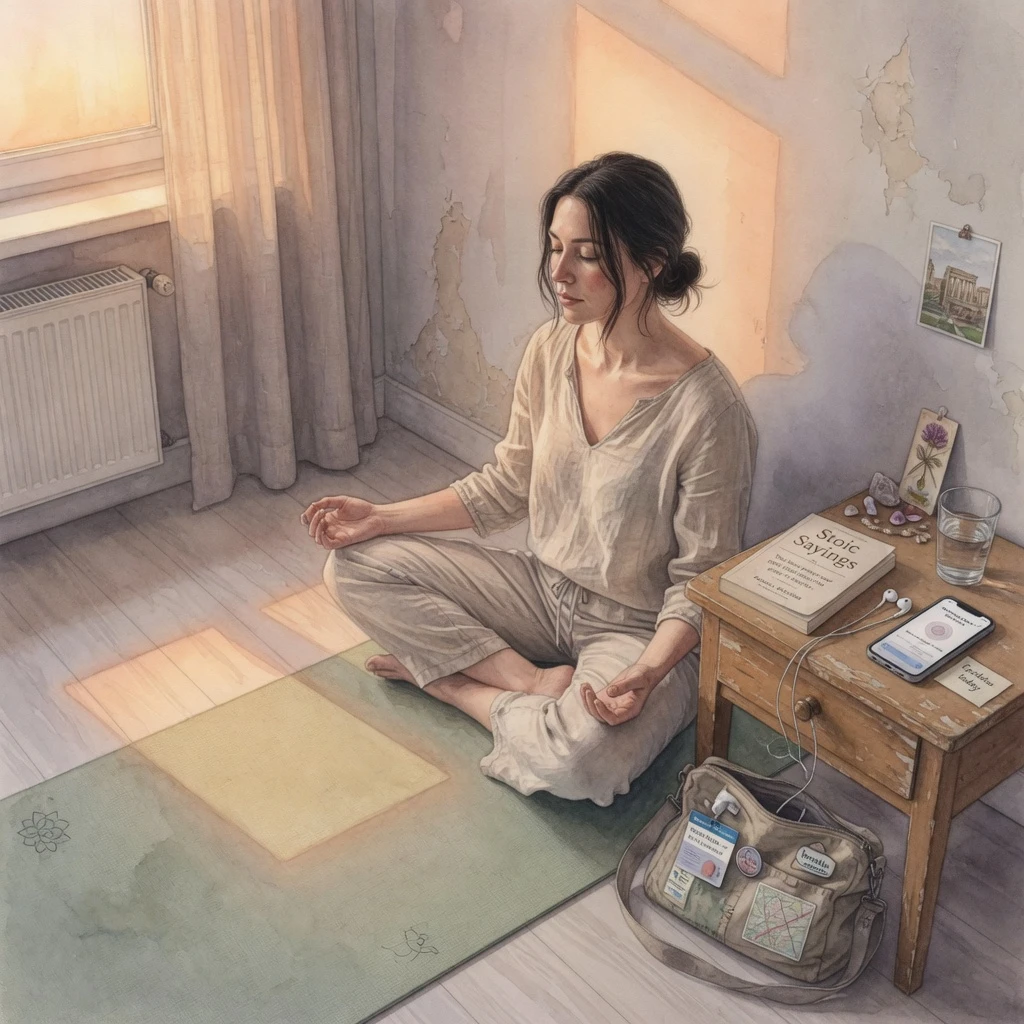
Hundreds of millions of people now say they are ‘spiritual but not religious’. That is not the absence of a dharma. It is the search for one, carried out by people who have lost the old foundations but kept the old need.
There is a kind of person nearly everyone now knows, and many of us have been.
She left the religion she was raised in, or was never really given one, and she does not believe in much that she cannot see. But she is not empty, and she is not satisfied. So she has assembled something. A little yoga, for the body and for whatever the body seems to know. A meditation app on her phone, ten minutes most mornings, its closing bell followed at once by the notifications waiting behind it. A book of Stoic sayings on the nightstand, a few wise voices in her headphones on the commute, some hard-won vocabulary from therapy, perhaps a quiet practice of gratitude she would feel slightly embarrassed to describe. She has not joined anything. She has built a private patchwork, stitched together from half a dozen traditions she does not formally belong to, and she lives by it as best she can.
There are now a vast number of these people, and the surveys have a name for them: the ‘nones’, the religiously unaffiliated. Theirs is the category that grew faster than any other in the Western world across the two decades to about 2020 (in the US, from 16% of adults in 2007 to roughly 29% by 2024), before its rise levelled off. The usual way to read them is as a story of decline, the slow draining-away of religion, leaving behind a thin consumer spirituality, a supermarket of the self where lonely people push trolleys past the incense and the self-help. I read them differently. What the seeker is doing is searching for a dharma, in the hardest possible conditions, as someone who has inherited the deep human need to hold a life together but has lost every one of the old foundations on which a dharma used to be built.
The old dharmas, with all their captures and cages, were made for the village and the empire and the believing crowd, and that world is gone. So the question now is whether a dharma can survive the loss at all. Can there be a real one, a binding one, a transforming one, without the foundations on which every previous dharma stood?
Three things a dharma used to get for free
To answer that, we have to be specific about what those lost foundations actually did, because ‘faith’ is too vague. A traditional religious dharma got three things, more or less for free, that a secular one has to find some other way to earn. Free, that is, to the person born inside it; the tradition itself paid for them continuously, in institutions and labour and discipline, and in no small amount of exclusion and coercion. The inheritance was free. The estate never was.
The first was grounding: a reason its commands were binding rather than merely optional, usually a commanding God who made ‘thou shalt’ into law rather than a preference. The second was installation: the whole apparatus of ritual, sacred ordeal, and tight community, anchored to unfalsifiable belief, that drove a dharma down into people until it ran their lives. And the third was a world that cooperated, a slow, face-to-face, information-poor world in which the main obstacle to living well was your own untrained heart. A secular dharma in the twenty-first century has lost all three. It has no divine lawgiver, a frayed and improvised apparatus, and a new world that, far from being indifferent to the holding-together a dharma does, is actively engineered against it.
A fourth thing is easy to leave off the list because it was so ordinary: a script for the day someone dies, saying who washes the body, who is told first, what is said, how long the house stays open, when the mourner may work again. Nobody had to invent it in the worst week of their life; it was simply there, and doing it was itself the consolation. That, too, is now something to be earned.
Before testing whether that loss can be survived, the frame itself has to stand trial, because the story I have just told has a name, and the philosopher whose title this part borrows spent nine hundred pages arguing against it. Charles Taylor calls accounts like mine subtraction stories: tales in which modernity is simply what remains once human beings have ‘lost, or sloughed off, or liberated themselves from’ the old confining illusions. His objection is not a quibble. Western secularity, he argues, is ‘the fruit of new inventions, newly constructed self-understandings and related practices’; not an emptiness left by religion’s retreat but a new, positive, built condition, whose signature invention is what he calls exclusive humanism, the first widely available way of living oriented entirely within this world. The anthropologist Talal Asad presses the same point from another flank: ‘the secular’ is not the neutral ground left when the gods withdraw; it is a constructed formation with a history of its own.
If they are right, and I think they are, then my talk of silence and loss is the believer’s-eye view of something that looks, from the other side, like a construction site. This does not weaken my argument; I think it completes it. The secular age is a crowded workshop of new dharmas, exclusive humanism first among them, the proliferating ‘nova’ of options Taylor describes, and the workshop is where the whole of Part 8 takes place.
But Taylor sharpens the problem too, in a way my subtraction telling actually understated. In the old world, the three free gifts went to whoever was born inside the dharma. In the secular age, Taylor argues, every position, belief and unbelief alike, is held as one option among others: contested, fragile, reflectively chosen. Which means the believer has lost the free gifts as well. Nobody now inherits grounding, installation, and a cooperating world; every dharma in the nova, religious or secular, has to earn all three the hard way. The tests that follow are therefore not the secular dharma’s special burden. They are the entrance exam every dharma now sits, and the secular candidate merely sits it without notes.
Can it bind?
Grounding is the objection the believer presses hardest, and the question Part 1 raised. Without a God behind it, the challenge runs, a dharma cannot really bind anyone. ‘Thou shalt not’ needs a lawgiver; remove the divine legislator and all our fine moral language collapses into ‘I would rather people didn’t’. The philosopher Elizabeth Anscombe put it in sharp terms: the whole vocabulary of moral obligation, of what one ought and must do, is the wreckage of a system that assumed a divine law, and it becomes literally incoherent once the lawgiver is gone, leaving only preferences dressed up as duties.
It is a serious challenge, and the answer comes in two moves, the first of which Part 1 named and left standing. Plato’s old trap, the Euthyphro question: is a thing good because God commands it, or does God command it because it is good? Take the first horn, and morality is arbitrary, a divine whim. Take the second, and the goodness was already there, independent, for God to recognise, so God is not its source after all. Either way, the divine command was never really doing the grounding work it advertised itself as doing. The believer who feels she stands on bedrock, and pities the secularist standing on sand, has mistaken the view. She was never on bedrock either.
The second move is harder, and it cuts against everyone, the believer and the secularist and the scientist alike. There is an old problem, sometimes called the trilemma, about any attempt to justify something all the way down: every chain of ‘but why?’ must end in one of three places, an infinite regress, a circle, or simply a place to stop and plant your feet. There is no exception. No system of ethics, religious, secular, or scientific, has ever reached genuine bedrock, because there is no bedrock to reach; the demand for an ultimate, unanswerable foundation is a demand that nothing in human life can meet. And once that is seen, the challenge to secular dharmas loses its force, because it was holding the secularist to a standard the believer never met either. The real question was never ‘is it grounded all the way down’, since nothing is. It is ‘is it grounded well enough to live by, and how?’
And to that question a secular dharma has real answers, just not cosmic ones. It can ground its claim on us in the brute fact that we are the kind of creature to whom things already matter, who cannot, except by damage, stop caring about suffering, our own and others’. It can ground it in what the philosopher Philippa Foot called natural goodness, the thought that for a living thing of a particular kind there is a recognisable shape to flourishing, the way there is for an oak or a wolf; cruelty and cowardice are defects in a human life as real as blight in a tree. It can ground it in the moral sentiments we are built with, the empathy and the sense of fairness that make another’s pain register in us whether we consent or not.
None of these is a thunderbolt from heaven. Each is enough to live by. The binding they produce is real, but it is a different shape of binding from the commandment’s: it is internal rather than imposed, conditional rather than absolute, a matter of if we would live well with others, then, rather than thou shalt, or else. That conditional, this-worldly binding may be the only kind there ever was. The commandment-shaped certainty the believer mourns was, perhaps, always a story we told about a binding that actually came from the same place the secularist’s does: the fact that we are an animal to whom it matters how we live.
That conditional shape is easy to mistake for weakness. To say a dharma binds you only if you would live well is not to say it binds you feebly. Compare the rules of health. They are not handed down from the sky; they hold, conditionally, for any creature that wants to go on living: if you would not sicken, then eat and move and sleep in roughly these ways. Nobody calls the laws of nutrition flimsy for being conditional on wanting to live. The dharmic ‘ought’ works the same way, and it binds with real force on anyone who has not somehow opted out of caring how their one life goes, which is to say on very nearly everyone alive.
The hardest version of the grounding objection, though, comes not from the believer but from inside the godless camp. Friedrich Nietzsche agreed entirely that the divine ground was an illusion – and drew the opposite conclusion from the one this part has been building. When the belief goes, he argued, the morality raised on it must eventually follow: the secular moralists of his day had rid themselves of the Christian God while clinging all the harder to Christian morality, not seeing that a faith is a system, a whole view of things thought out together, so that breaking out the God breaks the rest.
On his diagnosis the very things a secular ethic keeps – compassion, the priority of suffering, care for the weak – are not self-evident truths but inherited residue, a pity-morality running on borrowed authority; he even jeered that Europe’s spreading religion of sympathy was heading toward ‘a European Buddhism’. The taunt lands close to home, and it deserves a straight answer rather than a wince. The answer is the one this book has been assembling since Part 2: care is not the residue of any creed. The mattering, the empathy, the fairness-sense are older than every scripture that later claimed them, the evolved endowment of a cooperative animal, which the creeds inherited and codified rather than invented. Nietzsche is owed one concession, and it is a real one: he is right that the content cannot simply be kept on as obvious. It must be defended, positively, on its own this-worldly ground.
And a dharma can add an answer here that is peculiarly its own. It does not finally rest its authority on an argument you could win or lose in a debate. It rests it on an invitation: come and see. The old Buddhist word is ehipassiko, and what it asks for is your experiment. Live this way, it says, actually do the practice, and watch what happens to your own suffering and to the suffering of the people around you. The grounding, on this view, is a result discovered inside a life, and that relocates the whole question from the heavens down to lived consequence, which is exactly where a secular age can still test it. It is a humbler foundation than a commandment, but it is also one you can actually check.
Can it install?
Grounding, though, is the easier of the two philosophical problems, and the one secular dharmas worry about too much. The harder one is installation, and it is where most of them fail.
A dharma gets inside a person not by argument but by drilling: by ritual, repeated practice, and tight community, driven below conscious thought until it runs a life. And part of what made that drilling stick, historically, was that it was anchored to claims one could never test and so never disprove. A secular dharma throws the unfalsifiable anchor overboard on purpose. The question is whether the apparatus still works once that is done, and the answer is that it sometimes does and often does not, and the difference between the two outcomes is the most practical thing a seeker can learn.
Take an ancient practice, lift the one technique out of the demanding ethical and communal whole it grew in, and sell that technique on its own as a tool for feeling better. This is what happened to mindfulness. Pulled out of Buddhism and packaged as an eight-week stress-reduction course, it spread to clinics and corporations and schools, and on its own narrow terms it works: Madhav Goyal’s meta-analysis of the careful trials finds real if modest reductions in anxiety and pain. There is nothing wrong with a clinical tool doing clinical work; nobody faults an analgesic for not being a way of life. But as a dharma it was hollowed out in the lifting, which is why the nickname ‘McMindfulness’ has bitten so hard. Stripped of the ethics that once gave it a direction, mindfulness became a way of helping stressed and exploited people tolerate the conditions that were stressing and exploiting them, a tool for making a worker more productive rather than a person more free. The lesson is brutal and clear: efficacy is not transformation. A practice can be clinically proven to work and have entirely lost the point.
But the other outcome is real, and it is why this is not a counsel of despair. One can strip the metaphysics and keep the whole bundle, the practice and the ethics and the community together, and put something this-worldly in the place the old supernatural anchor used to hold. This is what the former monk Stephen Batchelor calls secular Buddhism, or better, secular dharma. He lets the rebirth and the karma fall away as the cultural packaging of ancient India, and keeps the contemplative practice, but he does not keep only the soothing technique. He deliberately puts the ethics back, and widens them, insisting that the practice must turn on racism and injustice in the world as much as on greed and craving in the self, exactly the social dimension that McMindfulness had dropped.
One doctrine in that discarded packaging deserves a second look before it goes, because the rule being applied – reconstruct, don’t extract – applies to it too. Karma can be let fall with the rebirth it was wired to, or indicted: wedded to caste, the doctrine that told a man his station was his own past deeds collecting their debt, until Ambedkar led half a million people out from under it. But there is a third option the argument should at least name: karma naturalised, as a this-worldly technology of intention and consequence.
The Buddha himself defined karma as intention, and read that way the doctrine asserts things a secular ethic can keep with a straight face: that intentions shape the actor who holds them, each choice grooving the next, which is Part 5’s habituation machinery in ancient dress; that consequences propagate through a community whether or not anyone is watching, which is Part 2’s reputation machinery likewise; and that no ledger is kept anywhere else. Rebirth was the packaging; the feedback loop was the point. I flag this reconstruction rather than perform it, since performing it would be a book of its own. But a secular dharma that admires Batchelor’s method should notice that the method does not have to stop where Batchelor stopped.
Or look at the success story of modern Stoicism, which translated into the secular world so completely that it became a school of psychotherapy: the founders of cognitive behavioural therapy openly credited Epictetus. His line ‘men are disturbed not by things, but by the views which they take of them’ is the seed of the whole method. The historian of ancient philosophy Pierre Hadot reframes the entire project. Ancient philosophy, he showed, was never mainly a set of doctrines; it was a way of life, a body of spiritual exercises practised daily, and that practical core withered only later, when philosophy hardened into something merely read and argued about. On Hadot’s reading, secular translation at its best is not a theft from religion at all. It is a recovery, a restoring of the lived, practised, transforming core that the traditions themselves had often buried under doctrine and institution.
Secular translation is a transferable structure, not one tradition’s lucky accident: the very same operation has been performed inside Christianity. The Anglican theologian Don Cupitt, in a book bravely titled Taking Leave of God, argued that religious language can carry our deepest human and ethical aspirations without pointing to any supernatural being out there at all, sustaining a this-worldly, practised spirituality with the metaphysics politely set to one side. Strip the supernatural, keep the practice and the ethics, re-ground the whole thing in this life: it is precisely Batchelor’s recipe cooked in a different kitchen, and the two men recognised each other as kin.
From the successes and the failures together, a clear rule emerges. A secular translation keeps its transforming power when it does three things: it preserves the whole bundle of practice, ethics, and community rather than lifting out the technique alone; it supplies some this-worldly replacement for whatever the old metaphysics used to do, the binding and the motivating and the enduring; and it stays a way of life one practises rather than a worldview one merely holds. Do all three and a dharma can survive the loss of its gods. Do none of them, keeping the soothing technique and discarding the rest, and the result is simply another McMindfulness.
The bundle has a third strand, though, and it is the one the modern world is least able to supply. A dharma installs through community, through a real and present ‘we’: the congregation that drills the practice together and holds its members to it, the people whose watching eyes make the commitment cost something. And community is what the secular and the digital age have thinned almost to nothing. The self that modern life produces is what its communitarian critics call the unencumbered individual, cut loose from the dense web of relationships that older dharmas took for granted, and increasingly that self meets other selves only through a screen. Our seeker with her app and her book is trying to install a dharma essentially alone, which is a little like trying to learn a language with no one to speak it to. She can keep the practice on her own, and even, with effort, the ethics. The ‘we’ is the hardest part to rebuild from scratch, and a dharma without a ‘we’ struggles to get beyond the surface of a single private life. This, more than the missing God, may be the secular dharma’s deepest practical wound.
The missing ‘we’ costs most at a death, because the seeker cannot bury alone. When her mother dies she discovers that the practice has nothing to say about a body, that the people who would have known what to do belong to a congregation she left, and that the old words, which she has decided are false, are the only ones anyone in the room knows. The humanist celebrant has appeared to fill that gap, in Britain especially: a professional hired to compose a rite for a family that no longer has one. I do not have reliable figures, but the trade exists and, as far as I can tell, is growing. A dharma that must hire its funerals from outside has not yet installed. Beside grounding and installation, then, a third test: can it bury?
Sumarah, the Javanese fellowship of total surrender we looked at in Part 4, looks like the strongest card in the secular dharma’s hand, and, as a model, in some ways it is: a living, non-Western tradition, now ninety years old, that practises without scripture, guru, or creed; that asks nobody to convert, having nothing to convert them to, so that Muslims, Christians and Buddhists sit together and remain what they are; that tells its members to accept nothing on faith (‘We differ from religions, within which people accept God on faith and without knowledge’, its first chairman said); and that installs, precisely, through the ‘we’ the modern seeker lacks, a weekly circle and a guide attuned to the room, transformation by sitting together rather than by doctrine.
Most of what the three-part rule demands was achieved in Java decades before any Western experiment began: the institutional half of the problem, practice without priesthood, and the epistemological half, conviction without creed, are demonstrably solvable, because a small fellowship solved them and has held the solution for three generations. But the rest of the story cuts the other way.
When Sumarah’s own practitioners devised a religiously neutral ‘relaxed meditation’ for officials and foreigners, the leadership ruled from inside that meditation without God ‘led to void and not God’; the apparatus was removable, but the theism was the point. Even that ruling, though, has a shadow that could not be named while the Indonesian New Order stood: it was issued under a state that had, after the massacres of 1965, treated atheism as communism’s twin – no statute ever named it; none was needed to make it lethal to profess – and made priority to God the price of a movement’s legal existence, so how much of the floor was devotion, how much the pious etiquette that opens all Indonesian public speech, and how much survival is a question the record can no longer answer.
The secular-feeling Sumarah that Western practitioners sit in today exists because the translation was performed in transit, by the receivers. A great deal, it turns out, can be stripped from a dharma and the practice survive. What no tradition has yet shown, from the inside, is the removal of its own God; that operation, so far, has always been done by someone else, somewhere downstream, and Sumarah, for three decades, was not even free to try. The proof of concept is real, and it is not ours. The hard part is still ours to do.
So can a secular dharma install? The verdict is: sometimes, if it keeps the whole bundle and works hard to replace what the gods used to supply. The secular experiments are real but young, and we should be suspicious of how readily the people running them, this project among them, declare their own success. But the failure mode and the success mode are now clear enough to steer by, and that is not nothing.
The new terrain
Suppose, though, that both problems were solved, that a secular dharma could be both grounded and installed. It would still have to do its work in a world unlike any a dharma has faced before, and this is the part that is genuinely new under the sun.
Nearly every dharma in history was built on the working assumption that the main obstacle to living well sat inside your own skull: your own craving, your own distraction, your own untrained mind. The contemplative traditions were, accordingly, technologies for disciplining attention against an inner enemy. The outer assault is not wholly new; the last century’s advertisers, propagandists and broadcasters had already begun it. What is new, and only about twenty years old, is an apparatus that is personalised, ubiquitous, and self-improving: one that learns each mind’s particular weaknesses, individually and in real time, and gets better at exploiting them with every use. The enemy is no longer only inside us, and no longer generic. It is outside us, industrialised, very well funded, and it knows you.
We have built, in a single generation, what its own critics call the attention economy, an enormous apparatus whose business is the capture and resale of human attention. Our gaze is the product; the feed is the bait. And the bait is engineered, with enormous skill and oceans of data, to hijack the very reward systems evolution gave us. In the psychologist Mark van Vugt’s description, social media is a supernormal stimulus, an exaggerated cue that feeds our ancient hunger for connection far more cheaply and intensely than real life ever could, the way junk food hijacks a palate evolved for scarce sugar and fat. We have, he notes bleakly, no natural defences against it.
James Williams, who left a career inside Google’s advertising machine to study what it does to us, puts the stakes plainly: these systems are not neutral tools but engines for ‘redirecting people away from their wills’, from what they actually, reflectively want their lives to be. A dharma’s oldest and deepest job was to hold a human life together, to gather a scattered self around what matters. The attention economy is, almost precisely, a machine built for the opposite purpose: to scatter the self, to shatter attention into sellable fragments, to keep us reactive and outraged and never quite still.
Private attention is only half the damage; the rest falls on the shared world we attend to together. The old gatekeepers of information, for all their faults, are gone, and into the gap pours an undifferentiated flood. The best-known study of how falsehood moves through a social network, by Soroush Vosoughi and his colleagues, found it spreading further and faster than the truth, and the usual explanation is that outrage is the most engaging product of all. I would not lean the whole weight of an argument on that finding, which concerns one platform in one period and which later researchers have worked hard to qualify.
But you do not need the strong version. It is enough that the sorting is done by engagement rather than by truth, and that nobody designed it to care about the difference. Worse, the very act of publicly broadcasting a conviction tends to harden it, so a medium built for endless broadcasting is also a machine for making everyone more certain and less movable. The new age does not tame the failure modes traced earlier; it amplifies and accelerates them. The purity spiral that once took a generation to consume a community can now run its course in a weekend, and the lethal fence between ‘us’ and ‘them’ is rebuilt a thousand times a day by systems that have learned that division holds attention better than peace. A dharma for this terrain is not facing the old, slow drift of a wandering mind. It is facing an adversary that gets cleverer every quarter.
This forces something new on any dharma that means to survive here. The old contemplative move, work on the self, train one’s own mind, is necessary but no longer sufficient, because no amount of private inner discipline can hold out indefinitely against a billion-dollar industry engineering our weaknesses in real time. A digital-age dharma has to work on the environment as well as the self: on the design of the machines, on the rules that govern them, on the shared structures of attention.
The contemplative traditions were never hermetically apolitical; monasteries negotiated with kings, and patronage shaped what could be taught. But no path before this one had to treat the design of the surrounding attention environment as itself a matter of practice, and that political and collective register is now central rather than marginal. The new register is audible in the people groping toward it: the writer Jenny Odell’s call to resist the colonisation of our attention by reattaching it to place and community and the physical world, or the movements pressing for a more humane technology that would be built to serve our intentions rather than to farm them.
And the deepest irony of all: the single most celebrated secular dharma of our time, mindfulness, has itself been swallowed whole by the attention economy, sold back to us as the very coping tool that lets us endure the machine, the same hollowing McMindfulness names. The cure has been digested by the disease. Any real dharma for this age has to be more than a better way of putting up with it.
One thing does not change in all this, and it points to the resource a new dharma has to draw on. The deepest contemplative traditions never treated attention as a neutral spotlight to aim wherever one pleased. In Buddhism, the relevant idea is not ‘bare attention’ but something closer to ‘appropriate attention’, a noticing already shaped by ethics and intention and woven into the whole question of how to live. The attention economy, by reducing mindfulness to a content-free knack of just-noticing, severed attention from that ethical core, and that severing is exactly what made it so easy to capture and resell.
A real digital-age dharma is therefore partly a recovery, the same move Hadot described: it restores the old truth that what you attend to, and how, is already a moral act, the very fabric of the person you are slowly becoming. And it has begun to grow its own concrete practices. The writer Cal Newport’s ‘digital minimalism’ is recognisably an installation practice in the old sense: a month-long declutter, a deliberate, almost ruthless pruning of the apps and feeds back down to the few that serve a chosen value, a ritual of subtraction meant to re-train a scattered attention until focus becomes, once again, a settled disposition rather than a daily losing fight.
The shape of the question changes
The inherited dharmas are fraying, and most of them were made for a world that is gone. The secular replacements can perhaps be grounded, though only in the quieter, conditional way that may be the only grounding there ever was; and they can perhaps be installed, though the apparatus is improvised and the evidence is young; and they must do their work on terrain engineered, deliberately and for profit, against the gathering of a self. That is a daunting tally. But the seeker we started with, the one with the yoga and the app and the book of Stoic sayings, looks different now. She is not a symptom of decline. She is doing, alone and clumsily and mostly without help, the most ancient human work there is: trying to assemble, out of the materials at hand, a dharma she can live by. The patchwork is construction, under conditions no earlier builder ever faced.
And that recognition changes the very shape of the question we have been asking all along. For all of human history before now, the question a person faced was: which of the inherited dharmas is the true one, and how do I submit myself to it? One was born onto a path, and the task was to walk it. But the seeker cannot ask that question any more, and she knows it. So the question is mutating, in her hands and in ours, into something no previous age could quite bring itself to ask out loud. Not which dharma do I receive, but: can we build a better one, knowing exactly what we are doing, on purpose?
That is a vertiginous question. It is also the most dangerous question there is, because the instant one says out loud that dharmas can be built, the terrible follow-ups arrive: built by whom, for whom, toward what end, and what gets crushed in the building? And we are being made to ask it at the most demanding moment imaginable, on a planet in crisis that may need some shared ethic to survive at all, and on the eve of building machines that may soon think, into which someone, somewhere, is already preparing to pour an ethic of their own. We have come, at last, to the making of dharmas. That is Part 8.
« 6: When dharmas go wrong | 8: Creating dharmas »
Sources & further reading
This part is built from the project’s research notes, which carry the full inline citations. Listed here are the notes it draws on and the key works behind them.
Research notes
Research notes used in this book are published on GitHub.
- 3.3 The Grounding Problem – whether a godless dharma can bind: the Euthyphro reframing, the trilemma of ultimate justification, Nietzsche’s radicalisation, and the this-worldly anchors. The spine of ‘Can it bind?’
- 6.1 Secular Translation – extraction versus reconstruction; Batchelor, McMindfulness, Stoicism-to-CBT, and Hadot’s ‘recovery’. The spine of ‘Can it install?’
- 3.5.4 Sumarah & the Secular-Dharma Question – the ‘living proof’ claim calibrated: the institutional and epistemological halves solved at origin, the theological half translated in transit; ‘void and not God’, and that ruling’s own duress-contamination under a state that outlawed atheism after 1965. The spine of the Sumarah paragraph.
- 3.5.2 Sumarah: Practice & Transmission – the weekly guided circle as installation through a ‘we’; practice without scripture, guru, or creed; the ‘relaxed meditation’ dispute.
- 3.5.3 Sumarah: Rasa Epistemology – Surono’s ‘we differ from religions’ and conviction-without-creed as a working epistemology.
- 6.2 Digital-Age Dharma – the attention economy as an external, industrial adversary; the supernormal stimulus; and the move from self-cultivation to environment-design.
- 3.1 Tension Resolution – the atomised modern self and the community a dharma needs but the secular age has thinned.
- 7.2 Cultural Adaptation & Appropriation – dharma-as-consumer-product; the extraction critique that ‘McMindfulness’ sharpens.
- 6.5 Secularisation & the ‘Nones’ – the Pew demographics behind the opening: the US ‘nones’ at 29% (and plateaued), SBNR at 22%, the global 1.9 billion; why ‘fastest-growing’ needs its time-and-place qualifier; and the Taylor–Asad correction to the subtraction frame (secularity as construction, and the fragilisation of every position) that this part’s ‘on trial’ passage states.
Key works
- Charles Taylor, A Secular Age (2007) – the source of this part’s title, engaged rather than merely borrowed: against ‘subtraction stories’, secularity as ‘the fruit of new inventions’; exclusive humanism; the nova effect; the fragilisation of belief and unbelief alike. With Talal Asad, Formations of the Secular (2003) – ‘the secular’ as a constructed formation with its own history, not religion’s residue.
- On grounding: GEM Anscombe, ‘Modern Moral Philosophy’ (1958), for the no-lawgiver objection; Plato’s Euthyphro; the Münchhausen trilemma; and Philippa Foot, Natural Goodness (2001), on flourishing for a creature of our kind. Friedrich Nietzsche, The Gay Science (1882), The Genealogy of Morals (1887) and Twilight of the Idols (written 1888), for the counter-thesis from the godless side: that the death of God takes the content of the morality with it.
- On karma naturalised: the Buddha’s definition of karma as intention (Aṅguttara Nikāya 6.63); BR Ambedkar, The Buddha and His Dhamma (1957), for the indictment Part 6 carries; the reconstruction sketched here is the author’s own application of Batchelor’s method, flagged rather than performed.
- The adjacent US American debate this book mostly stays out of: Robert Wright, Why Buddhism Is True (2017), the evolutionary-psychology vindication of meditation; Owen Flanagan, The Bodhisattva’s Brain (2011), Buddhism naturalised as a philosophy of mind; and Evan Thompson, Why I Am Not a Buddhist (2020), the sharpest refusal of both – of Buddhist exceptionalism and of ‘neural Buddhism’ – and the objection nearest this book’s own method.
- B Alan Wallace, ‘Distorted Visions of Buddhism’ – the traditionalist counter-voice to Batchelor: rebirth and karma as load-bearing structure, not cultural packaging.
- Soroush Vosoughi, Deb Roy & Sinan Aral, ‘The Spread of True and False News Online’ (Science, 2018) – the falsehood-travels-faster finding; read here at second hand, and how far it generalises is debated.
- Stephen Batchelor, Secular Buddhism / After Buddhism – reconstruction that keeps the practice, the ethics, and the community; with Ronald Purser, McMindfulness (2019), for the extraction failure mode, and the Goyal et al. (2014) meta-analysis on mindfulness’s modest efficacy.
- Epictetus, Enchiridion, and the Stoicism-to-CBT lineage (Ellis, Beck); with Pierre Hadot, Philosophy as a Way of Life (1995), on ancient philosophy as practised exercise rather than doctrine; and Don Cupitt, Taking Leave of God (1980), for the same reconstruction performed inside Christianity.
- Paul Stange, The Evolution of Sumarah (PhD dissertation, University of Wisconsin–Madison, 1980) and Relaxed Meditation: Selected Sumarah Teachings (1977/2001) – the insider record of practice without apparatus and of the ‘relaxed meditation’ ruling; with Stange, Politik Perhatian (LKiS, 1998), on the post-1965 treatment of atheism as communism’s twin and the state pressure on mystical movements to put God first, and Robert Cribb (ed.), The Indonesian Killings of 1965–1966 (Monash, 1990), on the massacres behind it.
- James Williams, Stand Out of Our Light (2018); Tristan Harris and the Center for Humane Technology; Mark van Vugt on the social-media ‘supernormal stimulus’; Jenny Odell, How to Do Nothing (2019); and Cal Newport, Digital Minimalism (2019).
- On the ‘nones’ / ‘spiritual but not religious’: in the US, 29% of adults are religiously unaffiliated (Pew Research Center, 2023–24 Religious Landscape Study, released February 2025), up from 16% in 2007, though Pew reports the rise has levelled off since about 2021. Some 22% of US adults describe themselves as ‘spiritual but not religious’ (Pew, Spirituality Among Americans, December 2023). Globally, the religiously unaffiliated numbered about 1.9 billion in 2020, 24.2% of the world’s population, up from 1.63 billion (23.3%) in 2010 (Pew, How the Global Religious Landscape Changed from 2010 to 2020, June 2025). Full figures and caveats are captured in research note 6.5.