
 Gary Dean
1. The showroom
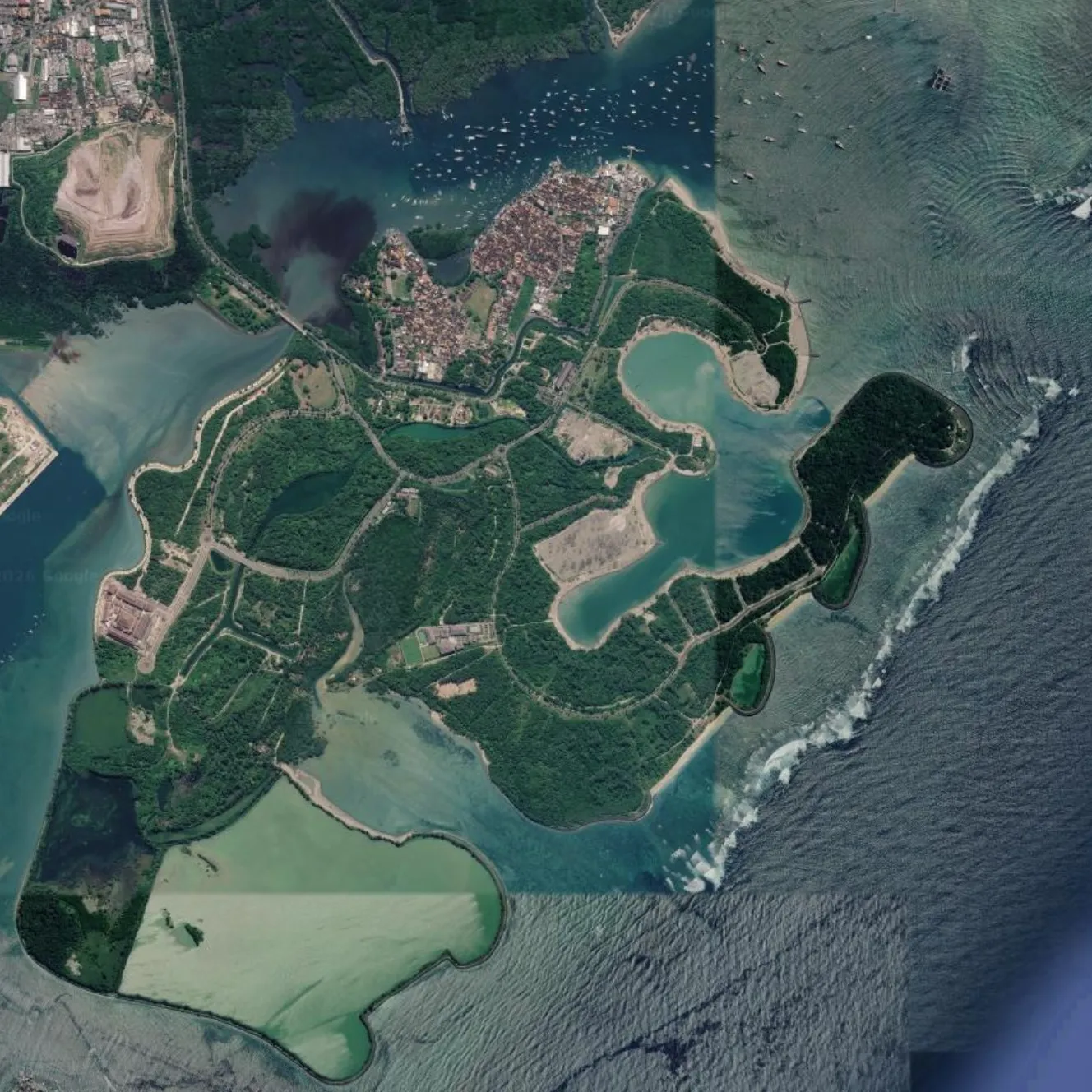
You reach the future of Indonesian finance by a short causeway off the Bypass Ngurah Rai, at the unlovely southern end of Denpasar where the city keeps its port, its power station and its landfill. The turn is easy to miss. There is a gate, and at the gate there are three security guards, and beyond the guards there is almost nothing at all.
The guards want to know where you are going. This is a more interesting question than it sounds, because there are not many possible answers. There is a Starbucks – it is called, and I could not have invented this, Starbucks United in Diversity – and there is a campus of handsome bamboo pavilions left over from the G20, and there is a golf-cart quietness of new boulevards and new asphalt, streetlights coming on at dusk for nobody, the whole thing laid out at full city scale across nearly five hundred hectares of dredged sand. If you say “Starbucks,” you will generally be let through. (Since the first of August there is also a mall, and we shall come to the mall.) Reviewers on Google Maps report that the experience varies with your footwear, but that is a matter for later.
Inside the campus is the exhibition. It is a serious piece of work: the whole island under glass, a masterplan reaching to 2052, renders of towers and marinas populated by the render-people of the future – silver-haired men in linen, women with yoga mats, children of no particular nationality. Financial district here. Wellness district there. A “Knowledge District,” in which, presumably, knowledge. The lighting is excellent, the air-conditioning hums. A member of staff materialises and offers coffee; the courtesy is real enough.
I have been several times now, on business of one kind and another. I should say what the business is: for three decades I have made my living setting up foreign-owned companies in Indonesia, which puts me in the trade that presumably stands to profit from all this. I have never had to queue. The staff at the exhibition have always outnumbered the visitors. Outside, the boulevards run empty to the mangroves and stop.
Everything is ready. They are waiting for something to happen.
2. What they say they are building
The law arrived at the speed of something wanted. The bill for a Pusat Finansial Internasional Indonesia – the PFII, the financial centre of the Republic – went from first committee deliberation to unanimous plenary passage in under three weeks of July 2026: five hundred and three comment entries from the factions, ten chapters, seventy-three articles, gavelled through while the public was still finding out what it was.1 Even the haste was statutory: the amendment that authorised the centre had, in June, given parliament three months to produce the law governing it. The deadline came before the bill did.
What it is, on the government’s own description, is a territory in which the ordinary law of the Republic largely does not apply. The enabling statute prefers “certain legal particularities”.2 Jakarta first, in a Danantara-owned tower, while the permanent zone is built in Bali “as soon as it is ready”. (The same statute permits “1 (one) or more” financial centres; nothing in it obliges a temporary home ever to close.) Inside: contracts in English under adopted principles of commercial law; a dedicated court, its ad hoc judges to be recruited from “the best legal talent in Indonesia and the world”; its own arbitration body, its own financial regulator, its own governing board under its own governor. Business in foreign currency. Income tax at up to zero per cent for up to fifty years, with VAT, luxury tax and customs relief to match. Golden visas for the residents. And here the drafters produced something new in the world: the golden-visa holder who lives in the zone is deemed not to be an Indonesian tax resident.3 You may live in Indonesia without, fiscally speaking, being here at all.
The model is named without embarrassment. Dubai: the DIFC, whose consultants have been engaged and whose framework has been “absorbed”, with Abu Dhabi as understudy. The Coordinating Minister for the Economy likes to show the comparison slide: eight hundred billion US dollars drawn through Dubai’s financial centre, against Indonesia’s two thousand-odd trillion rupiah a year of ordinary, earthbound investment. The President’s own summary to parliament on 14 August at least has the virtue of candour: “We are building the PFII so that global capital finds certainty in Indonesia, the best talent works in Indonesia, and transactions involving Indonesian wealth are settled in Indonesia.”4
Now two details that tell you what is actually going on.
The first is a sentence of Luhut Binsar Pandjaitan’s, the project’s originator, explaining himself with the frankness of a man near the end of a long career: “My actual objective at the time was to build our credibility regarding the law, because we are known to be inconsistent with the law.”5 Read it twice. The zone is not a reform of Indonesian law; it is a confession about Indonesian law, entered into the statute book. The ordinary courts, the ordinary currency rules, the ordinary tax administration (the things you and I live under) are, on the sponsor’s own account, the product that cannot be sold. So a second product has been built, behind a gate, for other people.
The second detail is a number: €750 million. Indonesia has signed the global minimum tax, and the drafters concede that any group with consolidated turnover above that threshold will pay fifteen per cent somewhere regardless of what Serangan charges.6 The fifty-year zero, in other words, is real only below the threshold: for the family office and the boutique fund, for wealth in its discreet, personal forms. The great banks get a handsome courtroom and a repatriation guarantee.
Is it a tax haven? Certainly not. “Tax havens exist everywhere now,” the Coordinating Minister spluttered when the question was put; “Dubai and Singapore also have tax havens” – so it is difficult, he implied, to see the problem.7 I am reassured, and I trust the financial-intelligence units of several friendly jurisdictions are too.
3. The island under the showroom
The island itself is a manufactured object. Serangan, before the machines came, was about 112 hectares of sand and coral at the mouth of Benoa harbour: a fishing settlement, seaweed frames in the shallows, and the nesting beaches that gave the place its name, Turtle Island (Pulau Kura-kura).
In 1992 the governor of Bali issued a reclamation permit over this to PT Bali Turtle Island Development (BTID), then a company of the Bimantara group, which is to say of Bambang Trihatmodjo and Hutomo “Tommy” Mandala Putra, the second and third sons of the President of the Republic. The land assembly that preceded the permit was conducted, in the words of one Balinese press retrospective, penuh tekanan dan intimidasi – full of pressure and intimidation – which I am prepared to believe, having watched such assemblies conducted elsewhere in those years.8 The dredgers arrived in 1995. By the time they stopped, 112 hectares had become nearly five hundred, and the surrounding reef and seagrass had gone into the fill. The villagers’ 13.5 kilometres of shoreline became 2.5. The turtle beaches went under the sand: the island named for turtles was enlarged by a method that guaranteed no turtle would nest there again.
Then 1998 came. The grand patron, Soeharto, fell, and the money stopped mid-dredge. For a quarter of a century the project sat much as the dredgers left it: a white apron of sand slowly greening over, roads that stopped in scrub, the ambition on hold while its owners attended to their difficulties.
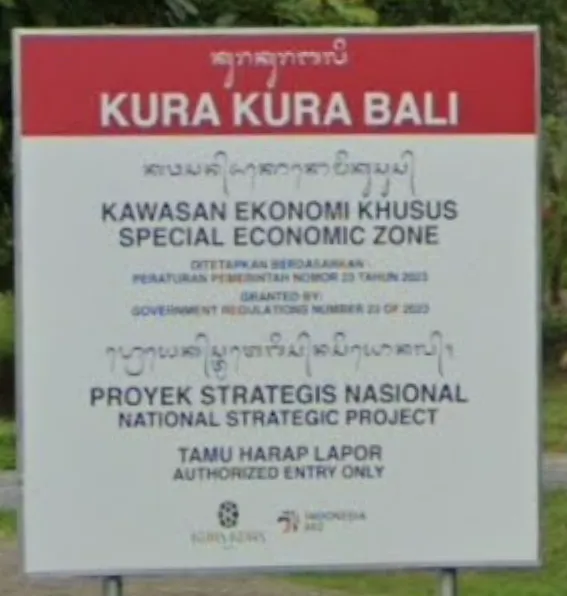
In 2023 the same land, still held by the same company, was designated by government regulation a Special Economic Zone and National Strategic Project: KEK Kura-Kura Bali, 498 hectares, build-out to 2052, projected investment of Rp104 trillion.9 A luxury mall with Mitsubishi Estate was scheduled for mid-2026; a masterplan themed on Tri Hita Karana was unveiled; the phrase “Knowledge District” began to appear in prospectuses. Realised investment by the first quarter of 2026 was Rp1.62 trillion and 2,146 jobs: modest against the projection, but real.
4. The season of seals
Then, three years into the rehabilitation, one arm of the Indonesian state walked onto the island and sealed part of it against another.
On 23 April 2026 a special committee of the provincial parliament arrived unannounced at the marina and found, behind the hoardings, mangroves cut and the ground compacted. The company’s licensing head offered the committee a theory of law it will not soon forget: that on private building-rights land, the cutting of mangroves is permissible. “Under the law,” replied the committee’s secretary, “not even a single mangrove stem may be cut.”10 The committee halted the marina works. The company then failed to attend the hearing called to examine its land-swap documents. And the committee noted with interest that the company’s spatial-use application had been approved, by somebody, within a single week. In May the Ministry of Marine Affairs and Fisheries did its own arithmetic (marine space used beyond permit, 1.12 hectares; mangrove felled, some 500 square metres) and put seals on the marina.11 The chairman of the provincial parliament has demanded the KEK designation be revoked outright. WALHI calls the reclamation perampasan ruang masyarakat, the seizure of a community’s space. The Balinese economist Jro Gde Sudibya calls the project a symptom of new colonialism. The company’s response has been to describe its critics as spreaders of hoax narratives, dangerous to the investment climate.12
The marina is the one part of the scheme I can assess without a lawyer. The berths are going into a lagoon on the island’s eastern flank: an enclosed bowl of water reached through a narrow gap across a reef flat, at present closed off by a floating boom strung over the entrance to keep the villagers out of it. The renders show superyachts. A ninety-metre yacht draws four or five metres; a cruising sailing yacht draws about two. That lagoon is comfortable for the second and out of the question for the first, and the entrance is shallow and awkward for anything large. To hold the depth the brochure implies, the basin and its approach would have to be dredged, and then dredged again, and dredged for as long as the marina exists.
Which changes what the seal means. The Ministry stopped the works for using 1.12 hectares of marine space beyond permit. Set that against the dredging and the 1.12 hectares stop looking like an overrun and start looking like a running cost. A marina in that lagoon cannot operate without disturbing the seabed on a schedule, in perpetuity, and whatever was done to the water this year will have to be done again next year, and the year after that. The company was not caught doing something unusual. It was caught early.13
The provincial prosecutors had come in even before the seals. On 25 April Kejati Bali opened a probe into the mangrove land swap, and sent its people to Jembrana to establish whether the replacement land the company claims to have handed over actually exists. “All must be clear,” said the head of its special-crimes desk, “which mangrove forest or replacement land was received, and which was handed over.”14 In May the alliance ARUKKI formally reported the company to the same prosecutors and to the parliamentary committee. The company will be summoned, the office says, once the field data is validated.
Who approved a spatial-use application within a single week is a question with a shortlist, and the provincial press has published it. BTID’s strategic positions, Detik Bali reports, are held by a roster of retired Bali provincial officials: the former head of the province’s Licensing Agency; the former head of its Transportation Agency; and, as the company’s licensing man, the former head of the province’s own Forestry and Environment Agency – the same official quoted above defending the cutting of mangroves.15 The regulators who once licensed the island now staff it, and the province’s ex-environment chief argues its environmental case. The traffic runs warm enough that Bali’s most senior civil servant felt obliged to deny, publicly, that a BTID commissionership awaited his own retirement (“I do not even know the owner”). Perhaps not. The bridge between the provincial government and the island carries traffic in one direction all the same.
None of it has slowed the theatre. On 1 August, with the seals still on the marina and the prosecutors still measuring mangroves, the project opened its US$85 million outlet mall: a Mitsubishi Estate joint venture with a hundred global brands and a brigadier general at the ribbon-cutting. The mall company’s president director is BTID’s own presiding commissioner, wearing his second hat. The mall’s Rp 1.5 trillion, as it happens, roughly equals everything the zone had realised in its first three years – one ribbon, and the investment statistics doubled. Even the Japanese partner is not quite the outside validation it appears: the mall’s Karawang original, the format’s first outing, is a fifty-fifty joint venture between Mitsubishi Estate and a Singapore company we shall meet again on the shareholder register.16 Nine days earlier a deputy chairman of a national parliamentary commission had toured the zone and pronounced it a model of green development, singling out for praise – of all the assets available to him – its mangroves.17 Not one report of the opening that I could find mentions the seals.
What the ribbon actually opened is worth a walk through, and ten days later a Balinese vlogger took his wife and small daughter round it with the camera running, which is the nearest thing to an audit the place has yet had. The retail verdict arrives in the accents of a man trying to be polite: most of the outlets still closed; two separate wings described, twice, as “still empty”; seventy and eighty per cent off in the few that were trading; a Starbucks, a Sports Direct, a Solaria, a souvenir chain and a Japanese restaurant, against the hundred and four gerai of the press release. Upstairs it is a different building. The terrace over the mangroves at six in the evening was crowded – Balinese families, phones up, a band setting up, the sunset coming on. What they had come for was the view, which is free. It is a first-rate viewing terrace with a hundred shuttered shops attached.18
Then the bill, which is presented outside the wire. Roads were closed for the opening itself, which the neighbours did not care for; and since the opening the traffic authorities have been running a trial scheme around Serangan from four in the afternoon until eleven at night, banning straight-through movement on stretches of public road and sending everybody to designated U-turn points. Public road, rerouted every evening for a private mall inside a zone the public may not enter. He is generous about it, this vlogger (good place, jobs for locals, the government should build a better road), and remarks in passing that the one-star reviews had been arriving in quantity before he ever got there.
The state made its own contribution to the season seven weeks earlier. On 29 June the customs service inaugurated a Customs Office and a designated customs area inside the zone: the apparatus by which an international marina becomes a port of entry, which the promotional literature likes to call a new door into the country. The Ministry of Marine Affairs and Fisheries had sealed that marina on 7 May. What the office has done since, the developer publishes itself, as an achievement: Rp8.3 billion of import duty and import tax forgone to date, about half a million dollars, which is the customs profile of a few containers of shopfitting. One arm of the state had padlocked the harbour; another came and built its front desk.19
5. Two names for one road
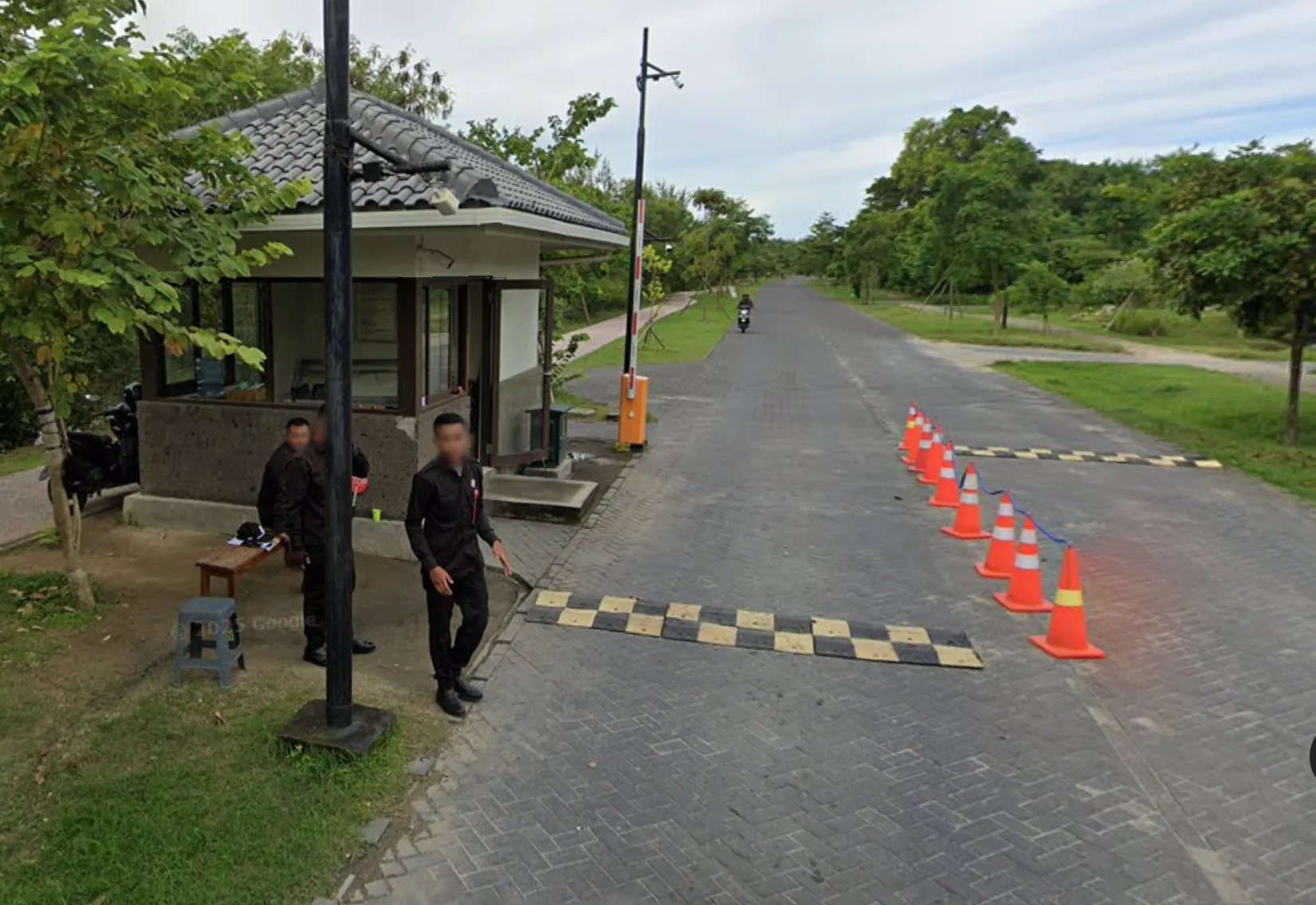
The official record is one thing. The unofficial record is better, because it is written by the people the gates are for, and Google Maps keeps it. A tourist on a paddleboard, ordered out of the water: “Security denied me to paddle on my SUP board around the Serangan Island! They told me that it is private property” – the sea, note, not the land. A local, this May: “I came to fish but was chased away by the security guard on duty. I don’t think this is Bali.” A Balinese guide who rode in wearing shorts and sandals with a foreign guest was tailed by three security men, stopped, and made to open his seat compartment while better-dressed riders passed unchecked; he asks the question the whole project should be made to answer: bedanya kita sama mereka apa, ya? – what, exactly, is the difference between us and them? And the most-liked review of Serangan’s beach, for scale: “I think some big company bought the whole place and made it a private beach.”20
One of those complaints is duller than the others and outranks all of them, because it is the only one that reached a parliament. A resident, on the company’s own review page: please change the street name back, do not just change it without permission. He was describing something the company had actually done. During the World Water Forum in May 2024 the beach began appearing on the maps as “Pantai Kura-Kura Bali”, and plates reading Jalan Kura-Kura Bali went up over Jalan Pulau Serangan. A member of the national parliament objected that in Bali a place name carries spiritual inheritance, not livery. The chairman of the provincial parliament’s second commission was blunter: investing in the land does not mean you own the beach as well. Asked how the beach had acquired its new name, the company’s head of communications observed that Google is a public domain, where anyone may write anything.
Summoned on 30 January 2025 to sit with councillors and Serangan residents, the company’s presiding commissioner undertook to take the plates down. The name was only temporary, he explained, to help the delegations find the zone; the road would go back to having no name at all. Three days later the company’s own staff, with security in attendance, went out and did it, conceding that the plates had been erected with no legal procedure behind them. The temporary wayfinding had been in place for nine months.21
The plates are down. Open Google Maps today, eighteen months on, and the single causeway onto the island still carries both names, the labels alternating down its length: Jl. Pulau Serangan, Jl. Kura Kura Bali, Jl. Pulau Serangan – the village’s name and the developer’s name running into each other along the same strip of asphalt.22 The metal came off under the eye of the provincial parliament. The name that anybody following a phone will actually see stayed exactly where it was.
The financial centre, whenever it comes, will not need to build its gates. They have been standing for thirty years. All that is proposed is to gild them, and to move the law inside.
6. A short course in how it worked
If you are under forty-five, the Orde Baru is a chapter heading: thirty-two years of Pak Harto, development, corruption, 1998, reformasi, the end. The chapter heading is doing a great deal of work in that sentence, and the people on this island are counting on it.
So: a short course. The corruption of the New Order was not a defect in the machine; it was the machine. The state was operated as the digestive tract of a single extended family and the circle around it: a device for converting public permissions into private income. Everything else, the five-year plans and the technocrats and the green-revolution rice, real as it all was, happened in the space the digestion left over.
Consider three families:
Ibnu Sutowo ran Pertamina, the state oil company, through the boom years of the early 1970s, and ran it as a private empire: tanker fleets ordered on a signature, hotels, an airline, a steel works, office towers. Little of it appeared on any budget the parliament or the planning ministry ever saw. In 1975 the empire failed, owing on the usual reckonings something over ten billion US dollars, a sum comparable in that year to a third of the national product. The Republic assumed the debts. Ibnu Sutowo was never charged with anything. He surrendered the company, kept the fortune, installed the family holding company (Nugra Santana, founded 1973, while the going was good) in its own tower on Jalan Sudirman, and died in 2001 covered in honours.23 His descendants run hotels and investment vehicles to this day.
Bimantara Citra was founded in 1981 by Bambang Trihatmodjo, the President’s second son, together with two friends from his primary-school days at SD Cikini. One of the two was a young man named Rosano Barack. Bimantara’s business model was the purest expression of the era: stand where the state’s signature is required, and charge for passage. Broadcast licences became RCTI. Satellite and telephone concessions became Satelindo. There were cars, petrochemicals, shipping, property; there was very little Bimantara did not touch, because touching things was the business.24 Tommy, not to be outdone, was handed the national clove monopoly, every kretek in the country paying its toll, and later a “national car” whose principal innovation was exemption from the taxes its competitors paid. I wrote in a business guide, years ago, that every layer of bureaucracy, every licence and every form to be filled in presents an opportunity for toll-collection, and that such opportunities rarely remain unexploited in Indonesia.
Sjamsul Nursalim was the third kind of New Order money: not the family and not the family’s schoolmates, but the cukong, the licensed tycoon, growing rich in the space the Palace allotted and paying for the privilege. His group made tyres (Gajah Tunggal, still on every second motorbike in the country) and owned a bank, BDNI, which did what New Order banks did: gathered the public’s deposits and lent them to the owner. When the system burned in 1997-98, the central bank pumped emergency liquidity into the banks to keep them standing, and BDNI took more of it than anyone. The obligation was settled, notionally, with assets that included shrimp ponds in Lampung later found to be worth a fraction of their stated value; the family decamped to Singapore, rebranded the group as Giti, and prospered. Prosecutors circled for twenty years. In 2019 the anti-corruption commission finally named Sjamsul and his wife as suspects; in 2021 it discontinued the case (the first such discontinuation in the commission’s history) and the state went back to seizing what assets it could find.25 The bill for BLBI, as every Indonesian taxpayer eventually learned, was ours.
(Okay, at this point the author feels a polemic coming on. But it could have been that dodgy rendang he had for lunch.)
In May 1998 the family fell. But the system did not. The patriarch retired to Jalan Cendana and died in bed. The debts were socialised: we paid them, through the bank bailouts, the IMF programme, the fire-sale of half the economy. And the operators – the sons, the sons-in-law, the school friends, the golf partners, the men who had held the concessions – kept, with few exceptions, the fortunes, the companies and the address books. Indonesian has precise words for what remained. The antek-antek: the henchmen, the running dogs. The bekas: the leftovers, the residue – the word you use for an ex. The polite English is “well-connected businessmen.”
Reformasi changed the constitution, the press, the courts, the elections (real things, dearly won). It never changed the concession. Nobody gave the coastline back. We shall now meet all three families on a shareholder register.
7. The register
Every company in Indonesia files its particulars with the Directorate General of Public Legal Administration (Ditjen AHU) at the Ministry of Law, and for a modest fee any member of the public may buy the file. In November 2024 my office bought BTID’s.26
The document is dry, in the way that only genuinely interesting documents are. PT Bali Turtle Island Development: a private foreign-investment company, of unlimited duration, domiciled at Jalan By Pass Ngurah Rai, Simpang Serangan No. 1. Issued capital of 2,039,285 shares at one million rupiah each: a little over two trillion rupiah, and the filing records it as paid up, in cash.
Then comes the shareholder register, and the register is where the Indonesian press and I part company.
The largest holder is Goodwill Property Investment Limited of Queen’s Road Central, Hong Kong, with 81.10 per cent. The future site of the Republic’s financial centre is, at the time of filing, four-fifths owned through a single Hong Kong company. The press has reported this, when it reported it at all, as an anonymous fact: “a Hong Kong-based property investment company,” full stop. It is not anonymous. For years, BTID’s own website said whose it was: “Master development team for Kura Kura Bali or Bali Turtle Island Development is under the Giti Group” (the Nursalim family’s group, rebuilt in Singapore after the crash), listing its affiliate Tuan Sing Holdings, its partnership with GIC, and William Liem’s corporate awards.27 The page has since been taken down; the Wayback Machine is patient. Tuan Sing’s audited annual reports still record the affiliate’s 2.26 per cent slice of Goodwill and Goodwill’s four-fifths of BTID.28 And Goodwill itself was incorporated in Hong Kong on 17 May 1994: mid-project, under the New Order, before the first dredger dropped its bucket. The offshore wrapper is not a post-crash buyer who picked up a distressed asset. It is original equipment.29
So the island’s controlling owner is, on the strong balance of the public record, the third family from the short course. The remaining 18.90 per cent, the Indonesian minority spread across six private companies, completes the reunion.
PT Rizki Bukit Abadi holds 6.875 per cent. Rizki Bukit Abadi is the investment company of the Barack family: Rosano Barack is its chairman, and his son Reino Ramaputra Barack is its president director.30 Rosano Barack, you will recall, co-founded Bimantara Citra with Bambang Trihatmodjo in 1981 and served the group as director and deputy managing director until the fall. Bimantara is the group that held BTID when the governor of Bali signed the Serangan reclamation permit in 1992. And Reino Barack runs the family company that owns a piece of BTID, and sits on BTID’s own board of commissioners. From the concession of 1992 to the cap table of 2024, the line does not break. It is thirty-four years long and two generations deep, and it was sitting in a public filing.
PT Nugra Santana holds 2.250 per cent. Nugra Santana is the holding company founded by Ibnu Sutowo in 1973 (the registered address on BTID’s filing is Wisma Nugra Santana itself), and on BTID’s board of commissioners sits Maulana Indraguna Sutowo, grandson of the man who ran Pertamina as a private exchequer until it nearly took the Republic’s finances down with it.31
The remainder is quickly told: PT Grahatama Kreasibaru (4.5 per cent: the parent of listed Indonesian Paradise Property, the vehicle of the Gozali family, who are the nephews and nieces of Sjamsul Nursalim’s wife; a Gozali daughter, Amelia, named with her family in INPP’s own annual report as the listed company’s ultimate beneficial owner, sits on BTID’s board of commissioners)32; PT Asriland (3.5 per cent, whose other interests assemble Chinese cars in Bekasi); PT Penyu Hijau Lestari (1 per cent; the name means “green turtle everlasting,” so somebody in that office has a sense of humour); and, with 0.772 per cent, PT Trisarana Adikreasi.
That last, smallest name is the one the national press found. Katadata and Kompas traced Trisarana up through PT Manning Development to the listed company OMRE and thence to the orbit of Sjamsul Nursalim, and – having found a famous name from the wreck of the bank bailout – stopped.33 They had the right family and the wrong keyhole; they had even misread the keyhole, because OMRE’s own rights-issue prospectus names the beneficial owners of Manning, the sliver’s actual parent, as Husni Ali and one Tommy Gozali: no Nursalim among them.34 The sliver they traced is 0.772 per cent; the Goodwill holding above it, which their own copy waved through as an anonymous Hong Kong company, is eighty-one. Add the Gozali block and the network around one extended family holds something like six-sevenths of the island. And the company’s own website had said so, in its cheerful way, for years. Nobody looked. The reporters were hunting a scandal and under-reported it by two orders of magnitude; and the filing was offering a second story besides, which they also missed: continuity. The Bimantara co-founder’s family at 6.875 per cent, his son on the board. The Sutowos at 2.250, a grandson on the board.
And the Starbucks? The group’s affiliated retailer, MAP, holds the Starbucks franchise for Indonesia.35 The only shop on the island is, in all likelihood, the owners’ own, named for the owners’ own foundation. Nor is it one coffee shop any more: when the outlet mall opened in August, the opening release itself advertised “Sira Space offering MAP’s luxury brands collective”: Coach, BOSS, Nike and the rest, supplied to the family’s mall by the family’s affiliated retailer, tax refunds available at participating MAP brands.36 Earlier I said I could not have invented it. I withdraw that. Nobody needed to invent it; it was disclosed.
The board completes the picture, and I will give it to you as the filing does, without comment. Presiding commissioner: a former Golkar parliamentarian and ambassador to New Zealand. Deputy presiding commissioner: a former trade minister, former tourism minister, former managing director of the World Bank – and, per the company’s own former website, at that time president director of the United in Diversity foundation, the Nursalim-orbit vehicle building the island’s campus.37 President director: the founder of Indonesia’s most consequential corporate law firm, born 1943, the same counsel quoted in the KEK’s press releases. Around them: the grandson of Ibnu Sutowo, the son of Rosano Barack, the daughter of the Gozali family, two commissioners shared with the Nursalim-orbit property company OMRE – the senior of whom, his own official biography records, was a director of BDNI itself from October 1989 until the month in 1998 when the state seized the bank38 – and four directors on Singaporean and Malaysian passports. Fifteen names. One of them was born in Bali.39 And even he, the record shows, is a minority partner in the Gozali family’s property orbit.
8. The clock
There is a clock under all of this. The regulation that created the KEK gave its developer thirty-six months to reach operational readiness, on pain of a ladder that ends with a draft regulation revoking the designation – a ladder the government has used before. The deadline fell on 5 April 2026. The zone had been declared “ready” by decree in June 2024, fourteen months in, with less than two per cent of the projected investment realised; when the parliamentary commission visited this July, the company recited that decree to its guests.
And the regulation permits the zone exactly two activities: tourism and the creative industries. A financial centre is neither. To put the PFII on Serangan the government must reopen the KEK’s own charter – and a zone whose marina is under seal and whose provincial parliament wants it abolished would emerge from that reopening as the seat of the Republic’s money, beyond any practical revocation forever. The financial centre is not an opportunity that came to the island; it’s the cure for the island’s legal condition.40
9. Both sides of the lagoon
At this point the story wants to resolve into virtue and vice: the village despoiled, the capital despoiling.
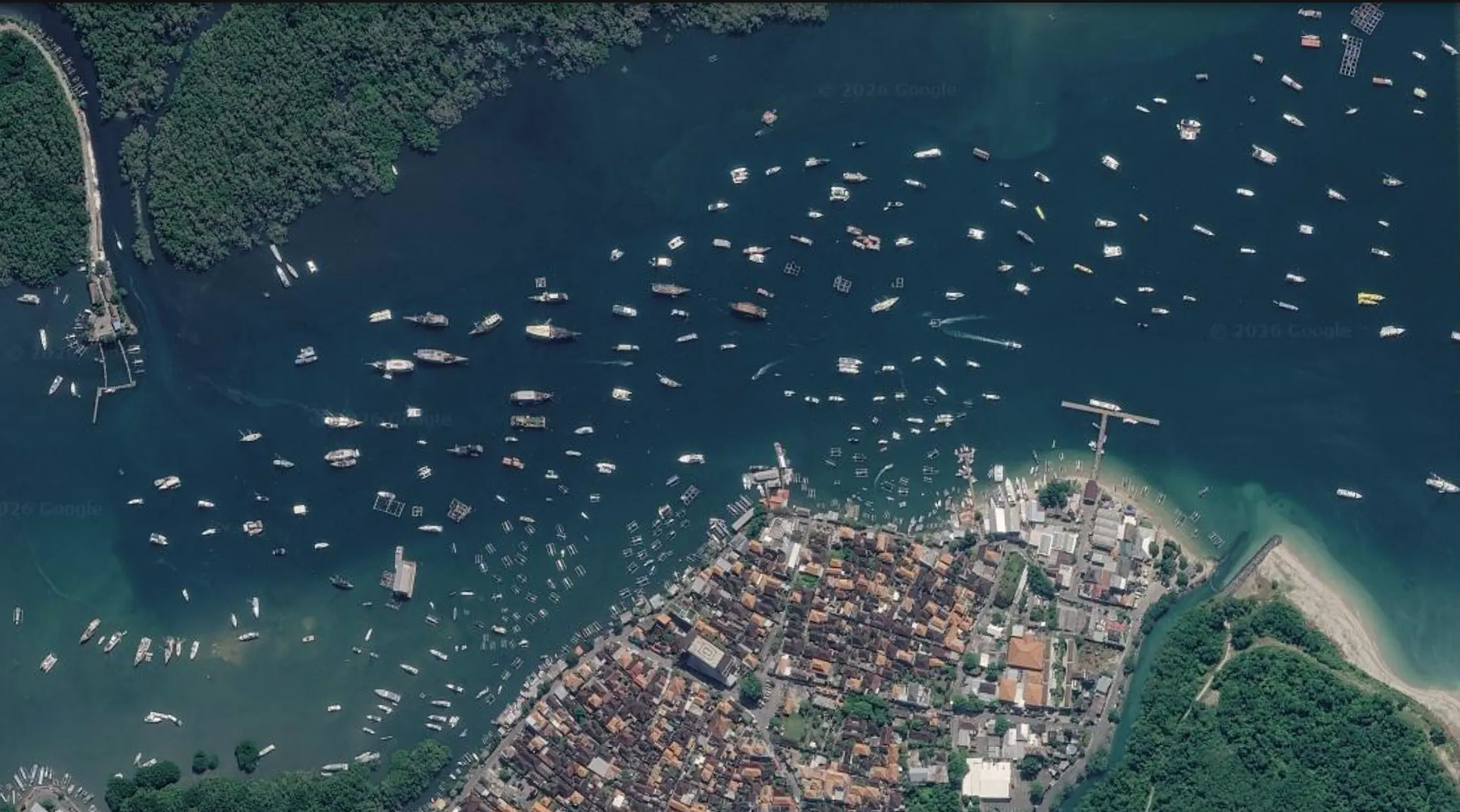
Between Serangan and the mainland lies the anchorage: mud, plastic bags, and lines of moorings where the cruising yachts of a dozen flags sit out the season. The sailors’ pilot guides and forums keep a record of what awaits them there, and it is not a record of gotong royong. Each mooring carries a “village fee,” about seventy US dollars a month, levied in the name of the people of Serangan. One mooring operator, the cruisers’ notes observe drily, “has a reputation for stealing the village fee, as well as dinghy engines and anything on the boat that’s left vulnerable.” Locals, the notes go on, “often squabble over new cruising yacht arrivals” – each yacht a small concession, to be captured.41 A sailor who came in by dinghy in 2018 was met at the new pier by a man “with broken English and a very aggressive manner”; the same account records, looking down through the water, that the dredge spoil of the nineties had “covered parts of the existing reef and killed much of the mangroves.”42 I have heard versions of this from passing sailors for years; their correspondence about Serangan is uniformly sour. The yachties’ verdict on the anchorage is the fisherman’s verdict on the gate, delivered from the opposite shore.
So: not innocence against appetite. The kampung side of the lagoon is its own toll-gate: smaller, poorer, rougher in its manners, collecting in the name of a community what does not always reach the community. The grammar is identical on both shores; only the letterheads differ. A fee levied in the people’s name and pocketed on the way through is the Orde Baru’s entire fiscal doctrine, executed at the scale of a dinghy engine.
And before the Western reader grows comfortable: ask, next time you are standing in a marina you know, who holds the concession on the moorings, and how they came by it. The difference between Serangan and elsewhere is one of degree, candour and enforcement. Mostly enforcement.
There are tolls on both parts of Serangan.
10. The single door
I have sat with officials of this zone, in connection with clients’ business, more than once. Naming them would be unfair, and unnecessary: their significance is generic. The manner is what I recognised: the settled ease of men to whom a queue has never applied, the confidence that a signature is an asset class. The signatures follow the men, too: the provincial officials who once licensed this island have, in retirement, reappeared on its payroll. I have smelled this money before. In Jakarta, in another century, when that machine was in its prime; the nose does not forget. Sitting in the bamboo showroom with the renders glowing, the old vocabulary arrived unbidden. Antek. Bekas.
Hold the zone up against the country it is being built in, and the pattern resolves. This is, after all, the government of the single door – satu pintu, a phrase Indonesian officialdom uses without embarrassment. Key commodity exports are being routed through one state trading company. Exporters’ dollars sit, by regulation, in state banks. Sovereign wealth has been consolidated into Danantara, a fund that controls the operating state-owned complex, issues the “Patriot” bonds, and, under Article 24 of the PFII law, provides the financial centre’s initial capital while also serving as its physical developer; its chief executive is simultaneously the Minister of Investment.43 The Patriot bond deserves a moment of silent admiration: purchase one, and by statute the record of your purchase can neither ground a tax assessment nor be admitted as evidence in court. The Finance Minister, asked about the laundering risk, allowed that there might be “a slight downside” – but the money enters our economy.44 A civil-society coalition has taken the article to the Constitutional Court, and its counsel observed that such an immunity regime is difficult to find an equal for anywhere in the Indonesian legal system.45 It isn’t difficult; you simply have to look before 1998.
And the zone’s celebrated independence? The governor of the PFII is appointed by the President. Directly. There is no fit-and-proper test; parliament does not examine the candidate; no candidate has been named.46 The minister assures us that “the essence of the PFII is that everything must be independent – the management, the judiciary, the OJK as well.”47 Everything independent; everyone appointed. We have had that constitution before. It governed this country for thirty-two years, and it always polled magnificently in beautifully curated elections.
So let me say plainly what I have been circling. The Indonesia Financial Centre, in the form now being assembled on Serangan, is one more attempt by the antek-antek and the bekas of the Orde Baru to regain economic and political position – through the one instrument reformasi never took from them, the concession – dressed this time in the costume of international finance. The sand is Suharto sand. The register reads Cendana on one side and BLBI on the other. A former son-in-law of the house sits in the Palace. And the showroom glows on its empty island like a stage set, attended by men who have built stage sets before and know their trade, waiting with the patience of professionals for the audience to arrive with its money. Twenty-eight years, it turns out, is roughly how long it takes before a country forgets.
11. The verdict
Go back, to the showroom, because the showroom is the truest thing on the island. The models are lit. The renders glow. The staff outnumber the visitors, and out beyond the glass the boulevards run empty to the mangroves and stop. The law has passed; the tower in Jakarta is being fitted out; the location decree is, at this writing, still unsigned, and the government has learned enough not to say the island’s name aloud.48 Officially, the permanent home of the Republic’s financial centre is “Bali, as soon as it is ready.”
Two futures now, and only two.
In the first, it works. The family offices come – Asia first, then the Gulf, whose advisers have already been consulted. The marina fills with the quiet money the threshold was tuned to admit; the zone’s court sits; the governor, appointed by the President without examination, governs. Serangan becomes what Dubai’s founders would recognise: a free port for wealth, gated five ways – physically, legally, fiscally, monetarily, politically – on land the law was suspended to create, under a law suspended to serve it.
In the second, nobody comes, or too few. The ecosystem does not assemble; the lawyers and auditors decline to relocate; the €750 million ceiling keeps the institutions away, and the zone settles into what such zones mostly become: Labuan with landscaping, a registry of brass plates, a courtroom with no docket. The showroom keeps its lights on, and so does the terrace, and the shops behind it stay shut, as do the gates.
I do not know which future arrives, and will not pretend to. What I can call is the meaning. Kura-Kura proposes to be wealthy the way the reclamation was legal. Luhut Pandjaitan, to his credit, told us the objective: credibility regarding the law, for a state known to be inconsistent with it. Thirty years of that inconsistency lie piled metres deep beneath the showroom’s foundations: the site was manufactured by it. And the audit of the project’s credibility has already been delivered, free of charge, by a man with a fishing rod at the gate: I don’t think this is Bali.